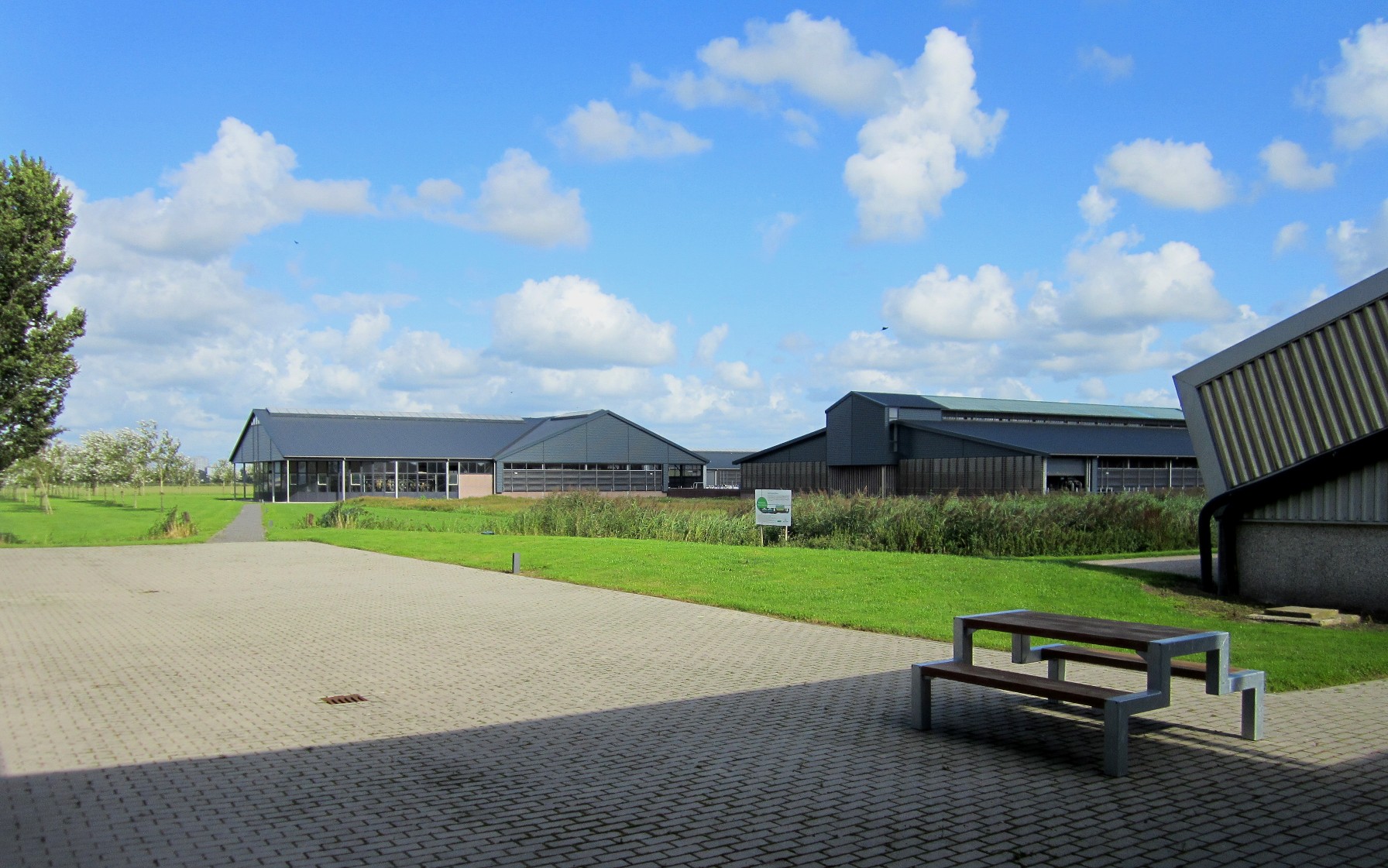
Dairy Campus
On a working farm just southwest of Leeuwarden, the dairy cows are not just producing milk. They are producing data. Ammonia concentrations under a canvas-covered barn roof. Step counts and rumen sensor readings. Methane measurements. The amount of biogas that can be coaxed from their manure and pushed into the Dutch national gas network. The Dairy Campus, opened in its current form in 2016, is the last remaining national center in the Netherlands where dairy science is done at full commercial scale — a place where Wageningen University researchers and Frisian farmers share the same barn, and the cows are the experiment.
From Bosma Zathe to Dairy Campus
The site has been a research farm for decades. It grew out of the older Bosma Zathe test farm near the Frisian capital, and was eventually merged with the dairy work that had been concentrated at Waiboerhoeve near Lelystad — a consolidation built on the simple argument that Friesland is, pre-eminently, a dairy province. The planning got stuck in budget cuts more than once, and it was not until February 2015 that expansion finally began. From 2016 onward, the Netherlands committed roughly €40 million over a ten-year period to the Dairy Campus, with about €1 million per year earmarked specifically for innovation projects. The campus is the only remaining facility of its kind in the country dedicated to scientific research and practical training in dairy farming.
Cows as Coworkers
What makes the place strange and quietly modern is that it has to pay for itself. Half of the operating income comes from selling milk to FrieslandCampina, the giant Dutch-German-Belgian dairy cooperative; the other half comes from sponsored scientific research. That means the cows are simultaneously livestock and laboratory subjects — milked on a rotary milking parlor that turns like a slow carousel, with most of the herd cycling through it daily, while their behavior, feed intake, and emissions are monitored for studies on ammonia, methane, animal welfare, and feed efficiency. A canvas curtain hung inside one of the barns is part of an active experiment to trap ammonia for measurement. The phrase a local newspaper used was that, at the Dairy Campus, cows mostly produce data.
Manure to Methane
In December 2018, a new gas installation went live on the site that pushed the experiment one step further. A biofermenter installed by Biogas B.V. had been turning the farm's manure into biogas for some time, but the new equipment cleaned and upgraded that gas to the specification required for the Dutch public gas grid. With it switched on, the Dairy Campus stopped just generating energy for itself and started feeding green gas into the same pipes that heat homes across the Netherlands. For a country with sharp legal limits on agricultural nitrogen emissions and a serious national debate about the future of livestock farming, that is not a marginal data point. It is a working demonstration that a real dairy herd can be a node in the energy network.
Teaching the Next Generation
Education at the Dairy Campus has had a bumpier history. In 2013, the practical training center PTC+ in Oentsjerk joined the campus under a new name, the Dairy Training Centre, and ran courses for Dutch and international groups on dairy farming and milk processing until it went bankrupt in December 2017. Training has continued in other forms, with contributions from agricultural employment agency AB Vakwerk and consultancy bureau The Friesian, but the bankruptcy was a reminder that even a well-funded research farm operates inside a tough market. What survives is the core ambition that brought everyone here in the first place: to keep one place in the Netherlands where dairy science, dairy farming, and dairy teaching all happen under the same set of barn roofs, with the cows themselves doing most of the talking.
From the Air
Located at 53.18°N, 5.76°E in flat polder country a few kilometers southwest of Leeuwarden city center. From altitude the campus reads as a tight cluster of modern dairy barns and silos surrounded by characteristic Frisian rectangular pastures and drainage ditches. Leeuwarden Air Base (EHLW) is the nearest field, immediately north of the city; Groningen Airport Eelde (EHGG) lies about 55 km east. Best viewed at low to medium altitude in clear weather; the rotating milking parlor and the canvas-covered ammonia-research barn are visible features.