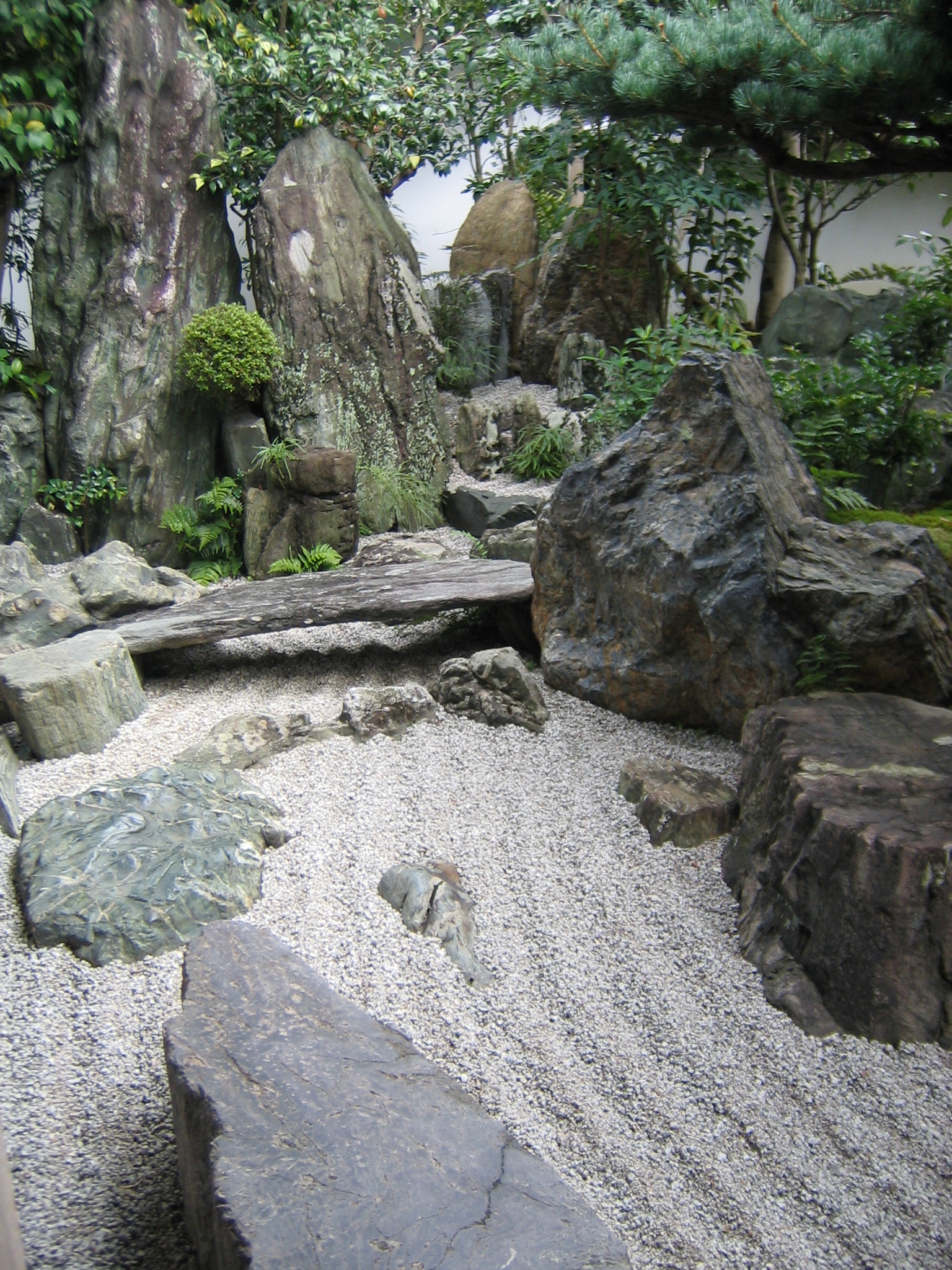
Daisen-in
There is a stone turtle in a garden in Kyoto that has been swimming upstream for five hundred years. It hasn't moved, of course -- it is a rock, carefully placed in a narrow channel of raked white gravel at Daisen-in, a sub-temple of the great Daitoku-ji complex. But that is precisely the point. The turtle struggles against the current of life, while nearby a "treasure boat" stone drifts effortlessly downstream. Between these two rocks lies the entire Buddhist parable of human existence, rendered in three dimensions and barely wider than a corridor.
The Academy of the Great Immortals
Daisen-in -- "The Academy of the Great Immortals" -- was built between 1509 and 1513 within the grounds of Daitoku-ji, one of the five most important Zen temples in Kyoto. It belongs to the Rinzai school of Zen Buddhism, the tradition that emphasizes sudden enlightenment through meditation and the contemplation of paradox. The temple was founded by a Zen priest and quickly became renowned for two things: its exquisite screen paintings and its karesansui, or dry landscape garden. Today the temple holds designations as a National Treasure, an Important Cultural Property, a Historic Site, and a Special Place of Scenic Beauty -- a concentration of recognition that reflects just how much artistry is packed into this compact space.
Painting in Three Dimensions
The screen paintings inside the temple and the garden itself are attributed to Soami, a Zen monk and ink painter who died around 1525. Soami was famous for his use of diluted ink to create misty, ethereal landscapes inspired by Song dynasty Chinese painting. Art historian Miyeko Murase wrote that his work represents "the very essence of the serenity of nature, the sacred ideal of all the zen monks and ink painters of the Muromachi period." The rock garden, however, is where Soami's vision -- or that of its true, perhaps unnamed creator -- achieves something remarkable. Scholar Wybe Kuitert has noted that despite later religious interpretations, the garden was fundamentally a Chinese-style landscape rendered as painting in three dimensions. There is no written evidence that Soami was a gardener; the name may have been used as a euphemism for garden makers of lower social standing who were not versed in Buddhism.
A Life in Gravel and Stone
The main garden wraps around the abbot's study in an L-shape, and its narrower section is a miniature world. Rocks suggest mountains. A cluster of stones evokes a waterfall. Clipped shrubs and trees stand in for a forest. Raked white gravel becomes a river that splits into two branches: one flows into a "Middle Sea" of gravel and scattered rocks, the other passes through a gate into a larger "Ocean" of white gravel punctuated by two cone-shaped hills. Garden historians David and Michiko Young have suggested that this progression -- waterfall to river to sea -- maps onto a human life: youth, maturity, and old age, with the rocks in the river standing for the obstacles we encounter along the way. French author Danielle Elisseeff reads four stages: the impetuous waterfall of early life, the gate representing life's transitions, the Middle Sea of accumulated experience, and the Ocean as a final destination of calm.
The Mountain and the Bodhi Tree
German author Gunter Nitschke offers perhaps the richest interpretation. He identifies the mountain at the garden's origin as Mount Horai, the legendary meeting place of the Eight Immortals in Daoist tradition, symbolized by a camellia. At the far end of the journey, in the corner of the "Ocean," stands a single "tree of bodhi" -- the Buddhist symbol of the fig tree under which the Buddha attained enlightenment. Between these two endpoints, the "treasure boat" stone accumulates the experiences of a full adult life, while the turtle stone represents the futile effort to return to youth. The Middle Sea and Ocean sections are believed to be later additions to the original garden, but they complete a philosophical circuit that few landscape designs anywhere in the world can match. In a space barely wider than a hallway, Daisen-in compresses birth, struggle, wisdom, and release into an arrangement of rocks and gravel that has remained essentially unchanged since the sixteenth century.
From the Air
Located at 35.0446N, 135.7460E in northern Kyoto, Japan, within the Daitoku-ji temple complex in the Murasakino neighborhood of Kita-ku. From the air, Daitoku-ji is identifiable as a large cluster of traditional rooftops and green garden spaces in the northern part of the city, south of the Kitayama hills. Nearest major airports: Osaka Itami (RJOO) approximately 20nm southwest, Kansai International (RJBB) approximately 45nm south. Recommended viewing altitude: 2,000-3,000 feet AGL for the broader temple complex. Individual sub-temple gardens like Daisen-in are not visible from altitude but the Daitoku-ji compound's scale and greenery make it identifiable among the urban fabric.