Daitoku-ji
A wooden statue of a man wearing sandals sits above a gate in northern Kyoto. In 1589, the great tea master Sen no Rikyu completed the upper story of the Sanmon gate at Daitoku-ji and, out of gratitude, the temple placed his likeness there. The gesture backfired catastrophically. Anyone passing through the gate now walked beneath Rikyu's feet, and the warlord Toyotomi Hideyoshi found this so intolerable that it became one of the pretexts for ordering Rikyu to commit seppuku. The gate still stands. This is Daitoku-ji -- a place where aesthetics, politics, and Zen have been tangling with each other for seven centuries.
Born Between Emperors and Shoguns
Daitoku-ji's origins lie in a power struggle. Its founder, Shuho Myocho, was born in 1282 in Harima Province. He entered the Tendai temple Engyo-ji at age eleven but was drawn to Zen, training under masters at Kencho-ji in Kamakura before building a small hermitage called Daitoku-an in the Murasakino district of northern Kyoto around 1315. Cloistered Emperor Hanazono designated it an imperial supplication hall in 1325, and the formal founding ceremony took place in 1326. Emperor Go-Daigo elevated the temple above even the Five Mountains of Kyoto in 1334. By 1333, it held estates worth 7,600 koku scattered across provinces from Shinano to Kii. But when the Kenmu Restoration collapsed and the Ashikaga Shogunate rose, Daitoku-ji's imperial connections became a liability. The new rulers demoted it to ninth in the temple hierarchy. In 1432, the 26th abbot made a radical choice: he withdrew from the Five Mountain System entirely, declaring Daitoku-ji independent of the increasingly politicized Rinzai establishment.
The Eccentric Monk Who Saved It All
Like much of Kyoto, Daitoku-ji was devastated during the Onin War of the 1470s. Emperor Go-Tsuchimikado appointed Ikkyu Sojun as head priest -- a choice that was either inspired or outrageous, depending on whom you asked. Ikkyu was one of Zen's great eccentrics: a poet, a provocateur, and a man who spent as much time in sake houses as in meditation halls. But he was also well connected among the wealthy merchants of Sakai, and it was their money that rebuilt the temple. Under Ikkyu, Daitoku-ji began its long association with the culture of tea, an affiliation that would define its identity for centuries. Sen no Rikyu, the father of the Japanese tea ceremony, became deeply entangled with the temple's fortunes, contributing to its physical restoration even as his relationship with Hideyoshi grew increasingly dangerous.
A Gate You Forget the Sun For
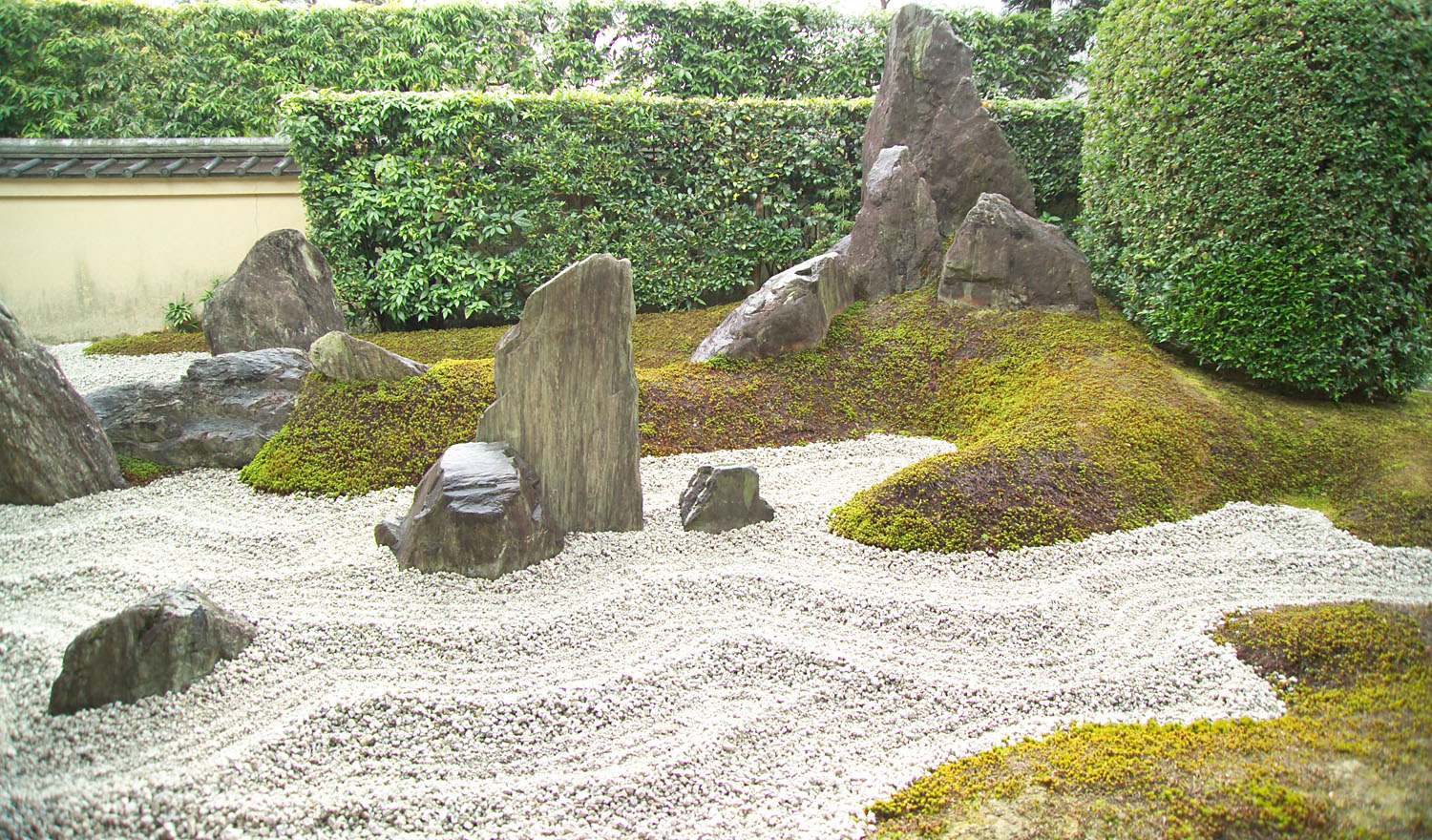
The temple complex covers a vast area, with more than twenty sub-temples arranged around a central axis of gates, halls, and lecture rooms. Three structures hold National Treasure status: the Hojo, or abbot's chamber, rebuilt in 1635 with a unique eight-room layout and 84 paintings by Kano Tan'yu; its entrance gate, donated by the merchant Goto Masukatsu in 1636; and the Karamon gate, said to have been relocated from Hideyoshi's Jurakudai Palace. This last gate carries the nickname "Higurashimon" -- the gate that makes you forget the sun is setting, because you become absorbed in its ornate carvings. It replaced an earlier gate called Akechimon, built with silver donated by Akechi Mitsuhide immediately after the Honnoji Incident of 1582, which was later sold to a sub-temple of Nanzen-ji. The southern garden of the abbot's chamber holds dual designation as both a National Historic Site and a Special Place of Scenic Beauty.
Exiles, Purple Robes, and Survival
Daitoku-ji's relationship with political power was never comfortable for long. In the early Edo period, the high priest Takuan Soho was exiled in the Purple Robe Incident -- a confrontation between the emperor's right to grant honorific robes and the shogunate's insistence on controlling temple affairs. Relations were eventually restored when Tokugawa Iemitsu, the third shogun, became a personal follower of Takuan. The temple expanded to over 280 branch temples across 25 provinces and more than 130 sub-temples. But the Meiji Restoration in 1868 hit Daitoku-ji particularly hard. Its close ties to the now-abolished shogunate meant the new government confiscated much of its economic foundation. The complex survived on a smaller scale. Today it operates twenty-two sub-temples, the most significant being Daisen-in with its celebrated dry landscape garden, where a stone turtle has been swimming upstream for five centuries.
From the Air
Located at 35.0439N, 135.7461E in the Murasakino neighborhood of Kita-ku, northern Kyoto, Japan. Daitoku-ji is one of the largest Zen temple complexes in Kyoto, covering a substantial area visible from altitude as a distinctive cluster of traditional rooftops, mature trees, and garden spaces set against the urban grid. The complex lies south of the Kitayama hills and north of central Kyoto's dense commercial district. Nearest major airports: Osaka Itami (RJOO) approximately 20nm southwest, Kansai International (RJBB) approximately 45nm south. Recommended viewing altitude: 2,000-4,000 feet AGL for the full complex layout. The Kamo River, a useful visual landmark, runs north-south approximately 1nm east of the temple.