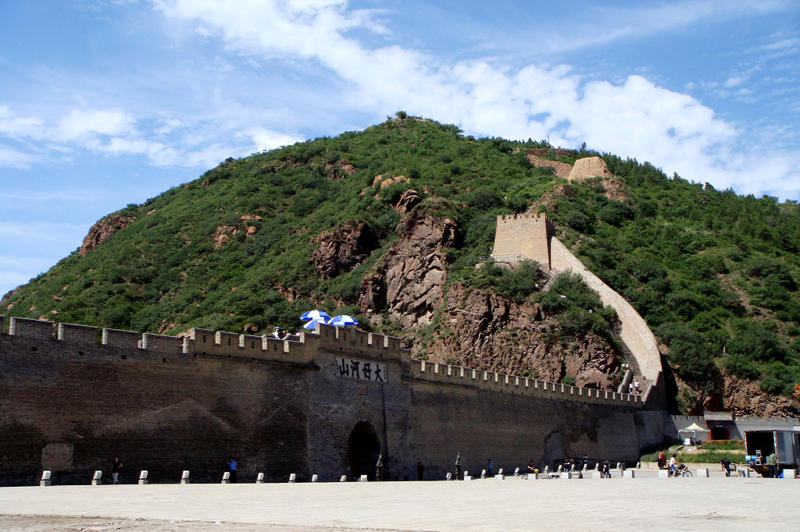
Dajingmen
Four Chinese characters -- 大好河山 -- stretch across the lintel in bold calligraphy: "Magnificent Rivers and Mountains." They were mounted in 1927 by Gao Weiyue, the ruler of Chahar Province, but they might as well have been written a thousand years earlier. Dajingmen, the Great Border Gate, sits at the precise point where the Great Wall descends from rugged western peaks to meet the plains of Zhangjiakou, and for centuries, anyone passing between the Mongolian steppe and the settled farmlands of northern China walked through this stone throat.
Where the Wall Meets the City
Built in 1644 -- the very first year of the Shunzhi Emperor's reign and the founding of the Qing dynasty -- Dajingmen rises 12 metres high, spans 9 metres wide, and reaches 13 metres deep. Above the gate, a terrace measuring 12 by 7.5 metres once served as a command post for soldiers scanning the northern horizon. Towers 1.7 metres tall crown the wall above, flanked by a parapet wall standing 0.8 metres on the outer side. The gate was not merely decorative. It controlled the single most important passage through the Great Wall in this region, the corridor that connected Beijing's northern defenses to the grasslands beyond.
A Frontier Between Worlds
Zhangjiakou has been called "Beijing's Northern Door" for good reason. The terrain here funnels traffic through a narrow gap between mountains, making Dajingmen a natural chokepoint. From the 18th century onward, camel caravans carrying tea chests from Chinese merchants to Russian traders at Kyakhta would pass through or near this gate, crossing the Gobi Desert in winter convoys. The gate marked a boundary not just between empires but between ways of life -- the agrarian south and the pastoral north, settled Han communities and nomadic Mongol tribes. Control of this passage meant control of trade, intelligence, and military movement across the northern frontier.
Stone Spine Along the Ridgeline
Just west of the gate, an approximately 100-metre stretch of brick-faced wall extends across the plain where Zhangjiakou sits. Beyond that, the Great Wall transforms. Built from hard local rock rather than brick, it climbs into mountainous terrain that grows wilder with every kilometre. This section of the wall is remarkably well preserved, its stonework following the contours of the ridgeline like a spine. The contrast is striking: the refined, carefully constructed gate gives way to raw, functional fortification that uses the mountain itself as a weapon of defense. Standing at Dajingmen, you can trace the wall in both directions and understand why this particular junction mattered -- it was where human engineering met natural geography to seal the border.
Written in Stone
The inscription above the gate has become Dajingmen's most famous feature. Gao Weiyue, who governed the former province of Chahar during the Republican era, chose the four characters 大好河山 -- a phrase that carries the weight of patriotic sentiment. Mounted in traditional Han style in 1927, the inscription frames the view through the gate as something worth defending. It was a statement of identity during a turbulent period when China's borders and sovereignty were being contested by warlords, foreign powers, and internal division. Today the inscription remains, weathered but legible, a reminder that this gate was always more than architecture. It was an argument about what lay on the other side.
From the Air
Located at 40.84N, 114.89E in Zhangjiakou, Hebei Province. The gate sits where the Great Wall descends from western mountains into the city plain. From altitude, look for the wall tracing the ridgeline west of the urban area. Nearest airport is Zhangjiakou Ningyuan Airport (ZBZJ). Recommended viewing altitude 3,000-5,000 feet AGL to appreciate the wall's path from mountains to city.