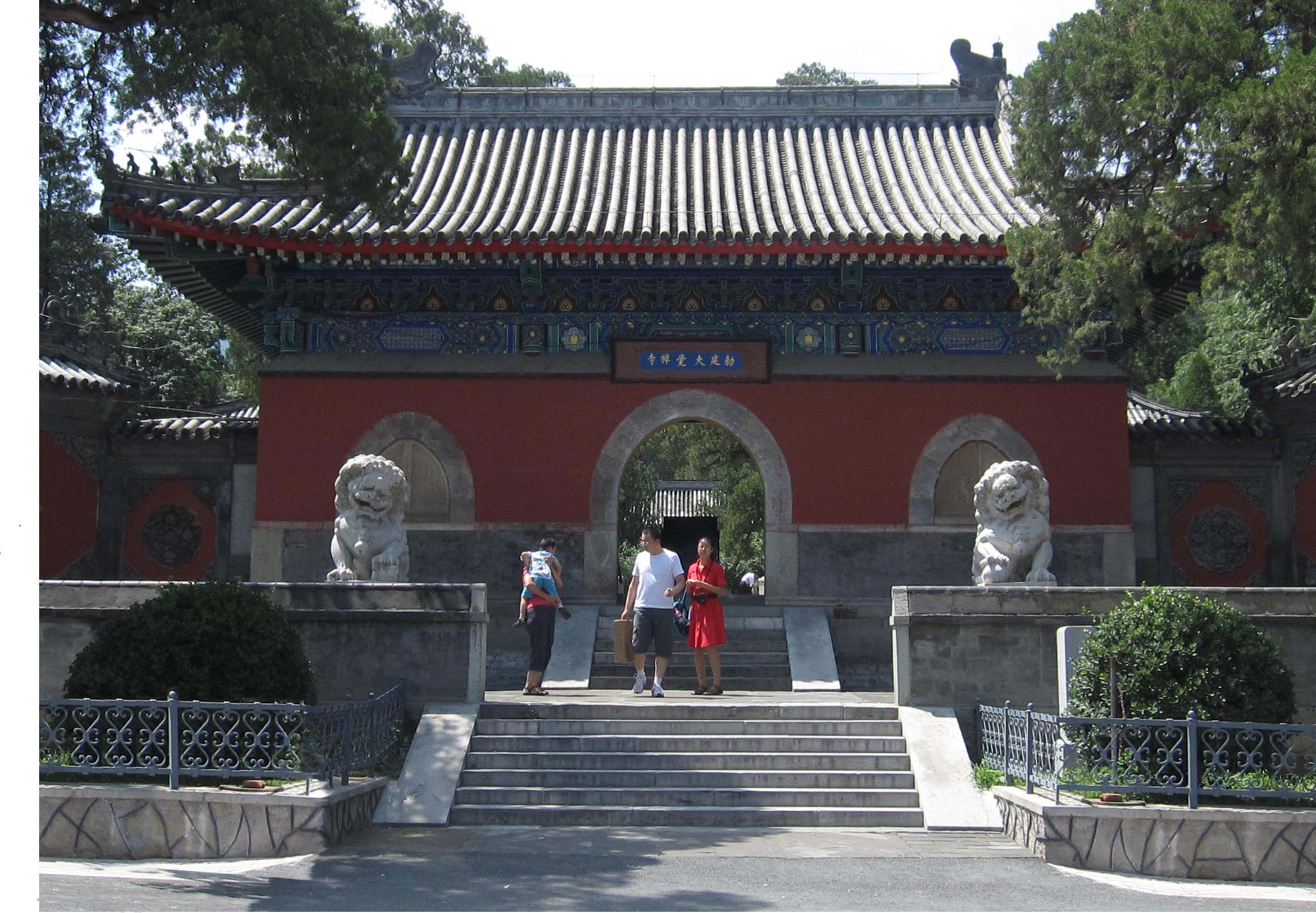
Dajue Temple
A stream once ran through the temple grounds so clear that the monks named the place after it. Qingshui Temple -- Clear Water Temple -- was built in 1068 during the Liao Dynasty, when Beijing was still a frontier capital called Yanjing. Nearly a millennium later, the stream still flows, the temple still stands, and the name has changed twice. It is now Dajue Temple, the Temple of Great Awakening, and it sits in the forested hills of Haidian District in western Beijing, a quiet compound of halls, statues, and a white pagoda that has absorbed the devotion of four dynasties.
Four Dynasties, Three Names
According to a stele still standing on the grounds, the temple was first built in 1068 during the Liao Dynasty. It was later renamed Lingquan Temple -- Spirit Spring Temple -- before being rebuilt in 1428 during the Ming Dynasty and given its present name. Renovations followed in 1720 and 1747 during the Qing Dynasty. Each dynasty left its mark, but the temple's layout has remained consistent: five main buildings arranged along an east-west axis, beginning with the main gate at the east end and progressing through the Mahavira Hall, the Amitabha Hall, the Sarira Pagoda, and finally the Longwang Hall, originally used to store sutras. The axial arrangement is unusual -- most Chinese temples align north-south -- and follows the natural slope of the hillside.
Buddhas of Wood and Stone
The Mahavira Hall anchors the complex with three large Ming Dynasty statues: Sakyamuni at the center, the Buddha of Medicine to the left, and Amitabha to the right. Behind them, facing the rear exit, stands a statue of Samantabhadra. Twenty devas line the side walls, with Qing Dynasty murals behind them and a large carved dragon on the ceiling. The Amitabha Hall is more intimate, centered on a large statue of Guanyin, the bodhisattva of compassion, flanked by two attendant bodhisattvas. Behind the main statues, a Qing-era flying figure appears to hover in mid-gesture -- an effect achieved through careful sculptural engineering that still catches visitors off guard.
The White Pagoda of Monk Jialing
The Sarira Pagoda is the temple's most distinctive structure. Built shortly after 1728 to house the relics of the monk Jialing, who served as abbot for several years in the 1720s, the pagoda combines three geometric forms: an octagonal base, a white circular middle section, and a slender spire that tapers skyward. It is a funeral monument and a piece of architecture that reads differently from every angle -- solid and geometric from below, ethereal and weightless from a distance. The pagoda sits at the spiritual center of the compound, marking the point where the temporal world of the lower halls gives way to something more abstract. Beyond it, the Longwang Hall, the westernmost building, once housed the temple's collection of sutras. The hills close in behind it, and the urban sprawl of modern Beijing feels very far away.
From the Air
Located at 40.05N, 116.10E in the Western Hills of Beijing's Haidian District, in a forested valley northwest of the city center. The temple compound is small but its white Sarira Pagoda may be visible among the trees at lower altitudes. Nearest major airport is Beijing Capital International Airport (ZBAA/PEK), approximately 45 km east. The temple is near Bussiere Garden and the China National Botanical Garden. Best viewed at 2,000-3,000 ft.