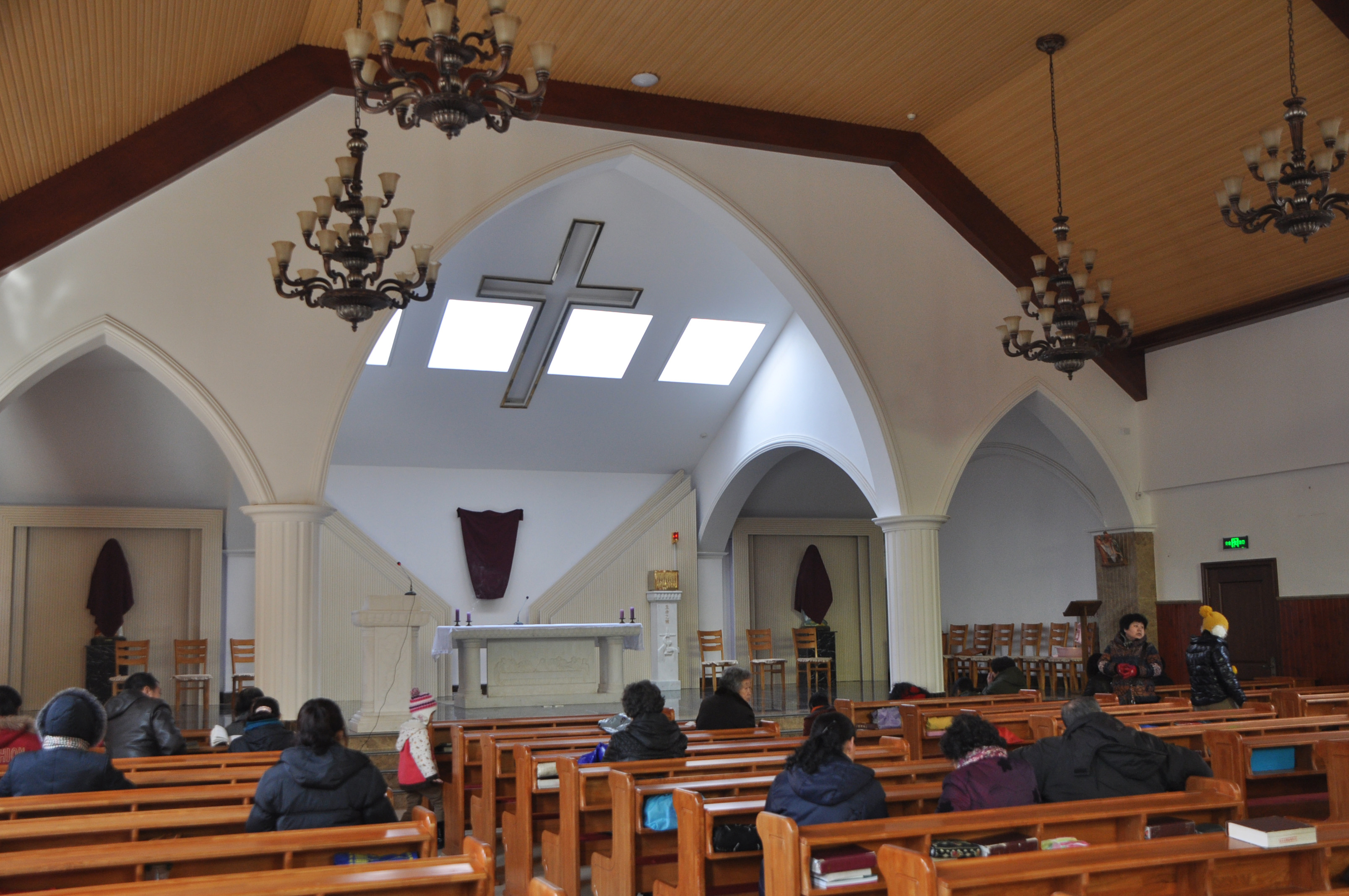
Dalian Catholic Church
It was railway workers who built it. Not missionaries arriving with grand plans from Rome, but Catholic employees of the South Manchuria Railway Company who pooled 20,000 yuan in the 1920s to give their faith a permanent home in a city that belonged, at the time, to Japan. Dalian Catholic Church, dedicated in 1926 as Stella Maris under the American Maryknoll mission, remains the only Catholic church in a city of over six million people. Across Dalian's six districts, there are six Protestant churches and this one.
Stella Maris in a Japanese Colony
Dalian in the 1920s was a Japanese leased territory, a colonial port city on the Liaodong Peninsula where imperial ambitions met commercial enterprise. The South Manchuria Railway Company was the economic engine of Japan's presence in Manchuria, and among its workers were Catholic believers who lacked a place of worship. Led by Daiji Oka, they raised the funds and built their church under the auspices of Maryknoll, the Catholic foreign missionary society headquartered in New York with a branch in Tokyo. The church was dedicated as Stella Maris, Star of the Sea, a fitting name for a congregation in a coastal city built on maritime trade. By 1931, the Chinese faithful had established their own worship at a separate Catholic church in Liujia Dun, but the total community at Stella Maris numbered over 1,200 believers.
The Weight of Revolution
Japan's defeat in World War II emptied Dalian of its Japanese residents, and the churches passed into Chinese hands. The transition was abrupt: one day the congregation included railway workers from Osaka and Tokyo, the next they were gone. When the Cultural Revolution swept China, Father Ding Runan was forced from his parish and sent to work the land in a village near Shenyang. The church fell silent. It was not until 1980 that Father Ding returned to Dalian and the church reopened, now renamed Sacred Heart Catholic Church. The years of persecution had reduced the parish to a shadow: during the 1980s, only two or three people were baptized each year. Recovery was slow, measured in individual conversions rather than crowds.
Faithful Across Languages
From 1989, Father Guo Jingcheng served the parish, followed by Father Peter Zhang Yongzhe in 1994. That same year, Korean-language mass began under Father Cui Zaizhe, reflecting the growing Korean community in Dalian and the city's deepening connections across the Yellow Sea. Today the church offers Chinese mass at 6:30 on weekday mornings and multiple services on weekends, Korean mass on Sunday afternoons, and English mass on Saturday evenings in the parish center courtyard. The Dalian City Patriotic Catholic Association occupies the former rectory on the church grounds, a reminder of the Chinese government's role in managing religious life. A small bookstore opens on weekends.
Old Walls, New Foundations
In 2002, the church building earned designation as Dalian City Historical Architecture, recognition that its value transcended any single denomination or political era. Eleven years later, in 2013, the parish built a new church structure whose exterior deliberately echoes the 1926 original. The decision to replicate the old building's appearance rather than start fresh speaks to what Stella Maris has always represented: continuity through disruption. From Japanese colonialism through Communist revolution, from the Cultural Revolution's silence to the quiet rebuilding of the reform era, this one Catholic parish has persisted at No. 31 Xi-an Street, adapting its name and its leadership while holding to the same patch of ground its railway-worker founders chose a century ago.
From the Air
Located at 38.92N, 121.62E in the Xi-gang District of central Dalian, Liaoning Province. The church is in the urban core at No. 31 Xi-an Street. Nearest major airport is Dalian Zhoushuizi International (ZYTL/DLC), approximately 10 km northwest. From altitude, the church is within the dense downtown grid south of the harbor area.