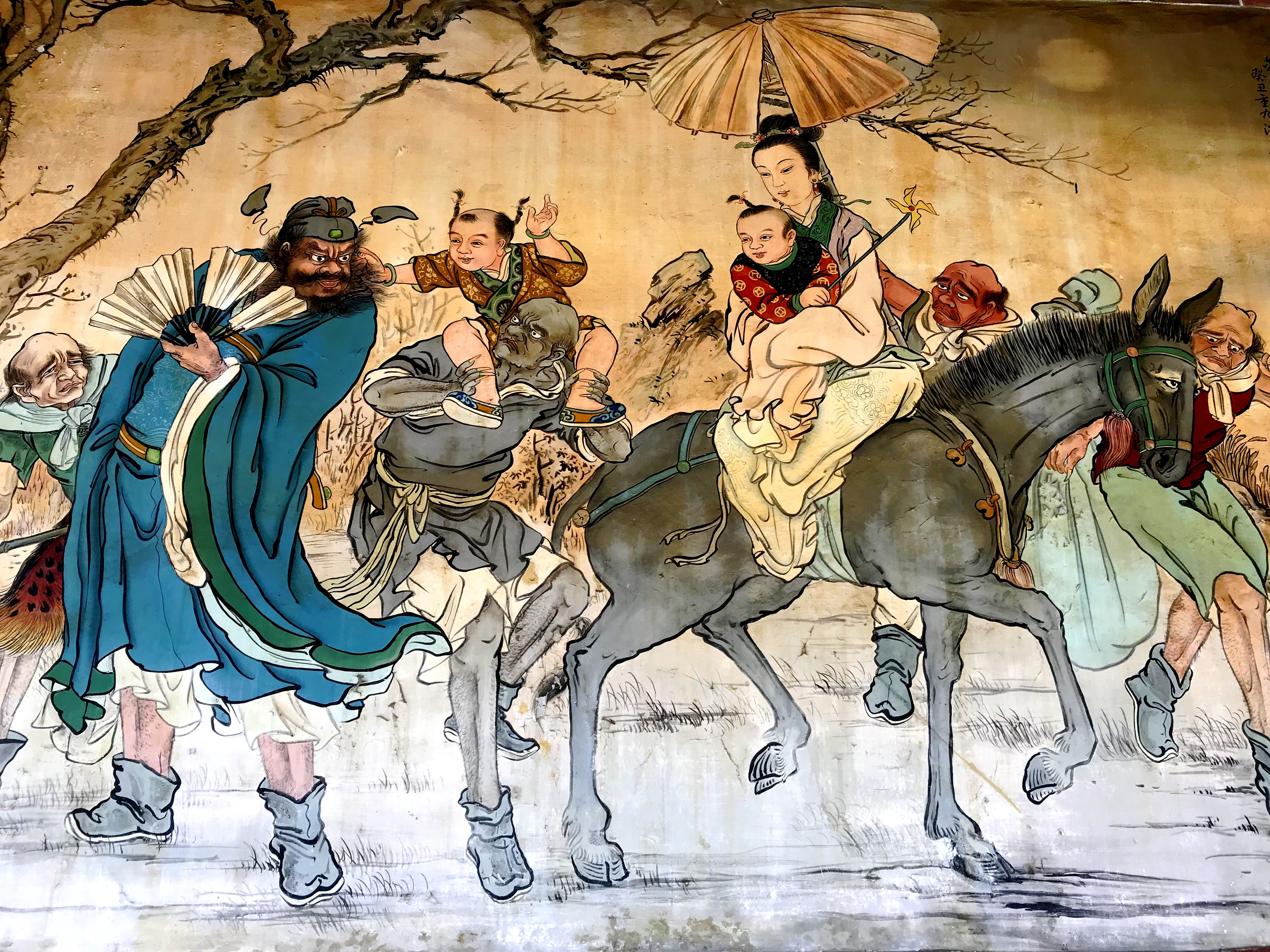
Dalongdong Baoan Temple
The name is a promise. Po-an -- "protect those of Tong'an" -- was chosen by immigrants from Tong'an, a district in Xiamen, Fujian Province, who crossed the Taiwan Strait in the early 19th century and wanted their gods to follow. The Dalongdong Baoan Temple was never just a place of worship. It was a declaration of community, a claim of belonging in a new land, and a lifeline to a home most of its builders would never see again. Two centuries later, the murals on its walls are vivid enough to make you forget how old they are.
From Wooden Shrine to Stone and Color
A wooden shrine had stood on the site since 1742, serving the settlers of the area then called Toaliongtong. But by 1804, the Tong'an clan members decided their community deserved something more substantial. Construction of the current temple began that year, replacing the older structure with one built to last -- stone foundations, carved wooden beams, and walls designed to hold the elaborate murals and decorative carvings that define Taiwanese temple architecture. The temple is dedicated to Baosheng Dadi, the divine physician of Chinese folk religion, a deity whose healing associations made him a natural patron for immigrants facing unfamiliar diseases in a subtropical climate far from their ancestral doctors.
Surviving the Colonial Century
The 20th century was hard on Taiwanese temples. During the Japanese colonial period, Shinto shrines were promoted and local religious practices were sometimes suppressed. The Baoan Temple survived, partly because the Japanese authorities also recognized the cultural significance of its architecture and partly because the community that built it never stopped using it. Throughout the colonial decades, the temple underwent improvements and extensions that expanded its grounds and refined its decorative programs. The murals that cover the interior walls -- scenes from Chinese mythology, Confucian parables, and Buddhist cosmology rendered in rich pigments -- accumulated over generations of artisan work, each layer adding to the visual density that makes the temple remarkable.
Ruin and Recognition
By the mid-20th century, decades of weather, neglect, and the wear of daily worship had taken their toll. In 1985, the Taiwan government designated the Baoan Temple a Level Two historic monument, acknowledging its architectural importance but not yet committing resources to its preservation. The real turning point came in 1995, when a comprehensive restoration project began, addressing structural damage, repainting faded murals, and reinforcing the carved wooden elements that give the temple its distinctive character. The painstaking quality of the restoration -- artisans used traditional techniques and materials wherever possible -- earned the temple international recognition. In 2003, the Dalongdong Baoan Temple received a UNESCO Asia-Pacific Heritage Award for Cultural Heritage Conservation, placing it alongside the finest preservation work in the region.
A Living Temple in a Modern City
The Baoan Temple is not a museum. Incense smoke still fills the courtyards on festival days. Worshippers consult the oracle blocks, offer fruit and flowers to Baosheng Dadi, and mark the lunar calendar with processions that spill into the surrounding streets. The Taipei Confucius Temple stands directly adjacent, creating an unusual juxtaposition of folk religious practice and scholarly tradition within a single block. Together, the two temples anchor the Dalongdong neighborhood of Taipei's Datong District, an area that retains a character distinct from the sleek commercial districts to the south. The temple is a short walk west from Yuanshan Station on the Taipei Metro, accessible but tucked far enough from the main tourist circuits to feel like a genuine discovery rather than a curated experience.
From the Air
Coordinates: 25.073N, 121.516E. Located in the Dalongdong neighborhood of Taipei's Datong District, adjacent to the Taipei Confucius Temple. From altitude, the ornate temple roofline with traditional curved eaves and colorful ceramic decorations is distinctive among the surrounding urban buildings. Nearby airport: RCSS (Taipei Songshan Airport, ~4 km southeast). Near Yuanshan Station and the Taipei Expo Park area. Best viewed at 1,500-3,000 feet.