Daly Waters, Northern Territory
John McDouall Stuart carved his initial into a tree here in 1862. That modest mark — an 'S' cut into bark — is one of the few surviving witnesses to the moment Australia was first crossed from south to north overland. Stuart's third expedition, which had pushed north from Adelaide through lancewood scrub at barely a kilometre a day, reached what he would name Daly Waters on 28 May 1862. He named it for Sir Dominick Daly, the new Governor of South Australia, a man who never came anywhere near the place. The springs that fed the site kept attracting people long after Stuart moved on, and a small, improbable town began to accumulate around them.
Telegraph, Then Flight
The next milestone arrived with wires. The Australian Overland Telegraph Line reached Daly Waters from the north in June 1872, and for two months a pony express carried messages the 421 kilometres south to Tennant Creek via Renner Springs while the line was completed. The telegraph station transformed the springs from a campsite into a waypoint on what was becoming a nervous system stretched across a continent. Then came flight. The Daly Waters Airfield served as a refuelling stop on the 1919 England-to-Australia air race — one of the earliest long-distance aviation contests — and went on to anchor Qantas's pioneering Singapore service through the 1930s. International air routes ran through this desert crossroads because there was simply no other practical place to stop. The growth of commercial aviation turned a lonely outback town into a busy, if still very rudimentary, transit point.
Wartime and After
The Japanese attacks of 1941 remade Daly Waters again. The RAAF requisitioned the airfield and turned it into an active military base, including a field hospital. American and Australian squadrons launched combat missions from here against Japanese positions in the Dutch East Indies and across the island chains to Australia's north. The war proceeded northward through 1943, the base wound down, and commercial flights resumed. They continued, barely, until 1970 — one Ansett flight north each week, one TAA flight south — until both airlines quietly ended their services a week apart in April. The original Qantas hangar survived the handovers; it still stands, housing photographs and equipment from the area's aviation past, a corrugated-iron monument to improbable distances.
The Famous Pub
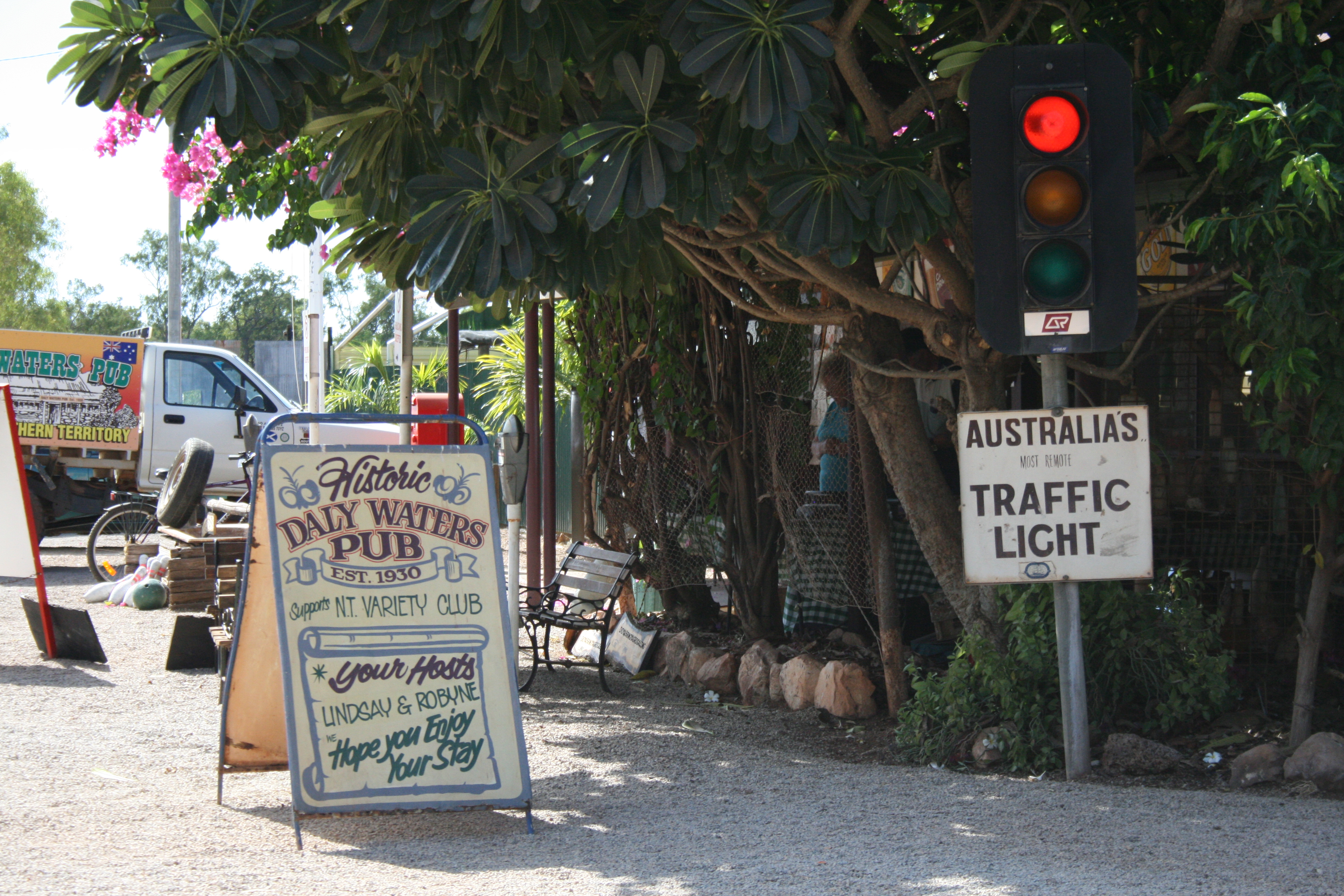
The Daly Waters Pub is licensed since 1938, when it began serving passengers and crew from the adjacent airfield. Today it is the main reason most travellers stop. The walls, ceiling, and every available surface are covered with banknotes, bras, business cards, licence plates, and other memorabilia deposited by visitors from every country imaginable — a sort of accidental archive of the kinds of people who pass through a crossroads at the edge of the outback. The pub has outlasted the airlines, the telegraph, and several eras of government. It remains the social heart of a town whose permanent population numbers around 55.
Country and Country's People
The traditional owners of the area — whose connection to these springs, this scrub, and the waterways running through it predates Stuart's visit by thousands of years — became the fourth Indigenous group in the Northern Territory to gain native title over their lands. The ruling covered both the townsite and ten surrounding pastoral leases, an area of 30,000 square kilometres. The Federal Court held a special ceremonial sitting at nearby Newcastle Waters Station to mark the occasion. It was a recognition of continuity: that the history accumulating at Daly Waters since the 1860s sits atop a much deeper and longer story.
From the Air
Daly Waters sits at -16.2533°S, 133.3693°E, where the Carpentaria Highway crosses the Stuart Highway — the two main arteries of the Northern Territory's outback interior. The town is easily identified from altitude by the highway intersection and the cluster of buildings around the pub and roadhouse. The airfield (YDLW) lies immediately adjacent. Darwin (YPDN) is approximately 350nm north; Tennant Creek (YTNK) roughly 175nm south. Terrain is flat savanna and lancewood scrub; a very clear landmark in dry-season conditions.