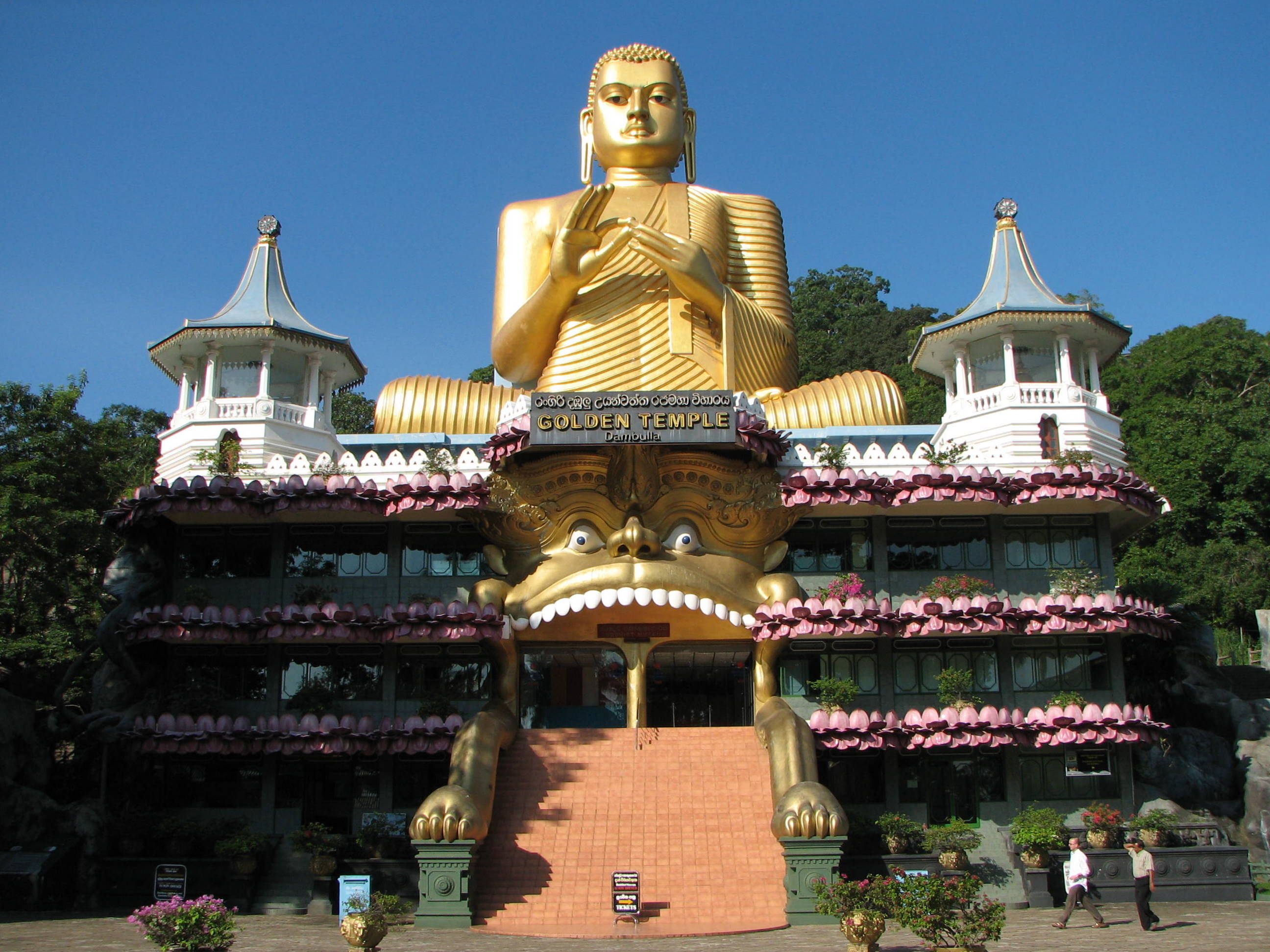
Dambulla Cave Temple
One hundred and fifty-three Buddhas sit in silence inside a rock. Some are standing, some reclining, some deep in meditation. They have been here for centuries, accumulating in the five caves of Dambulla like offerings that no one dares remove. The oldest date to the first century BCE; the newest were gilded by a medieval king who added seventy more in a single act of devotion. Together they form the largest and best-preserved cave temple complex in Sri Lanka, a place where worship has never stopped since an exiled king first took shelter here over two thousand years ago.
A King's Refuge
In the first century BCE, King Valagamba of Anuradhapura lost everything. South Indian invaders seized his capital, and for fifteen years he lived as a fugitive in the wilderness around Dambulla. The caves in the 160-meter-high rock offered shelter, and the Buddhist monks who already inhabited them offered sanctuary. When Valagamba finally reclaimed his throne, he returned not with soldiers but with gratitude, converting the caves into a magnificent temple. It was an act of worship born from exile, and it set a pattern that would repeat for centuries. Each successive king who visited Dambulla added something: a statue, a painting, a layer of gold. Nissanka Malla of Polonnaruwa gilded the caves and installed roughly seventy Buddha statues in 1190. The Kingdom of Kandy restored and repainted the interiors in the 18th century. The rock became a palimpsest of Sri Lankan devotion, each generation layering its faith onto the one before.
Painted Ceilings, Living Rock
Step inside the second cave, the Maharaja Lena, and the ceiling disappears into color. Tempera paintings from the 18th century follow the natural contours of the rock overhead, depicting scenes from the Buddha's life: the dream of Mahamaya, the temptation by the demon Mara, the first sermon at Deer Park. The murals cover a total of 2,100 square meters across all five caves, making Dambulla one of the most extensively painted religious sites in South Asia. The largest cave stretches 52 meters from east to west and rises 7 meters at its peak, a natural cathedral whose irregular ceiling forced the artists to adapt their compositions to every bulge and hollow. A cleverly carved drip line along the rock overhang keeps rainwater from seeping inside, a feat of engineering that has kept these interiors dry for over two millennia. At dusk, hundreds of swallows swoop past the cave entrances, tracing the same flight paths they have followed for generations.
Five Caves, Five Worlds
Each cave has its own character. The first, Devaraja Lena, is dominated by a 14-meter Buddha hewn directly from the rock, with Vishnu standing at the statue's head, said to have created the caves with divine power. The second cave holds 56 Buddha statues alongside Hindu gods Saman and Vishnu, their forms draped with fresh garlands by pilgrims. A spring drips healing water from a crack in the ceiling into a vessel below, never running dry. The third cave, the Maha Alut Vihara, was painted during the reign of Kirti Sri Rajasinha in the mid-18th century, its walls and ceiling glowing with the distinctive palette of the Kandyan artistic tradition. Across all five caves, statues of Sri Lankan kings stand among the Buddhas and bodhisattvas, a reminder that this is a place where political power and spiritual authority have always been intertwined.
Before the Buddha
Buddhism arrived at these caves, but people were here long before it did. At nearby Ibbankatuwa, burial sites containing human skeletons approximately 2,700 years old have been excavated, evidence of prehistoric communities that lived in and around the Dambulla cave complexes. More than eighty caves have been documented in the surrounding area, many of them bearing traces of ancient habitation. The rock that now shelters golden Buddhas once sheltered families who knew nothing of the faith that would one day transform their home. UNESCO recognized Dambulla as a World Heritage Site in 1991, and conservation efforts between 1982 and 1996 focused on preserving the 18th-century murals that make up roughly eighty percent of the surviving paintings. The temple remains an active ritual center, with monks chanting and devotees making offerings just as they have for more than twenty-two centuries.
Between Two Landmarks
From the gentle slope leading up to the caves, the surrounding plains stretch in every direction. On a clear day, 19 kilometers to the northeast, the unmistakable column of Sigiriya rises from the flatlands. The two sites are bound by more than geography: King Kashyapa, who built his fortress palace atop Sigiriya in the 5th century, was part of the same lineage of rulers who enriched Dambulla's caves. The road between them traces one of the densest concentrations of ancient sacred sites in the world. Dambulla sits 148 kilometers east of Colombo and 72 kilometers north of Kandy, a central position that has made it a crossroads of pilgrimage and trade for millennia. The temple complex has survived not by being remote but by being essential, a place that every generation has found reason to honor, embellish, and preserve.
From the Air
Dambulla Cave Temple sits at 7.857N, 80.648E in Sri Lanka's central plains. The 160-meter rock outcrop is visible from moderate altitude, rising distinctly above the flat surrounding terrain. Sigiriya rock is visible 19 km to the northeast. Nearest airport: Sigiriya (VCCS/GIU), approximately 20 km northeast. Bandaranaike International Airport (VCBI/CMB) is 148 km to the west near Colombo. Best viewed at 2,000-4,000 feet AGL in clear conditions. The golden temple structure at the base of the rock may be visible as a glint of color against the green landscape.