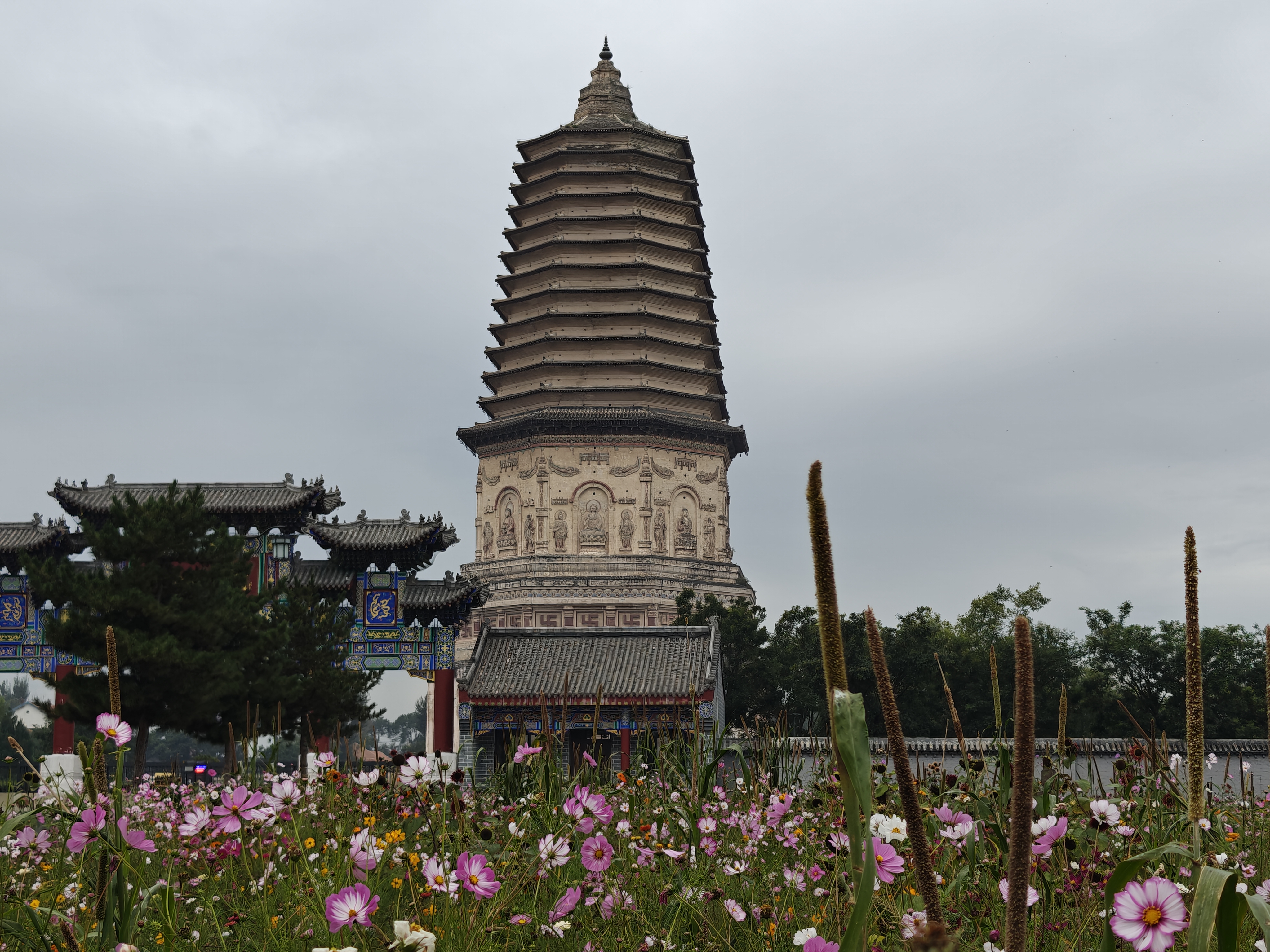
Daming Pagoda
For nearly a thousand years, the Daming Pagoda has been the tallest thing on the horizon in Ningcheng County. At 80.22 meters -- roughly the height of a 25-story building -- this thirteen-story octagonal tower of solid brick rises from the grasslands of Inner Mongolia with an authority that time has not diminished. It is the largest ancient pagoda in China by volume and the second-tallest surviving, surpassed only by the Northern Song-era Kaiyuan Temple Pagoda in Dingzhou, Hebei, which stands about four meters higher. That such a monument exists not in one of China's famous ancient capitals but in the former Middle Capital of the Liao dynasty speaks to a chapter of Chinese history that is often overlooked.
A Date Debated Across Centuries
When exactly the Daming Pagoda was built remains a matter of scholarly disagreement. The Yuan-era Records of the Unified Yuan places its construction in 1035, during the reign of Emperor Xingzong of Liao. But an inscription carved into the pagoda itself bears a different date: the fourth year of the Shouchang era, corresponding to 1098. Whether this inscription marks the structure's completion or a major renovation is unclear. What is certain is that the pagoda has stood through the rise and fall of dynasties, surviving nearly a millennium of weathering, earthquakes, and human intervention. The earliest documented repairs came in 1854, evidenced by a Mongolian inscription on the southern facade reading "Great Qing, Xianfeng Year Jiawu, respectfully repaired."
Eight Buddhas, Eight Faces
The pagoda rises from a 16.21-meter Sumeru base in the dense-eave style typical of Liao dynasty religious architecture. Each of its eight facades features a large arched niche sheltering a seated Buddha, flanked by attendant bodhisattvas on the four primary sides and fierce guardian deities on the diagonals. The main image on the southern face depicts Mahavairocana, the cosmic Buddha, accompanied by exquisitely carved attendant figures. Above the niches, flying apsaras hold lotus blossoms and float on carved clouds with a fluidity that belies the solidity of their brick medium. On the diagonal sides, guardian figures wield vajras -- ritual thunderbolt scepters -- their exaggerated musculature and ferocious expressions intended to ward off evil from the sacred structure.
Tang Echoes in Liao Stone
Art historians note that the Daming Pagoda's sculptural style reflects Tang dynasty influences, with larger-than-life Buddha figures rare among surviving Chinese pagodas. This is not surprising -- the Liao dynasty, founded by the Khitan people, absorbed and reinterpreted Tang artistic traditions even as they maintained their own distinct cultural identity. The pagoda thus represents a cultural fusion: Khitan builders working in a Chinese architectural form, decorating their creation with sculptures that draw on Tang aesthetic ideals while serving the Buddhist devotion that had become central to Liao court life. The result is a monument that belongs fully to neither tradition and enriches both.
Restoration and Endurance
The twentieth century brought both neglect and rescue. Minor work in 1912 and a 1937 refurbishment that involved repainting the Buddhist sculptures kept the pagoda standing, but more serious intervention came in 1974 when the Liaoning provincial government reinforced the foundation. The most comprehensive restoration arrived in 1982, funded by the National Cultural Heritage Administration, addressing structural weaknesses, replacing decayed wooden elements, and replicating damaged sculptures and the copper finial that crowns the tower. Today the Daming Pagoda stands as the centerpiece of the former Liao Middle Capital, a physical reminder that this remote corner of Inner Mongolia was once the heart of an empire that stretched from the Pacific coast to the Mongolian steppe.
From the Air
Located at 41.57°N, 119.16°E in Ningcheng County, Chifeng, Inner Mongolia. The 80-meter pagoda is visible from the air as a prominent vertical structure in relatively flat terrain. Nearest airport: Chifeng Yulong Airport (ZBCF). Recommended viewing altitude: 5,000-10,000 ft. The pagoda stands near the remains of the Liao dynasty's Middle Capital.