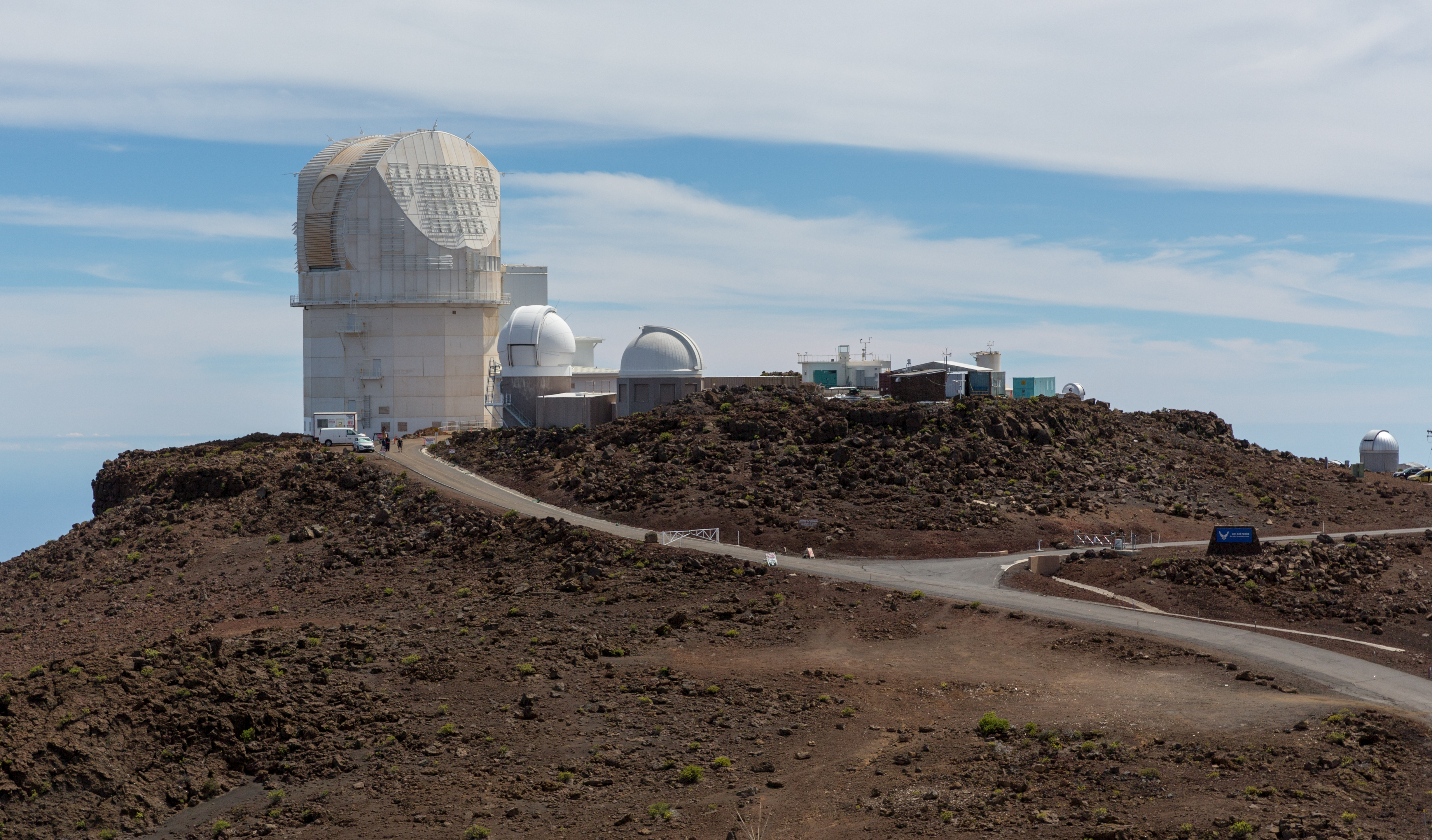
Daniel K. Inouye Solar Telescope
When the first test images arrived from Haleakala in January 2020, solar physicists around the world did something unusual: they gasped. The photographs showed the Sun's surface in a resolution never before achieved from Earth, a roiling mosaic of plasma cells each the size of Texas, their bright centers surrounded by dark lanes where cooled material sinks back into the solar interior. The instrument responsible for these images, the Daniel K. Inouye Solar Telescope, had just demonstrated why anyone would spend $344 million and more than a decade building a telescope that points at something you can see with your naked eye.
A Mirror on a Sacred Mountain
The telescope sits at the summit of Haleakala, the 10,023-foot shield volcano that dominates eastern Maui. Native Hawaiians consider the mountain sacred, its name meaning "house of the sun" in the story of the demigod Maui, who lassoed the Sun from this peak to slow its passage across the sky. The site was chosen not for mythology but for meteorology: Haleakala's summit rises above the marine inversion layer, where the atmosphere is exceptionally stable and dry. That stability matters because atmospheric turbulence distorts telescope images, and when you are trying to resolve features just 20 miles across on a star 93 million miles away, even faint shimmer is the enemy. The telescope is named for Daniel K. Inouye, the decorated World War II veteran who served as a U.S. Senator from Hawaii for nearly five decades, the longest-serving senator in Hawaii's history.
Engineering the Impossible Gaze
At the heart of the DKIST is a primary mirror 4.24 meters in diameter, cast from Zerodur, a glass-ceramic material with nearly zero thermal expansion, and polished at the University of Arizona's Richard F. Caris Mirror Laboratory. Only four meters of the mirror's surface are used, an off-axis section of what would otherwise be a 12-meter parabola. This off-axis design eliminates the secondary-mirror supports that would otherwise scatter light and degrade image quality. The secondary mirror, just 0.65 meters across, is made from silicon carbide and mounted on a hexapod that adjusts its position in real time to compensate for thermal expansion and structural flexing. A deformable mirror in the adaptive optics system reshapes itself hundreds of times per second, reading distortions measured by a wavefront sensor and correcting them before the light reaches the instruments. The result is diffraction-limited imaging, meaning the telescope achieves the sharpest images that physics allows for its aperture.
Reading the Sun's Magnetic Soul
The DKIST carries five first-generation instruments, and their ambition extends far beyond pretty pictures. The Visible Broadband Imager captures the Sun's surface in wavelengths ranging from dark-violet calcium lines to near-infrared iron emissions, bursting images at 30 frames per second so that software can reconstruct a single, speckle-free frame. The Visible Spectro-Polarimeter and the Cryogenic Near-Infrared Spectro-Polarimeter do something even more revealing: they measure the polarization of sunlight, which encodes the direction and strength of the Sun's magnetic field. Solar magnetic fields drive sunspots, flares, and coronal mass ejections, the violent eruptions that can disable satellites, disrupt power grids, and endanger astronauts. Understanding how magnetic energy builds and releases on the Sun's surface is not abstract science. It is infrastructure protection on a planetary scale.
First Light and Coordinated Discovery
Construction began in 2013, and the primary mirror was delivered by truck up the winding Haleakala highway on the night of August 1-2, 2017, arriving under cover of darkness to avoid softening in the tropical heat. The telescope achieved first science observations on February 23, 2022, beginning a year-long commissioning phase. In October 2022, the DKIST participated in its first coordinated campaign with the European Space Agency's Solar Orbiter spacecraft, the two facilities observing the Sun simultaneously from ground and space. Together they studied coronal loop physics, the formation of small-scale brightenings in active regions, and the dynamics of coronal rain, plasma that condenses in the Sun's atmosphere and falls back to the surface along magnetic field lines like luminous precipitation. The collaboration demonstrated how pairing the highest-resolution ground telescope with a space-based observer can answer questions neither could tackle alone.
A New Era of Solar Science
The DKIST represents a leap in solar observation comparable to Galileo's first telescope pointed at the Sun four centuries ago. Its resolution reveals structures as small as 30 kilometers across on the solar surface, a scale where the fundamental processes of magnetic reconnection and energy transport become visible for the first time. Twenty-two institutions across the United States, Germany, and beyond have joined the collaboration, a testament to the scientific hunger for data at this resolution. The telescope is funded by the National Science Foundation and managed by the National Solar Observatory, with a total project cost of $344.13 million. For solar physicists, the DKIST is not just an instrument. It is the beginning of an era when the Sun's behavior can finally be studied at the scale where that behavior originates.
From the Air
Located at 20.70N, 156.18W atop Haleakala on Maui at approximately 10,000 feet elevation. The telescope dome is visible from the air as a white structure near the summit. Nearest major airport is Kahului Airport (PHOG). The summit area hosts multiple observatory domes. Best viewed on clear mornings before afternoon cloud buildup engulfs the peak.