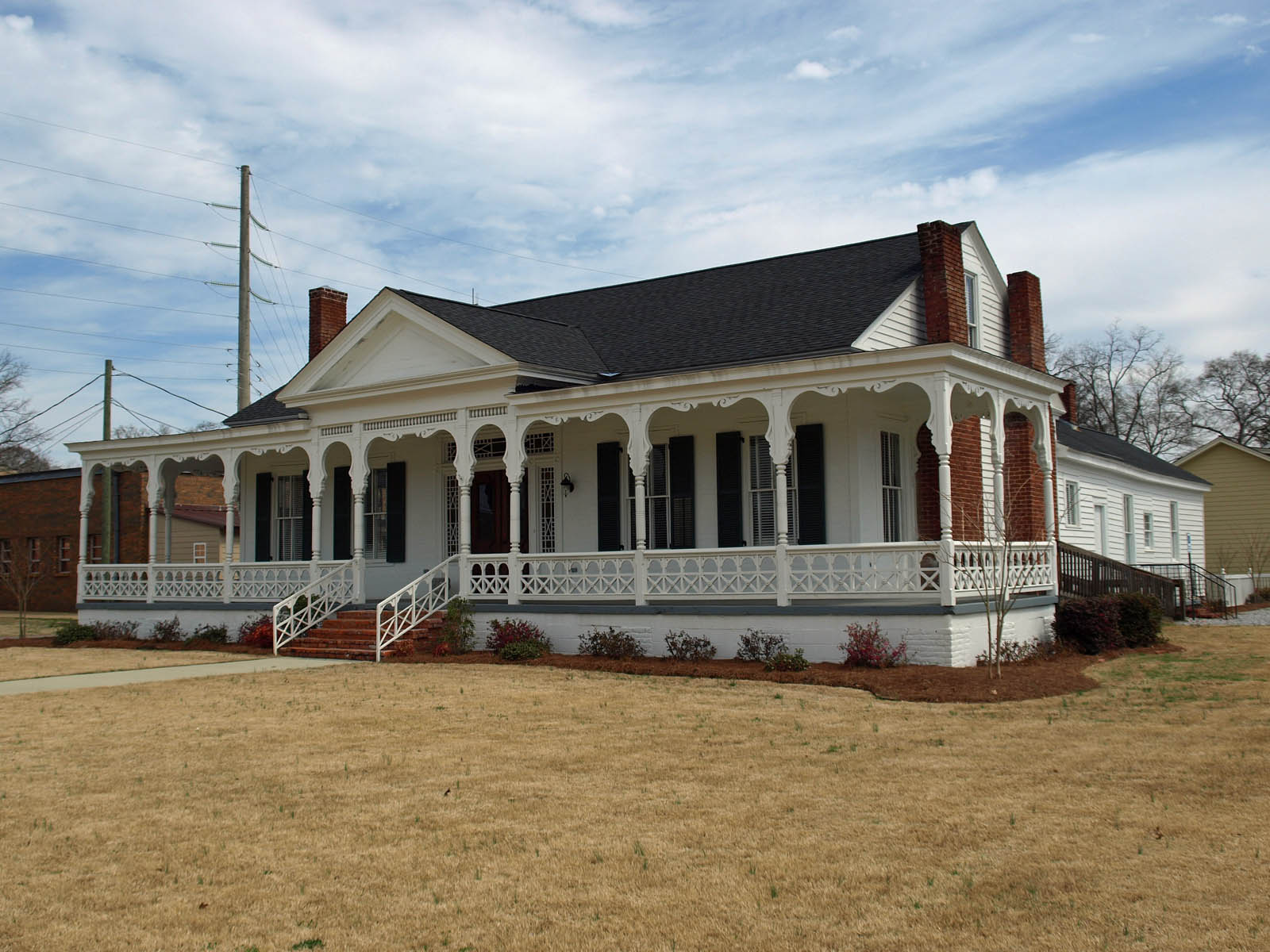
Daniel Pratt Historic District
On a faded brick wall along Autauga Creek in Prattville, Alabama, remnants of painted letters still spell out "DANIEL PRATT COTTON MANUFACTURY" -- the misspelling frozen in place since the 1850s. The sign marks the cotton gin factory that Daniel Pratt, a New Hampshire native who arrived in central Alabama in 1833 with his wife, two enslaved people, and materials to build 50 gins, grew into the largest cotton gin manufacturer in the world. Pratt did not just build a factory. He built an entire town around it: worker housing, churches, a hotel, a school, a cemetery. The 15-block historic district that bears his name preserves over 200 structures spanning from the 1840s to the 1930s, a remarkably intact record of a Southern industrial company town from its founding through nearly a century of growth.
A Yankee Industrialist in Cotton Country
Daniel Pratt was born on July 20, 1799, in Temple, New Hampshire. He left New England in 1819 after completing an architect's apprenticeship, and while in Georgia he met Samuel Griswold, a fellow New Englander who manufactured cotton gins. Griswold promoted Pratt to partner within a year, but Pratt struck out on his own, moving to Autauga County, Alabama in 1833. He leased land along Autauga Creek, then purchased 1,822 acres and built a permanent cotton gin factory in 1838. By the 1850s, the Pratt Gin Company was shipping gins to planters across the globe -- to Russia, Great Britain, France, Cuba, Mexico, and Central and South America. By 1860, the factory produced at least 1,500 gins per year. Pratt diversified into sawmills, grist mills, a window factory, an iron foundry, a woolen mill, and even a railroad. The town of Prattville grew up around his operations.
Brick by Brick Along the Creek
The district's architecture reads like a catalog of 19th-century American building styles. The Autauga County Courthouse, built in 1906, is Richardsonian Romanesque, designed by the Bruce Architectural Company of Birmingham. A service station from 1920 at 201 South Court Street features Mission Revival elements including tiled parapets. The First United Methodist Church, built in 1912, is neo-Tudor. St. Mark's Episcopal Church from 1909 is Gothic Revival. The Fay-Mercer House, built in 1854, and the Ticknor-Hazen House from around 1850 represent Greek Revival domestic architecture -- the latter constructed by Pratt himself for his niece Mary Ticknor. At 176 West Main Street stands what was once the Prattville Mercantile Company, built by Pratt around 1855 for mill operatives and considered one of the most significant antebellum commercial structures in central Alabama.
The Mill Village That Survived
What makes this district exceptional is not just its grand buildings but its humble ones. Scattered along North Court Street and First Avenue are the few surviving mill cottages from the hundreds that once housed workers at Prattville Cotton Mills. A cottage at 117 North Court Street, built around 1880, is one of the last 19th-century mill houses standing. A pair at 131 and 141 First Avenue are among the few surviving houses of the original mill village. The Wainwright-Smith-Cook House at 115 Maple Street, built around 1860 for factory mechanic James Wainwright, is the only unaltered residence surviving from the residential areas immediately surrounding the original factory buildings on the south side of Autauga Creek. Even the Spigener House at 346 South Washington Street, possibly built before 1836, may predate Pratt's arrival entirely.
Industry and Its Ghosts
The industrial complex along the west side of Autauga Creek anchors the district. The oldest surviving structure is the Sash, Door, and Blind Factory from around 1849, which by 1857 also housed a grist mill, machine shop, and carriage factory. The Daniel Pratt Cotton Gin Factory building dates to 1854-55. A later addition from 1896 represents the final expansion before Pratt's companies merged with Continental Gin Company in 1899. The Continental Gin Warehouse, built in 1911, sits on the site where Pratt had built a church and storefront in 1853. On the hill south of the complex, Pratt Cemetery was established around 1840 for Pratt's family, friends, and mill operatives. The earliest marked grave belongs to Pratt's baby daughter, Mary, who died on September 21, 1843. The painter George Cooke is also buried there.
Main Street Commerce
West Main Street preserves a nearly continuous row of commercial buildings from the turn of the 20th century. Behrendson Bakery occupied two different storefronts over the decades. The Rawlinson-Gay Building from 1899 served as Rawlinson's Mercantile. The Red Arrow Hardware at 172 West Main occupies a cotton warehouse built by Pratt around 1860 for his manufacturing company. The district was listed on the National Register of Historic Places on August 30, 1984, recognizing architecture in Greek Revival, Italianate, and Bungalow styles. What was once a New England industrialist's vision of an orderly Southern mill town remains remarkably legible, its streets still tracing the patterns Pratt laid out when Alabama's cotton economy was remaking the world.
From the Air
Located at 32.461°N, 86.472°W in Prattville, Alabama, about 12 miles northwest of Montgomery. From altitude, Prattville appears along Autauga Creek, a tributary of the Alabama River. The historic district occupies the original downtown core around the creek's industrial corridor. Nearest airports: Montgomery Regional Airport (KMGM, ~15 nm southeast) and Prattville-Grouby Field (1A9, ~3 nm east). The mill complex along Autauga Creek and the Autauga County Courthouse are the most recognizable structures from above. Best viewed at 2,000-3,000 ft AGL.