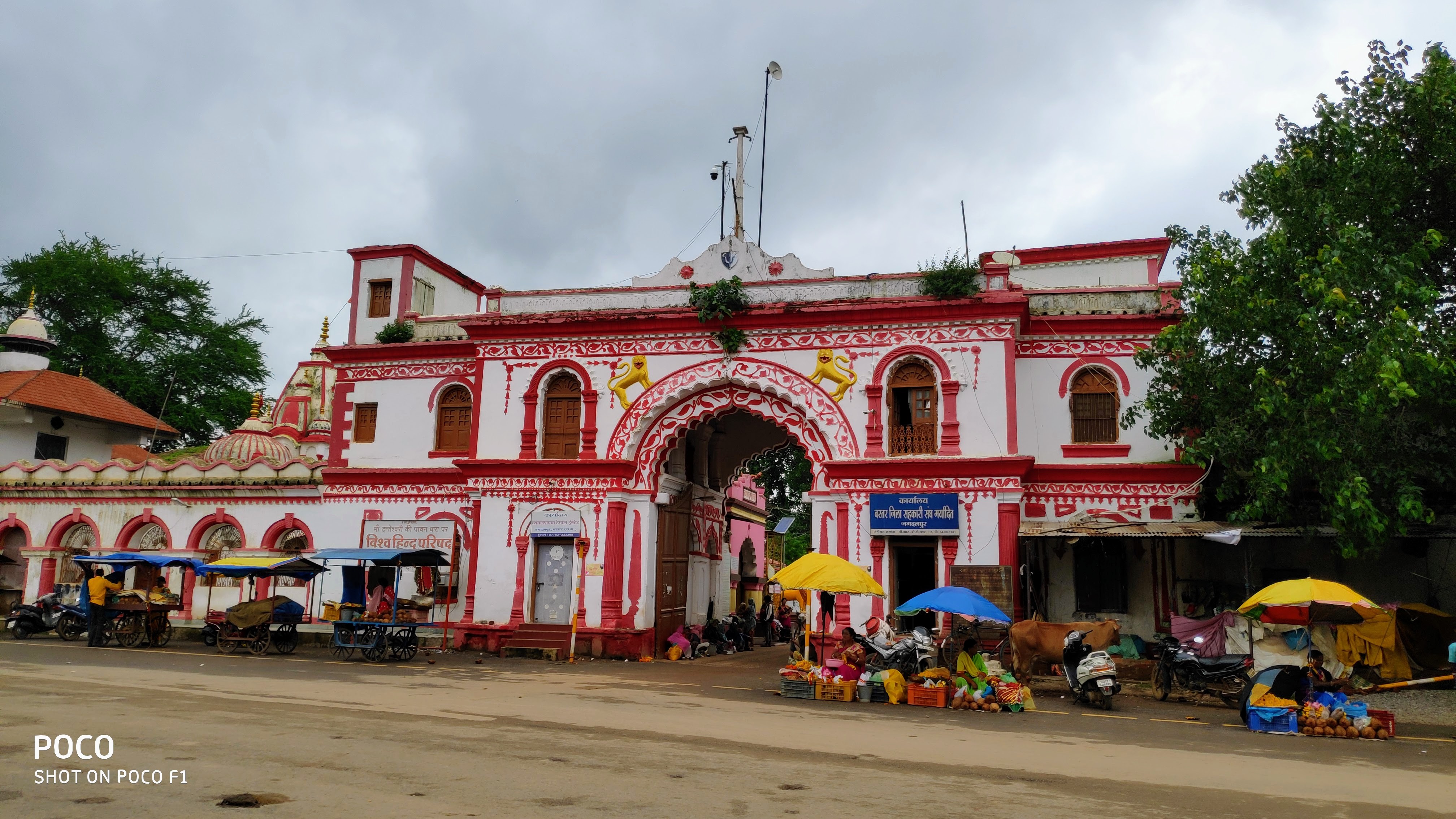
Danteshwari Temple
The word dant means tooth in Hindi, and this temple exists because of one. According to Hindu tradition, when the goddess Sati immolated herself in protest against her father Daksha's insult to Lord Shiva, the grief-stricken Shiva carried her body across the heavens, performing the cosmic dance of destruction known as Tandava. To stop him, Lord Vishnu used his Sudarshan Chakra to sever Sati's body, and its parts fell to fifty-two locations across the Indian subcontinent, each consecrated as a Shakti Peetha. At Dantewada, it was her tooth that landed. The temple built over this spot in the 14th century gave the town its name, and for more than 600 years, it has stood in the forests of Bastar as a place where tribal devotion and pan-Indian pilgrimage converge.
Stone and Story
The Danteshwari Temple was built during the 14th century, attributed to the Chalukya kings who ruled this region. The idol of Danteshwari Mai is carved from black stone, and the temple follows a traditional four-part layout: the Garbha Griha (sanctum), Maha Mandap, Mukhya Mandap, and Sabha Mandap. The sanctum and Maha Mandap were constructed from precisely fitted stone blocks, a technique that has allowed the structure to endure through centuries of monsoons and forest encroachment. A Garuda Pillar stands before the entrance, and the entire complex sits within a spacious courtyard enclosed by massive walls. The shikhara, the temple's tower, is adorned with sculptural detail that reflects the craftsmanship of its era, though time and climate have softened its contours.
The Goddess of Bastar
Danteshwari is not merely a deity in Bastar; she is the region's identity. The Kakatiya rulers who followed the Chalukyas adopted her as their presiding deity, and she became the Kuldevi, the family goddess, of the Bastar royal house. The town of Dantewada itself takes its name from her. This is unusual among India's Shakti Peethas, where the shrine typically sits within an existing settlement. Here, the settlement grew around the shrine. For the tribal communities of the surrounding forests, Gond and Muria and Halba among them, Danteshwari represents a point of convergence between their own traditions and the broader currents of Hindu worship. The devotion is local and specific: this is not an abstract goddess but a protector tied to this particular landscape of rivers and sal forest.
When Bastar Celebrates Dussehra
The Bastar Dussehra is unlike any other Dussehra celebration in India. While the rest of the country observes the festival for ten days, Bastar's version stretches across 75 days, making it one of the longest festivals in the world. Danteshwari Temple stands at its spiritual center. During the celebration, the idol of the goddess is taken from the temple and carried through the streets in an elaborate procession that draws thousands of tribal participants from surrounding villages and forests. Jyoti Kalashas, ceremonial flame vessels, are lit during the Navaratri period. A tradition of erecting a Trishul, the trident of Shiva, on Basant Panchami has been maintained for 600 years. The festival is both a religious observance and a living expression of Bastar's distinctive tribal-Hindu cultural fusion.
Two Temples, Two Colors
There is a second Danteshwari Temple, located in Jagdalpur, the administrative capital of the Bastar district. While the Dantewada temple houses a black stone idol, the Jagdalpur temple's idol is white. Both are revered, and the Jagdalpur temple serves as the ceremonial endpoint for the Bastar Dussehra procession. The 80-kilometer distance between the two temples traces a route through forest and farmland that pilgrims and festival participants travel during the celebrations. For visitors approaching from the air, Jagdalpur and its temple are the more accessible of the two. Dantewada, deeper in the forested interior, requires a road journey through terrain that grows more remote with every kilometer south of Jagdalpur.
From the Air
Located at approximately 19.14°N, 81.38°E in Dantewada, Chhattisgarh, roughly 80 km south of Jagdalpur. Nearest airport is Maa Danteswari Airport, Jagdalpur (VEJR). The temple sits in a small town surrounded by dense forest. The town of Dantewada is visible from lower altitudes as a clearing in the forest along a road corridor. Best viewed at 3,000-5,000 feet. The Indravati River flows to the north and west as a navigation reference.