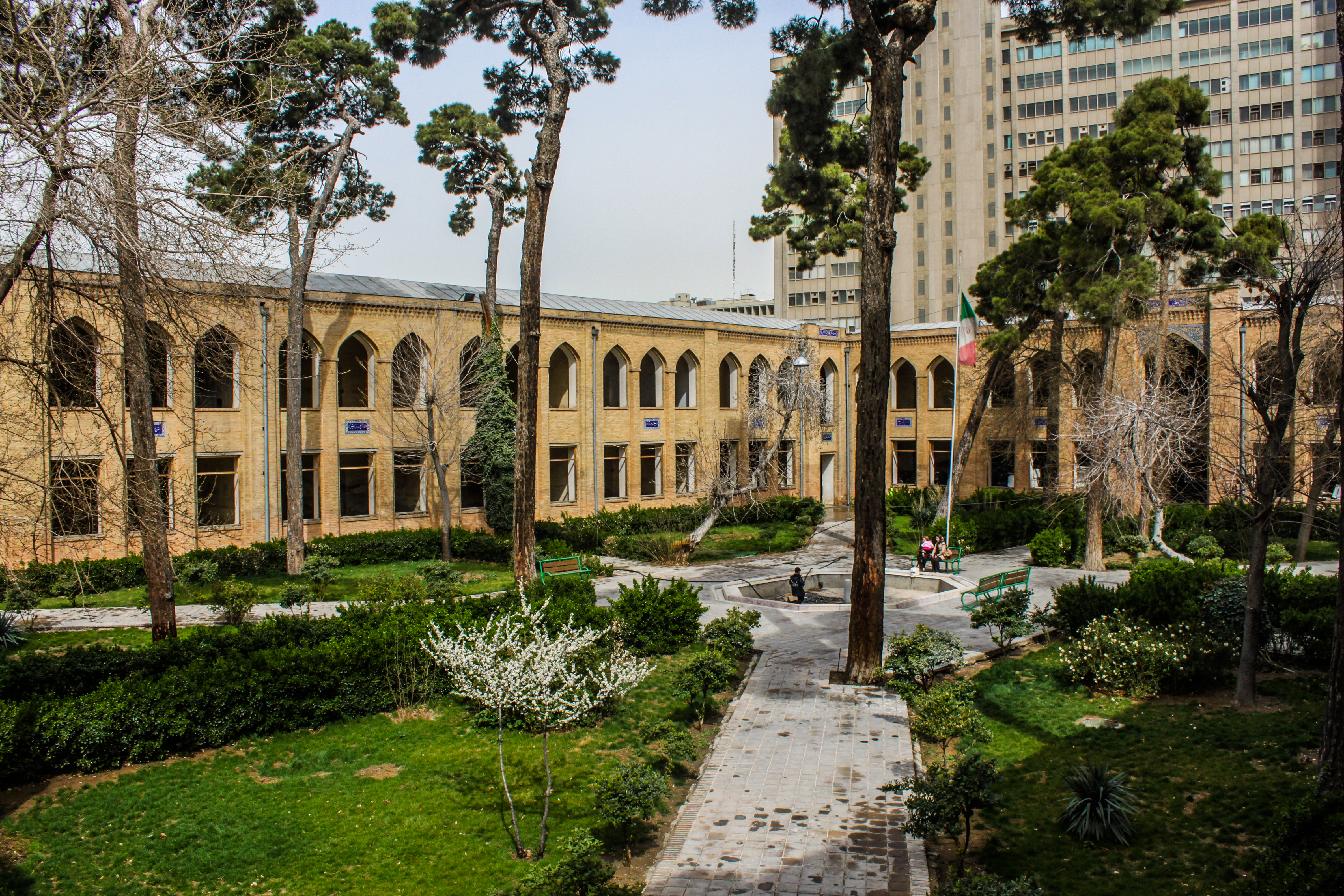
Dar al-Fonun
Amir Kabir, grand vizier to Nasereddin Shah, conceived a school that would drag Iran into the modern world. He envisioned a polytechnic where upper-class Iranian youth would study medicine, engineering, military science, and geology, something comparable in ambition to American land-grant colleges like Purdue or Texas A&M. He did not live to see it flourish. Amir Kabir was dismissed from his position and executed in 1852, one year after Dar al-Fonun opened its doors in 1851. The school outlived its founder by more than a century, its departments and legacy feeding directly into the University of Tehran, founded in 1934.
Blueprints for a New Iran
The institute was planned by Mirza Reza Mohandes and built by the architect Mohammad-Taqi Khan Memar-Bashi under the supervision of the Qajar prince Bahram Mirza. The campus included an assembly hall, a theater, a library, a cafeteria, and a publishing house. European instructors were recruited to staff departments that had no precedent in Iran. Dr. Jakob Eduard Polak taught medicine and pharmacy. Austrian and Italian officers taught artillery, mineralogy, and infantry tactics. Jules Richard taught French. Alfred Jean Baptiste Lemaire taught music. The faculty was a deliberate import: sixteen European professors alongside twenty-six Iranian ones by 1889.
The Students Who Became the State
Dar al-Fonun's graduates populated Iran's government for generations. Mirza Hossein Khan Moshir od-Dowleh Sepahsalar served as prime minister from 1871 to 1873. Mohammad-Hassan Khan Etemad os-Saltaneh became a leading politician and historian. Military graduates rose to command armies and navies. Admiral Gholam-Ali Bayandor, an alumnus, would die defending Iran during the 1941 Anglo-Soviet invasion. By 1889, the school was training 287 students. By 1891, it had graduated 1,100. These numbers seem modest, but in a country that had no comparable institution, each graduate represented a node in a network of modernization.
Demolition and Rebirth
In 1930, Mirza Yahya Khan Qaragozlu, the minister of education, ordered the original building destroyed. A new structure rose in its place, designed according to Russian engineering principles. The demolition erased Amir Kabir's physical creation, but the institution's legacy had already propagated beyond any single building. The Faculty of Medicine, established as part of Dar al-Fonun in 1851, evolved into the School of Medicine in 1919 and was eventually absorbed into the University of Tehran. Other departments followed the same trajectory: birth within Dar al-Fonun, growth into independence, and absorption into the modern university system.
A Vizier's Unfinished Vision
Amir Kabir's story haunts the institution he created. He was a reformer in a court suspicious of reform, a man who built modern infrastructure while surrounded by rivals plotting his removal. His execution, carried out in a bathhouse in Kashan, came just months after Dar al-Fonun admitted its first students. The grand vizier never saw his school graduate a single class. Yet the school's influence proved impossible to reverse. Iran's first feature film was directed by Ovanes Ohanian, an Armenian-Iranian filmmaker who built his career in Tehran during the era Dar al-Fonun's graduates were reshaping the country. The first generation of Iranian diplomats, physicians, and generals trained within its walls. Amir Kabir built something stronger than himself.
From the Air
Dar al-Fonun is located at 35.684N, 51.422E in central Tehran, near the Golestan Palace complex and within the historic core of the city. The site is close to the University of Tehran's modern campus. Mehrabad International Airport (OIII) is approximately 8 km to the west. From the air, the area falls within Tehran's dense central urban grid. Best viewed at 3,000-5,000 feet AGL in context with the surrounding governmental and educational district.