Darra Adam Khel
Somewhere between Peshawar and Kohat, in the rugged foothills of Khyber Pakhtunkhwa, a single unpaved street runs through a town that makes one product and one product only: guns. Darra Adam Khel has been manufacturing firearms since 1897, when the Adam Khel Afridi tribesmen first turned metalworking skills into an arms trade. Walk down the main bazaar today and you will find shops stacked floor to ceiling with replicas of every weapon imaginable -- AK-47s, Mauser pistols, shotguns disguised as walking sticks, and pen guns small enough to slip into a breast pocket. The crack of test-firing echoes off the hillsides all day long, as every weapon must prove itself before it changes hands.
The Craftsmen's Bazaar
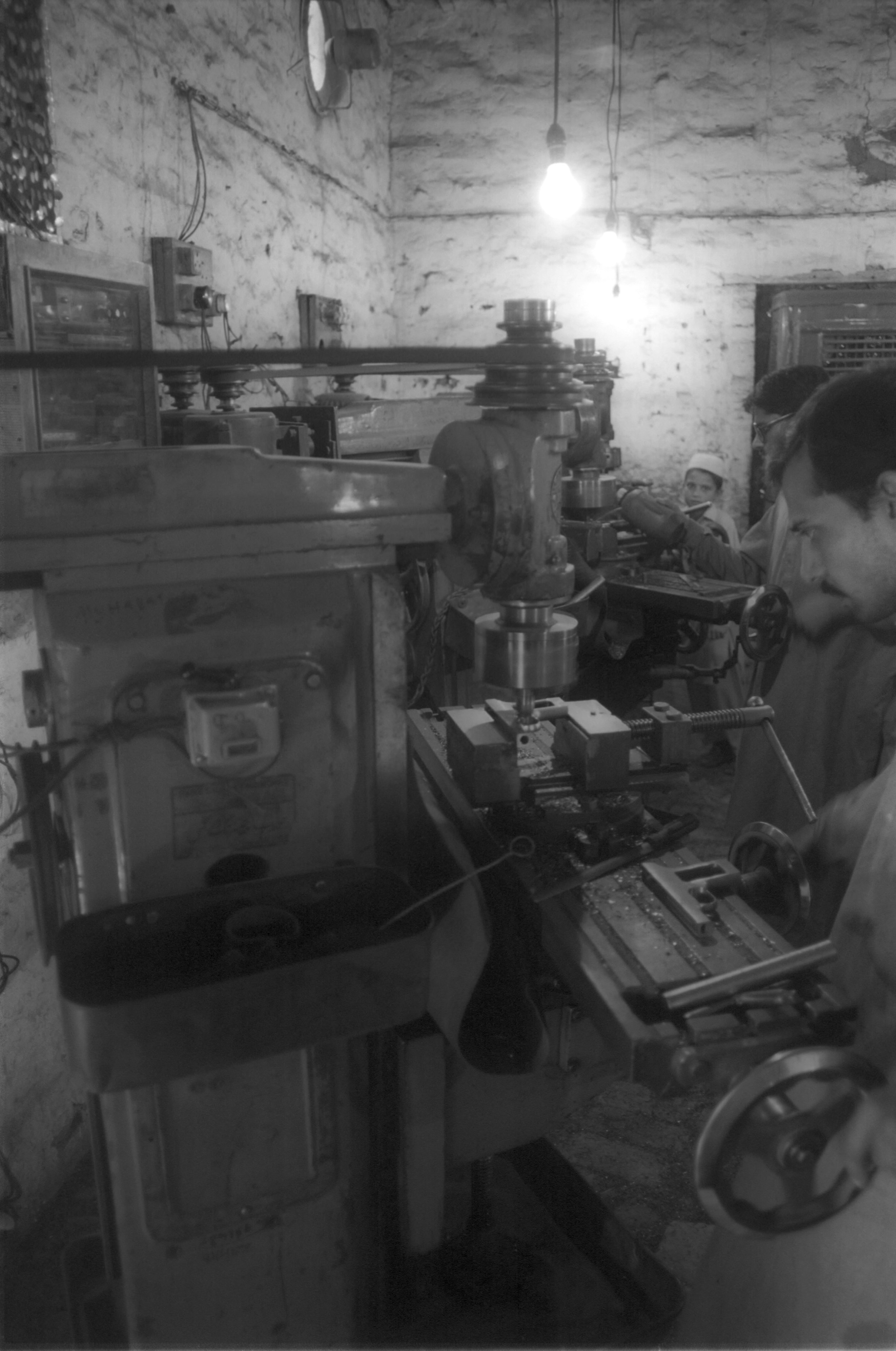
The town's layout tells you everything about its economy. One main street, lined with storefronts, feeds into a maze of narrow side-alleys where the actual work happens. In dim workshops, individual craftsmen shape receivers, file triggers, and bore barrels using hand tools and techniques inherited from their fathers. There are no assembly lines here, no industrial machinery -- a single gunsmith may spend days fashioning one weapon by hand, replicating designs from around the world with nothing more than a sample to study and generations of accumulated skill. The range of production spans the absurd to the lethal: tiny pen guns that fire a single .22 caliber round sit in display cases alongside functional copies of anti-aircraft guns. Heavy ammunition manufacturing has been shut down by authorities, but the small arms trade persists, governed by local tribal laws that operate outside the norms of the rest of Pakistan.
A World Apart
Darra operates under its own rules. Formerly part of the Frontier Region Kohat -- a semi-autonomous tribal territory -- the town exists in a legal gray zone where Pakistani federal authority has historically been light. Tribal police known as Khasadar patrol the bazaar, enforcing local codes rather than national statutes. Foreigners who arrive without permits are not arrested but escorted to secure locations, a pragmatic acknowledgment that the town's business does not welcome outside scrutiny. According to Vice News, the Taliban's growing influence in the region pushed much of the gun trade underground, forcing dealers to operate more discreetly than the open-air bazaar of decades past. The transport industry ranks as the town's second-largest business -- trucks carrying goods in and out of this isolated market keep the economy turning when the arms trade contracts.
Through the Outsider's Lens
Despite -- or because of -- its reputation, Darra Adam Khel has drawn a steady trickle of adventurous journalists, filmmakers, and travel writers. Michael Palin passed through while filming his Himalaya television series, capturing the surreal normality of a town where test-firing a Kalashnikov is as routine as haggling over vegetables. Ethan Casey wrote about the experience in his travel book Alive and Well in Pakistan. Australian director Benjamin Gilmour went further, setting his 2007 feature film Son of a Lion entirely in Darra -- it premiered at the Berlin International Film Festival in 2008. In 2006, Vice Media's Suroosh Alvi walked through the market with cameras rolling, producing footage that introduced the town to a global internet audience. Each visitor returned with the same sense of disbelief: a place that functions as an open-air arms factory, operating in plain sight, governed by its own ancient codes.
Legacy in Steel and Powder
The Adam Khel Afridi tribe has inhabited these hills for centuries, and their gunsmithing tradition reflects a broader Pashtun culture where weapons are both tools and symbols of autonomy. The trade that began in 1897 -- during the era of British colonial campaigns along the Northwest Frontier -- was born of practical necessity: tribesmen needed arms, and the passes between Peshawar and Kohat provided the geography for a discreet market. More than a century later, the craft endures even as the world around it transforms. Nearby cities modernize, highways extend toward the tribal areas, and government authority gradually tightens. But the workshops of Darra Adam Khel continue to hammer, file, and test-fire, their rhythms unchanged, their artisans passing down a trade that predates the country they live in.
From the Air
Located at 33.68N, 71.52E on the Potohar Plateau between Peshawar and Kohat in Khyber Pakhtunkhwa, Pakistan. The town sits in a narrow valley visible from above as a linear settlement along a single road. Nearest major airport is Peshawar (OPPS), approximately 35 km to the northwest. Kohat airfield lies closer to the southeast. Best viewed at 5,000-8,000 feet AGL. The surrounding terrain is rugged, semi-arid hills typical of the tribal frontier region.