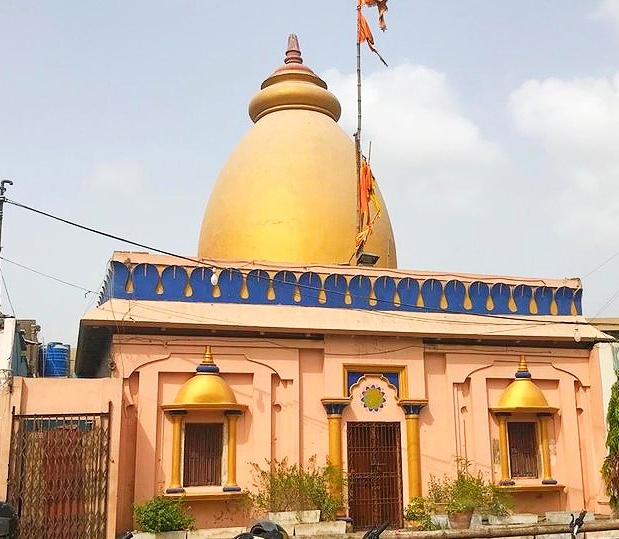
Darya Lal Mandir
Forty blue snakes coil across the top of a limestone cube in the middle of Karachi. The building is exactly 40 feet wide, 40 feet long, and 40 feet high -- a geometric precision that has survived roughly 300 years of monsoons, riots, and neglect. This is Darya Lal Mandir, a Hindu temple dedicated to Jhulelal, the river deity of Sindh, standing near Custom House in Saddar Town as though it had always been there and always will be. Given what it has endured, that confidence may be earned.
The River God's House
Darya Lal -- also known as Jhulelal -- is revered as an incarnation of Varuna Deva, the Vedic god of water and cosmic order. For the Sindhi Hindu community, Jhulelal represents both the physical power of the Indus River and a broader principle of interfaith harmony. The temple also hosts shrines to Lord Hanuman and Lord Ganesh. According to Goswami Vijay Maharaj, the temple's caretaker, Hanuman's presence traces to a mythological encounter: when Hanuman flew over the sea to Lanka to rescue Sita, Varuna Deva rose from the water on his makara to challenge the intruder. The two deities recognized each other's purpose, and since then devotees who worship Varuna also pay their respects to Hanuman.
Attacked, Abandoned, Enduring
The temple was attacked in 1965, during the India-Pakistan war, when Hindu sites across Pakistan became targets of communal rage. It was attacked again in 1992, in retaliation for the demolition of the Babri Masjid in Ayodhya, India -- an event that triggered anti-Hindu violence across the subcontinent. After the second attack, the temple fell into severe disrepair. Regular worshippers stopped coming. The limestone walls crumbled. The prayer area, a perfect 40-by-40-foot square, gathered dust. For more than two decades, the temple existed in a liminal state -- not destroyed, not functioning, just present.
Rebuilding with Borrowed Stone
In 2015, as part of the Eduljee Dinshaw Road urban renewal project, the Sindh provincial government funded a full renovation of Darya Lal Mandir. The work was careful: the dimensions of the temple were kept exactly intact, and the new facade was sourced from India to match the original aesthetic. The 40 blue snakes were repainted atop the structure. On December 13, 2015, Sindh Governor Ishratul Ibad inaugurated the restored temple. The renovation was more than cosmetic -- it signaled that Karachi's Hindu heritage, however diminished, was worth preserving. In a city where Hindu temples have declined from dozens to a handful, where the Hindu Gymkhana has shrunk, Darya Lal Mandir stands as both a place of worship and a monument to the idea that a city's identity includes all of its communities.
From the Air
Located at 24.849°N, 66.991°E in Saddar Town, central Karachi, near Custom House. Not individually visible from altitude -- it is a small structure within dense urban fabric. Jinnah International Airport (OPKC) is approximately 12 km north. The temple is near Karachi's historic downtown core along Eduljee Dinshaw Road.