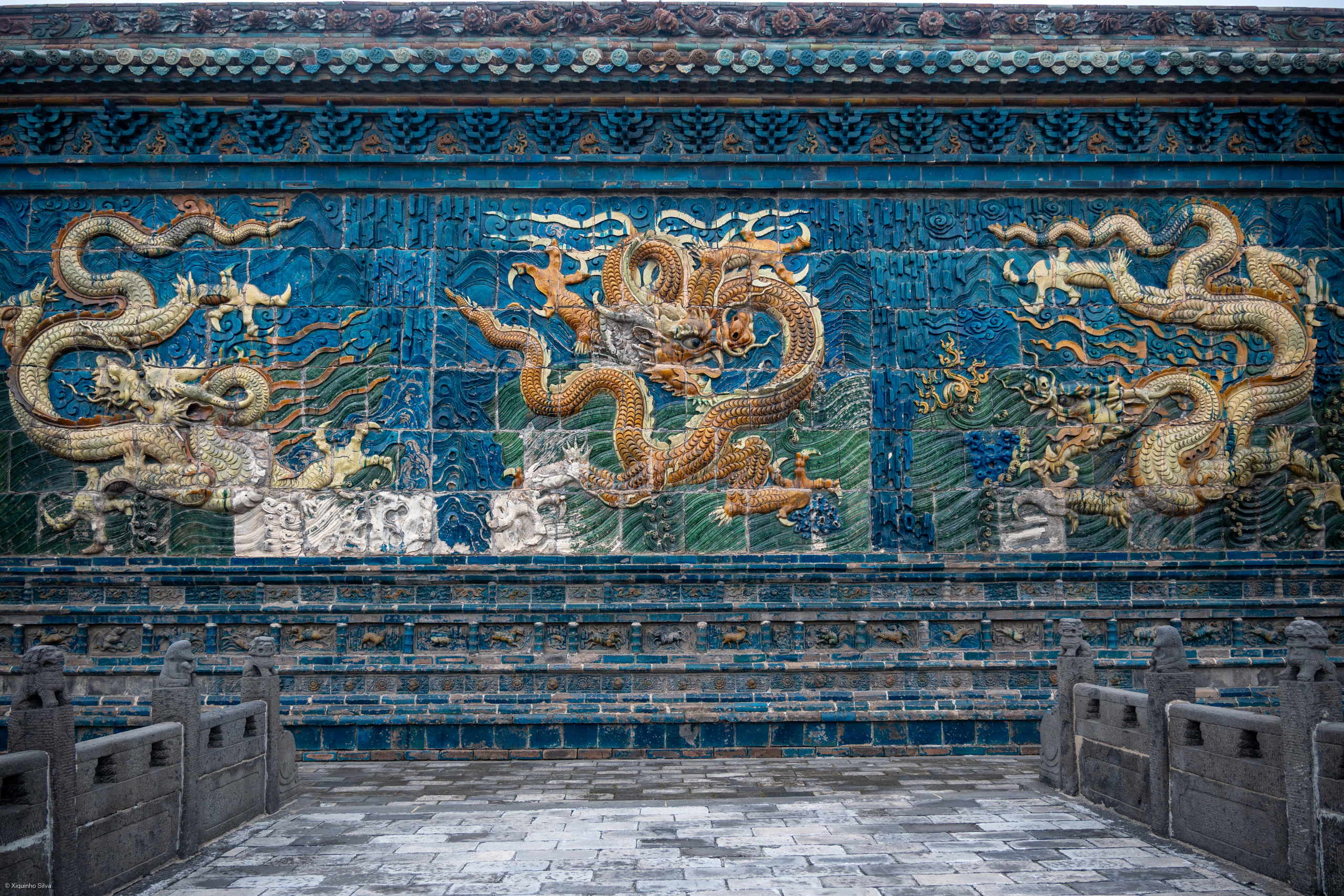
Datong Prince's Palace
Twenty-five years before the Forbidden City rose in Beijing, a palace of similar design took shape in Datong. In 1392, the Hongwu Emperor ordered construction of the Residence of Prince Dai for his thirteenth son, Zhu Gui, who had been reassigned from Nanchang to guard the empire's volatile northern frontier along the Great Wall. The palace was not merely a royal dwelling -- it was a statement that the Ming dynasty's reach extended to the very edge of the steppe.
The Emperor's Thirteenth Son
Zhu Gui received his appointment as Prince of Dai in 1391, part of the Hongwu Emperor's deliberate strategy of installing imperial kinsmen as military governors along China's borders. Datong was no arbitrary posting. The city, known historically as Pingcheng, had served as a capital under the Northern Wei dynasty and as a secondary capital under the Liao and Jin. It sat directly astride the approaches from the Mongolian steppe, making it one of the most strategically important cities in the empire. Construction of the princely palace began on the site of a former imperial academy from the Liao and Jin periods, and work was largely completed by 1396. Over the next two and a half centuries, eleven successive Princes of Dai would call it home.
The Nine Dragons That Survived
The original palace complex was largely destroyed during the upheavals of the mid-17th century, when the Ming dynasty collapsed and Manchu armies swept through northern China. But one element survived intact: a monumental Nine-Dragon Screen, a glazed ceramic wall depicting nine writhing dragons in vivid relief. These screens were symbols of imperial authority, and the Datong example is one of the oldest and largest in China. The screen's survival through centuries of warfare, political upheaval, and neglect is itself a small miracle, and today it anchors the historical significance of the site even as the surrounding palace has been entirely rebuilt.
Rebuilding a Frontier Past
In the 21st century, Datong undertook an ambitious reconstruction of the entire palace compound as part of a broader effort to restore the old city. The project generated both admiration and controversy -- admirers praised the return of Ming architectural grandeur, while critics questioned the authenticity and purpose of rebuilding structures that had been ruins for 350 years. The reconstructed palace now functions as a cultural venue, hosting exhibitions, performances, and festivals that present Datong's history as a frontier city. Guided tours combine the palace with visits to the Nine-Dragon Screen and the nearby restored city wall, creating a circuit through layers of real and reconstructed history.
A Palace at the Edge of Empire
From the air, Datong's restored old city is a striking geometric composition -- the rectangle of the city wall enclosing a grid of streets centered on the palace compound. The scale is deliberate: the Hongwu Emperor intended these frontier palaces to project imperial power at the margins of his territory, where the population might otherwise feel distant from Beijing's authority. That the palace predates the Forbidden City by a quarter century adds a layer of irony -- the template for imperial architecture was tested here at the frontier before it was perfected in the capital. The Nine-Dragon Screen, original and weathered, stands amid the fresh reconstruction as proof that some things survive not by design but by the stubbornness of good craftsmanship.
From the Air
Located at 40.10°N, 113.30°E within the walled old city of Datong, Shanxi Province. The reconstructed palace compound is visible from altitude as a large formal complex within the rectangular city walls. Nearest airport is Datong Yungang Airport (ZBDT). The city wall perimeter and grid street pattern make Datong's old city distinctive from the air.