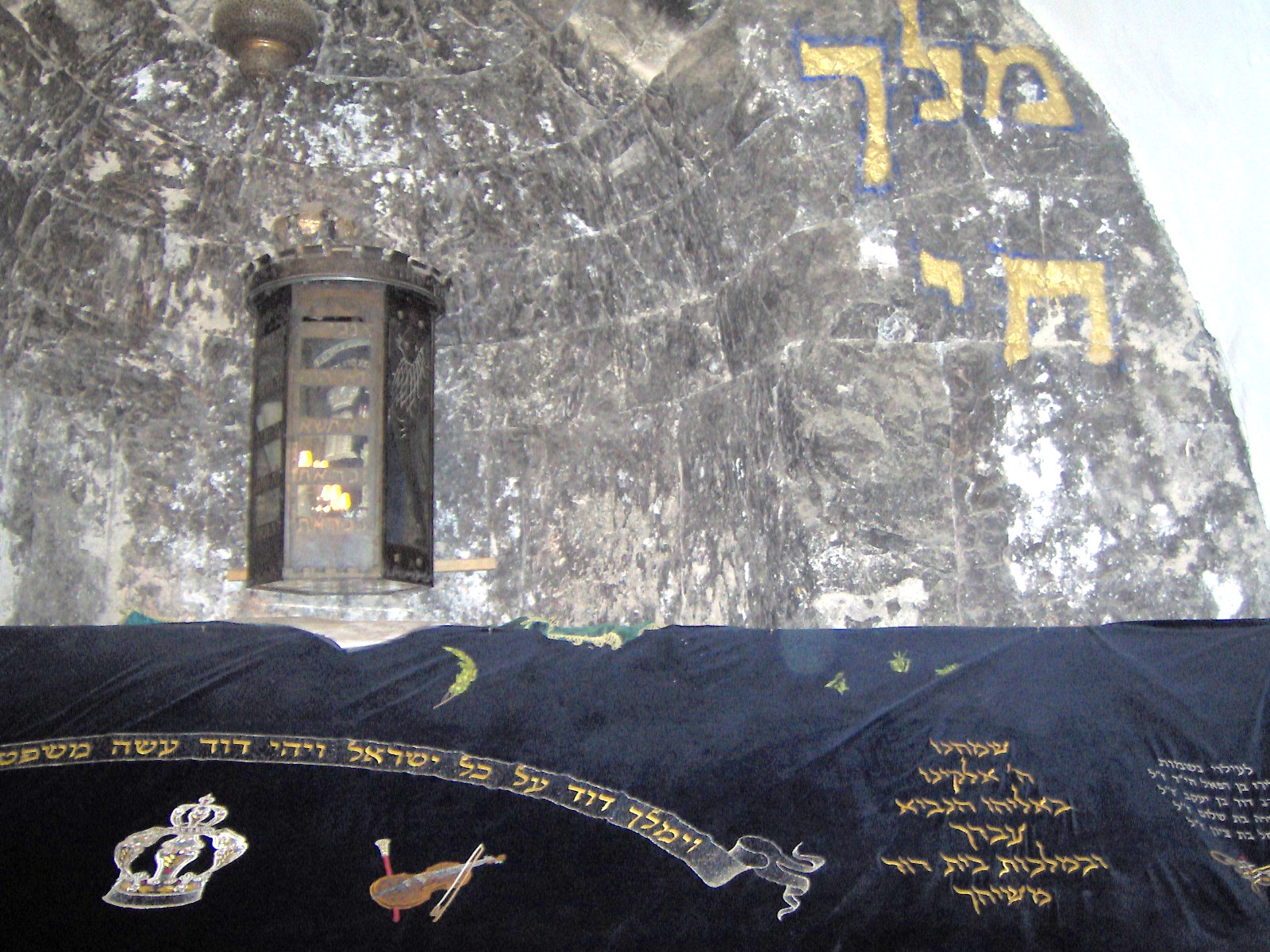
David's Tomb
The tomb is almost certainly empty -- or rather, it almost certainly does not contain King David. Scholars agree on this point with unusual unanimity. The biblical king was buried in the City of David, the original Jebusite settlement southeast of the current Old City walls, together with his forefathers, as the Books of Kings record. Yet for nearly a thousand years, pilgrims of three faiths have climbed Mount Zion to pray at a stone cenotaph draped in velvet and embroidered cloth, venerating a tradition that everyone acknowledges began somewhere else and migrated here through a process no one can fully explain.
The Cenotaph on Mount Zion
The structure known as David's Tomb occupies the ground floor of a building on Mount Zion, just outside the Old City's Zion Gate. Above it sits the Cenacle, or Upper Room, traditionally identified as the site of the Last Supper. The cenotaph itself is a large stone sarcophagus covered with a velvet cloth, positioned in a vaulted room with a niche in the original foundation walls. Archaeologist Jacob Pinkerfeld, who worked on the lower parts of the structure in 1951, suggested it might originally have been a second-century Roman-era synagogue, later converted into a church by Judeo-Christians. The niche, which some interpreted as a Torah niche, was disputed by scholars who noted it was too large -- roughly eight by eight feet -- for that purpose. The building's layers reflect the building's history: Jewish, Christian, Muslim, and back again, each community adding its own interpretation to a structure whose original purpose remains uncertain.
How a Tradition Migrated
According to the Book of Samuel, Mount Zion was originally the name for the Jebusite fortress that David captured, which became the City of David -- a location southeast of the current Mount Zion. Toward the end of the First Temple period, as Jerusalem expanded westward, the name "Zion" began to drift. By the time of Josephus, writing just before the Roman destruction of the Second Temple, "Mount Zion" referred to the western hill. The tomb tradition followed the name. Professor Doron Bar has argued that the belief in David's burial on Mount Zion took root during the early Muslim period, was inherited by Christians, and only later adopted by Jews. Others trace the first literary reference to the tenth-century Vita Constantini. The Muslim traveller Mas'udi wrote in 943 of traditions placing David's tomb in the Aleppo region of Syria and in eastern Lebanon. By the twelfth century, the Jewish pilgrim Benjamin of Tudela was recounting stories of workmen accidentally discovering the tomb on Mount Zion, borrowing details from Josephus's account of Herod the Great attempting to rob the real burial site.
Sacred to Three Faiths
What makes David's Tomb remarkable is not its authenticity but its persistence as a shared sacred site. For Jews, David is the founder of the royal dynasty and the unifier of Israel; his tomb, wherever it is, carries deep theological weight. For Christians, the building's upper floor -- the Cenacle -- is associated with the Last Supper and Pentecost; the fourth-century writer Epiphanius described it as "the church of God, which was small, where the disciples went to the upper room" after the Ascension. For Muslims, David (Dawud) is a prophet; the Ottoman sultan Suleiman the Magnificent converted the site into a mosque in the sixteenth century, and Islamic tiles decorated the tomb chamber until their destruction in 2012. This convergence is not always peaceful. Between 1948 and 1967, when Jordan controlled the Old City and Jews could not access the Western Wall, David's Tomb became the closest accessible Jewish holy site, intensifying its significance and the emotions surrounding it.
Vandalism and Competing Claims
The site has been a flashpoint for the tensions inherent in shared sacred space. In December 2012, unknown persons destroyed a large number of seventeenth-century Islamic tiles in the tomb chamber; the Israel Antiquities Authority decided not to reconstruct them. A statue of King David, installed near the compound in 2008 by a Russian charitable foundation, was vandalized repeatedly before being dismantled in 2018 -- its placement in the Old City area had been negatively received by much of the ultra-Orthodox Jewish community. Greek Orthodox Pentecost prayers at the site have angered Jewish activists, while Jewish prayer at the compound has drawn objections from Muslim authorities. Each act of worship or restoration by one community risks being perceived as encroachment by another. The site is small, the claims are large, and the architecture that contains them was never designed for the weight it now bears.
The Power of an Empty Tomb
Beneath the arguments over tiles and statues and access hours lies a deeper question: why does a tomb that almost everyone agrees does not contain its namesake continue to matter? The answer may lie in what sacred sites actually do. They are not simply markers for historical events; they are places where communities concentrate their identities, anchor their memories, and perform their belonging. King David may have been buried in the City of David three thousand years ago, but the city has been destroyed and rebuilt so many times that the original burial site is unreachable. Mount Zion offers what the original location cannot: a physical space where tradition can be enacted. The cenotaph beneath its velvet cloth is not a fraud -- it is a substitute, and substitution has a long and honest history in religious practice. Pilgrims come not because they believe the bones of David are here, but because generations of other pilgrims came before them, and the accumulation of devotion has given this place a gravity of its own.
From the Air
Located at 31.772N, 35.229E on Mount Zion, just outside the Zion Gate of Jerusalem's Old City. The building is not individually distinguishable from altitude but sits in the cluster of structures on Mount Zion's summit, identifiable by the nearby Dormition Abbey with its distinctive conical dome and bell tower. Best viewed from 3,000-5,000 feet AGL as part of the broader Jerusalem Old City panorama. Note: Extremely sensitive airspace over Jerusalem. Nearest airports: LLJR (Jerusalem/Atarot, currently closed), LLBG (Ben Gurion International) approximately 30 nm west-northwest.