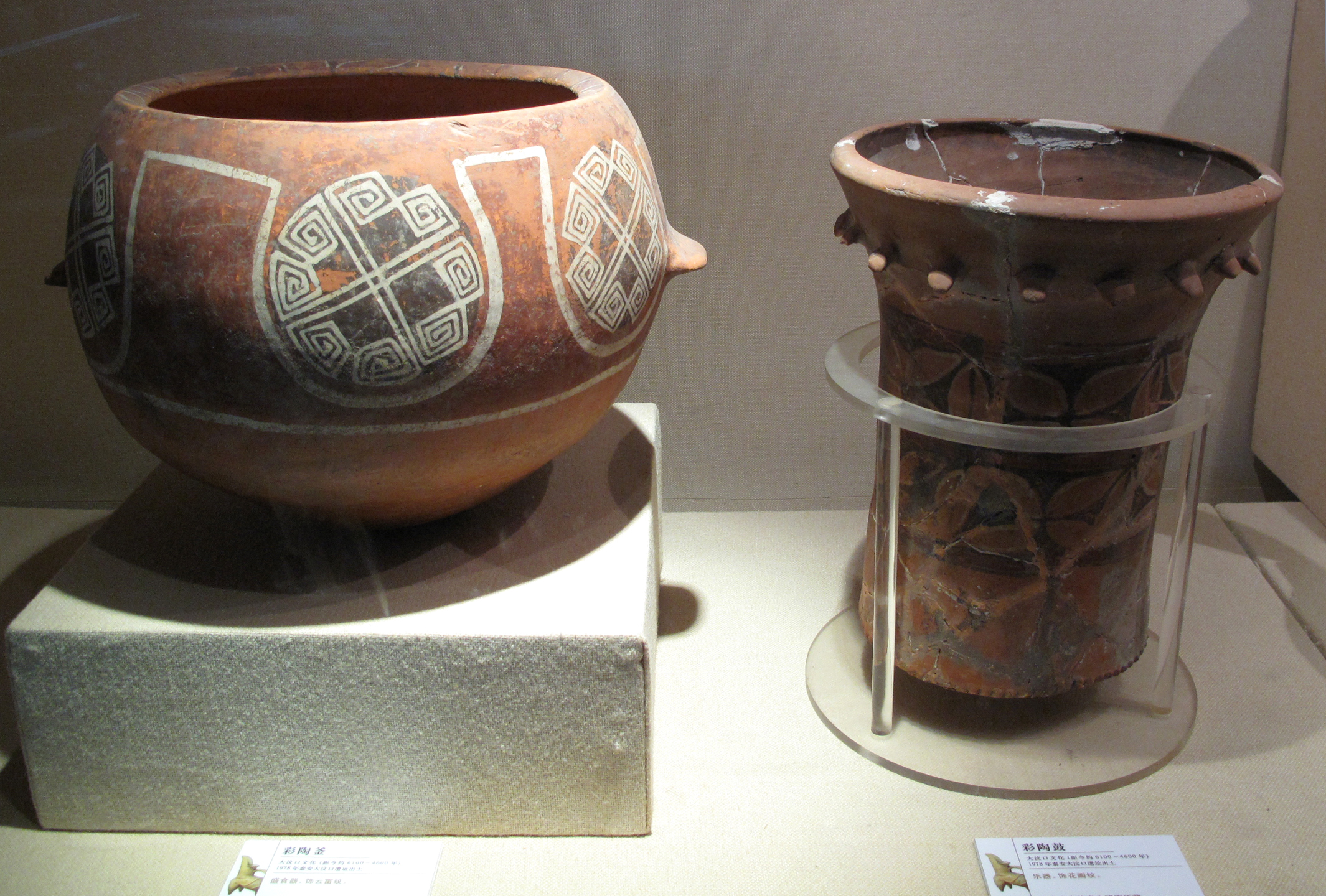
Dawenkou Culture
Five thousand years before the first Chinese dynasty, someone in what is now Shandong Province drilled a hole in another person's skull -- and that person survived. The evidence comes from a Dawenkou burial site dating to around 3000 BC, one of the earliest examples of trepanation in prehistoric China. The Dawenkou people, who thrived across eastern China from roughly 4300 to 2600 BC, were not gentle farmers peacefully tending millet. They were a complex, stratified, occasionally violent civilization that made drums from alligator hides, carved mysterious signs on their pottery, and deliberately reshaped their own skulls and teeth.
From Equality to Hierarchy
Archaeologists divide the Dawenkou into three phases, and the story they tell is one of increasing inequality. During the early phase, from roughly 4100 to 3500 BC, graves contain individually designed long-stemmed cups and modest offerings distributed with relative equality. By the middle phase, grave goods began emphasizing quantity over diversity -- some burials grew richer while others grew plainer. By the late phase, from 3000 to 2600 BC, wooden coffins appeared in some graves while others contained nothing at all. The type site at Dawenkou, near Tai'an in Shandong, was excavated in 1959, 1974, and 1978. Only the middle layer corresponds to the Dawenkou culture proper; the earliest belongs to the ancestral Beixin culture, and the latest to the Longshan culture that followed.
Millet for the Many, Rice for the Elite
The Dawenkou farmed millet at most sites, and they were good at it -- storage containers capable of holding up to 2,000 kilograms of grain have been found, accounting for decomposition. But at southern Dawenkou sites, particularly during the late period, rice became increasingly important. Analysis of human remains revealed a telling dietary split: upper-class individuals ate primarily rice, while ordinary people ate millet. The distinction was stark enough to leave chemical signatures in their bones. They domesticated chickens, dogs, pigs, and cattle, though pig remains account for about 85 percent of all animal bones found. Pigs were buried alongside humans, underscoring their economic and possibly spiritual importance. Seafood -- fish and various shellfish -- supplemented the diet, especially in the early periods when shell mounds accumulated near settlements.
Marks on Clay That Might Be Writing
Among the most tantalizing Dawenkou artifacts are the Neolithic signs scratched and painted onto pottery. Scholars have debated for decades whether these marks are decorative, symbolic, or genuinely ancestral to the scripts of the Shang dynasty. The connection remains unproven but provocative -- if confirmed, it would push the origins of Chinese writing back by millennia. What is certain is that the Dawenkou produced exquisite objects: turquoise and jade ornaments, ivory combs with openwork designs, painted bowls with star motifs, and the earliest known alligator-hide drums in China. The people themselves practiced dental ablation -- the deliberate removal of teeth -- and cranial deformation, reshaping the skulls of the living. Both practices disappeared from China by the Bronze Age, leaving the Dawenkou as a cultural endpoint as much as a starting point.
A Culture Between Two Worlds
The Dawenkou did not exist in isolation. For two and a half millennia, they engaged in dynamic interchange with the Yangshao culture to their west, sometimes leading the interaction and ultimately playing a key role in generating the Longshan culture that succeeded both. Some scholars have noted similarities between the Dawenkou and modern Austronesian peoples in practices like dental avulsion and certain architectural forms, though genetic evidence suggests the Dawenkou were distinct from pre-Austronesian cultures to their south. Power in Dawenkou villages was likely held by dominant kin groups exercising authority through religion rather than coercion. But unlike their Beixin ancestors, the Dawenkou were violent. Scholars suspect they raided for land, crops, livestock, and prestige goods -- a pattern that would define Chinese civilization for millennia to come.
From the Air
Located at 37.00N, 119.00E in western Shandong Province, near Tai'an. The type site at Dawenkou sits in the flat agricultural plain south of the Yellow River. Nearest major airport: Jinan Yaoqiang International (ZSJN) approximately 80 km northwest. Mount Tai (ZSTN area) is a prominent visual landmark nearby. Best viewed at lower altitudes for context of the archaeological landscape within the agricultural plain.