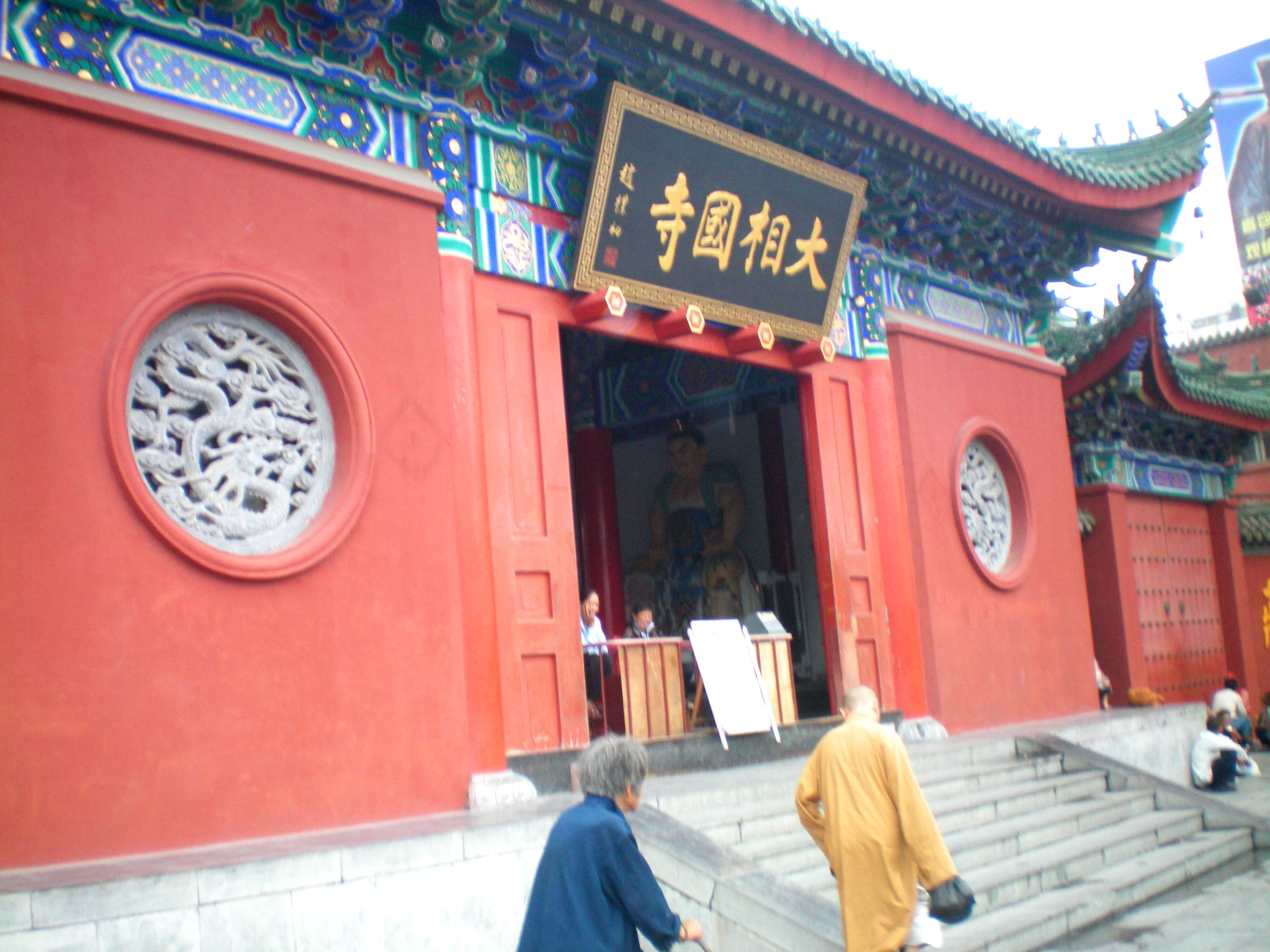
Daxiangguo Temple
On winter mornings in Kaifeng, when fog rolls off the lakes and the city's noise has not yet risen, a five-ton bronze bell rings from the tower of Daxiangguo Temple. The sound carries across the old imperial quarter, echoing off buildings that stand where Song dynasty emperors once held court. Locals call the phenomenon "Xiangguo Frosty Bells" -- one of the famous eight sights of Bianliang, Kaifeng's ancient name. The bell was cast in 1748, but the temple it belongs to is nearly twelve hundred years older than that.
From Warring States Nobleman to Royal Temple
The temple's origins reach back to 555 AD, when it was built during the Northern Qi period on land that once belonged to Lord Xinling, one of the celebrated "Four Gentlemen" of the Warring States era. Initially called Xiangguo Temple, it was renamed Daxiangguo in 712 AD to honor Emperor Ruizong of Tang, who had held the title of King of Xiang before ascending the throne. But the temple reached its zenith under the Song dynasty, when Kaifeng served as the imperial capital. Emperors patronized its reconstruction into a vast complex covering roughly 360,000 square meters, with 64 departments of Chan Buddhism overseen by several thousand monks. It became one of the largest Buddhist temples in all of China -- and something more: a cultural crossroads where poets, musicians, and citizens gathered, and where foreign monks came to study alongside Chinese scholars.
Drowned and Rebuilt
The Yellow River has shaped Kaifeng's history as much as any emperor. In the late Ming dynasty, catastrophic flooding destroyed the temple along with much of the city. What stands today is largely a Qing dynasty reconstruction, built over the ruins of its predecessors. The main hall -- the Daxiongbao Dian -- dates to 1661 and enshrines three Buddhas flanked by the Eighteen Arhats. Behind them, a large sculpture of the Bodhisattva Guanyin depicts the pilgrimage narrative from the Avatamsaka Sutra. Ten stone lions guard the entrance, weathered sentinels from a dynasty that itself has passed into history. The rebuilding was faithful enough to preserve the temple's essential character, even as the floodwaters erased many of the specific structures that had made it famous.
Halls of Eight Angles
The temple's most architecturally distinctive building is the Luohan Dian -- the Hall of Arhats -- an octagonal structure roofed in colored glaze. Inside, five hundred Buddhist arhat statues line both sides of the building, each figure individually carved, while a wooden statue of Guanyin presides from the center. The Tianwang Dian, or Hall of the Heavenly Kings, greets visitors through three red doors beneath golden glazed tiles. At its center sits the smiling Maitreya Buddha on a lotus, flanked by the Four Heavenly Kings standing guard. These halls represent different periods of construction and reconstruction, yet together they create a coherent architectural experience -- a temple that feels both ancient and continuously renewed.
Still Ringing
Daxiangguo Temple remains an active place of worship and one of Kaifeng's most significant cultural sites. The annual Lantern Festival fills the temple grounds with elaborate lantern displays that draw crowds from across the region. But the temple's most persistent presence is its bell. Cast under the Qianlong Emperor, standing 2.23 meters tall, it continues the centuries-old tradition that gave the temple one of its most famous epithets. The sound of the bell in winter -- clear, resonant, carrying farther than it should through the cold air -- connects modern Kaifeng to a city that was once the cultural capital of the world. The temple has been destroyed and rebuilt, silenced and reopened, but the bells have never stopped ringing for long.
From the Air
Located at 34.79N, 114.35E in the center of Kaifeng city, Henan province. The temple complex is visible from low altitude amid the dense urban core, identifiable by its traditional rooflines and the surrounding park area. Nearest major airport is Zhengzhou Xinzheng International (ZHCC/CGO), approximately 75 km west. From altitude, Kaifeng's network of lakes and the walled old city area are visible landmarks.