Day of Infamy Speech
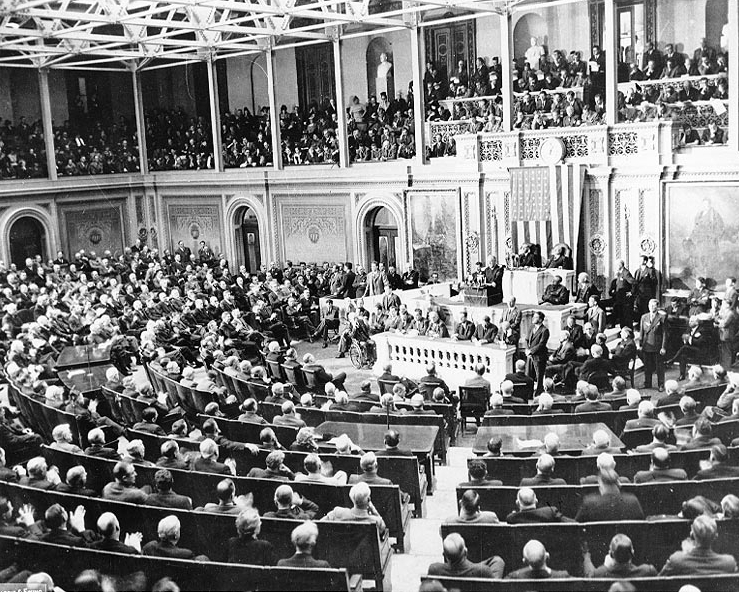
The initial draft read "a date which will live in world history." Roosevelt crossed it out and wrote "infamy" instead. That single editorial stroke, made the evening of December 7, 1941, transformed a serviceable phrase into one of the most recognized sentences in the English language. Delivered the next afternoon inside the chamber of the House of Representatives at the U.S. Capitol, Roosevelt's six-and-a-half-minute speech drew the largest radio audience in American history -- over 81 percent of adult listeners tuned in. Thirty-three minutes after he finished, Congress voted to declare war on Japan, with only one dissenting vote. A nation that had been bitterly divided over isolationism became, in the span of a single lunch hour, a nation at war.
The Sunday That Shattered Silence
At 7:48 a.m. Hawaii time on December 7, 1941, 353 Imperial Japanese Navy aircraft swept over Pearl Harbor in a surprise attack that destroyed 21 American ships and roughly 350 aircraft, killing more than 2,400 military personnel and civilians. Roosevelt learned the news shortly after 1:00 p.m. Eastern time while having lunch with advisor Harry Hopkins. Secretary of the Navy Frank Knox relayed a phoned message that would become its own piece of lore: "Air raid on Pearl Harbor. This is not drill." Roosevelt immediately ordered full military mobilization and convened his cabinet. British Prime Minister Winston Churchill, calling from the country estate Chequers, offered a characteristic summation: "We are all in the same boat now." Roosevelt decided he would address a joint session of Congress the following day.
Crafting the Words That Went to War
Secretary of State Cordell Hull urged Roosevelt to deliver a lengthy exposition of Japanese-American diplomatic relations. Roosevelt rejected the advice. He understood that brevity would carry more force than explanation. The speech was deliberately aimed at the gut rather than the intellect -- an appeal to patriotism, not the kind of idealistic vision Woodrow Wilson had offered when America entered World War I in 1917. Roosevelt even invited Wilson's widow, Edith Bolling Wilson, to accompany him to the joint session, drawing a symbolic thread between the two declarations of war. The opening was constructed in the passive voice -- "the United States of America was suddenly and deliberately attacked" -- to cast America as an innocent victim. Roosevelt then catalogued a rolling series of simultaneous Japanese attacks: Malaya, Hong Kong, Guam, the Philippines, Wake Island, Midway. The rhythm built like a drumbeat, each line beginning with "Last night" until the scope of the assault felt inescapable.
A Nation Answers in Thirty-Three Minutes
Roosevelt delivered the speech at 12:30 p.m. on December 8 to a chamber packed with legislators, cabinet members, and Supreme Court justices. Presidential adviser Samuel Rosenman called it "the most dramatic spectacle" ever witnessed in the House chamber. The cooperative spirit crossed party lines. When Roosevelt finished, Congress needed just thirty-three minutes to pass a declaration of war against Japan, with only Representative Jeannette Rankin of Montana voting no. The White House was flooded with telegrams. Recruiting stations went to 24-hour operations to handle crowds of volunteers reported to be twice the number that had appeared after Wilson's 1917 call to arms. Even Charles Lindbergh, the nation's most prominent isolationist, fell in line, declaring that America must build "the greatest and most efficient Army, Navy and Air Force in the world."
An Immortal Line, Often Misquoted
The speech's most famous phrase is routinely rendered as "a day that will live in infamy," but Roosevelt actually said "a date which will live in infamy," deliberately emphasizing December 7, 1941, as a fixed point in history rather than a generic day of the week. That distinction mattered to him: he wanted Americans to memorialize the specific date, not merely the shock. The phrase became a template for national trauma. November 22, 1963 -- the assassination of John F. Kennedy -- and September 11, 2001, both inherited the infamy framework. After the September 11 attacks, the Bush administration explicitly echoed Roosevelt's rhetoric, and scholars identified direct parallels between the two presidential addresses. Hollywood, too, adopted Roosevelt's narrative almost immediately; wartime films like Wake Island, Air Force, and Across the Pacific wove actual radio reports of pre-attack diplomacy into their plots, reinforcing the message of enemy deception that Roosevelt had so carefully constructed.
From the Air
Coordinates: 38.890N, 77.009W. The speech was delivered inside the U.S. Capitol building, which sits at the eastern end of the National Mall. The Capitol dome is one of the most recognizable landmarks from the air in the Washington, D.C., area. Nearby airports: KDCA (Ronald Reagan Washington National, 3 nm south), KADW (Joint Base Andrews, 10 nm southeast). Best viewed at 2,000-4,000 ft AGL. The entire National Mall corridor -- from the Capitol to the Lincoln Memorial -- is visible as a continuous green strip.