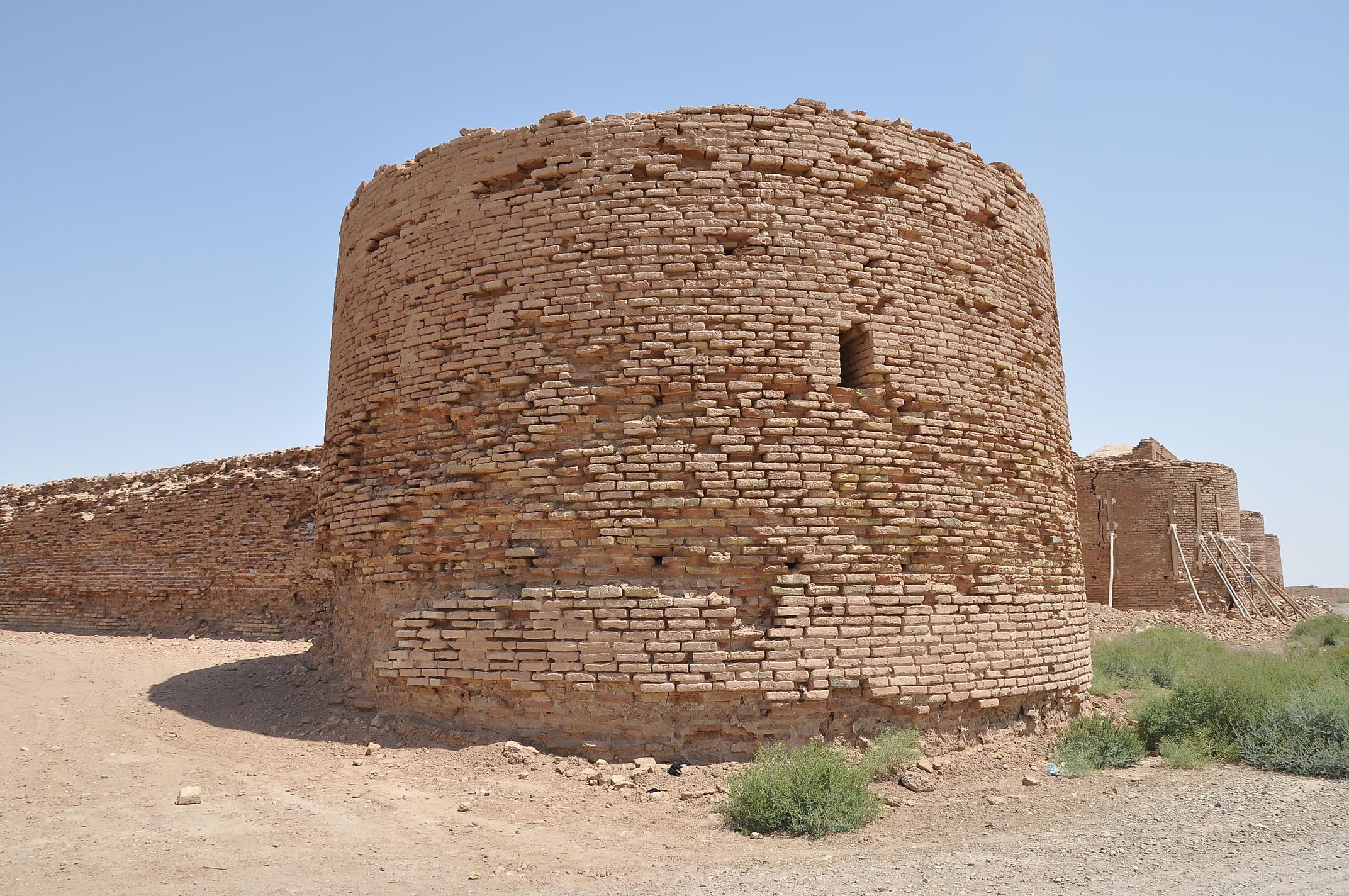
Dayr-e Gachin: The Mother of Iranian Caravanserais
Somewhere in the salt desert between Qom and Varamin, eighty kilometers from either city and thirty-five from anything resembling a town, an enormous rectangle of brick and plaster rises from the flat earth. Dayr-e Gachin has stood here since the Sasanian Empire, when Ardashir I ordered its construction in the 3rd century AD. The name translates roughly as "plaster dome," referring to a gach dome that once crowned the structure but has long since disappeared. Iranians call it the Mother of Caravanserais, and standing inside its 12,000-square-meter courtyard, surrounded by walls more than three meters thick, you begin to understand why. This was not merely a rest stop. It was a self-contained world, engineered to keep humans, animals, and cargo alive in one of the harshest landscapes on the Iranian Plateau.
A Palace for the Road-Weary
The caravanserai measures 109 by 108 meters and follows the classic Persian four-iwan design, with a vaulted hall facing each cardinal direction and 44 rooms arranged around a central courtyard. Every room has nine niches set into the walls a meter above the floor and a fireplace built into the wall opposite the entrance. The arched doorways are deliberately small, trapping heat inside during the freezing desert nights. No wood was used anywhere in the structure. Brick, lime, adobe, and plaster were the only materials available in this treeless expanse, and the builders made them sufficient. The northern iwan is the grandest, with a lobby and three chambers behind it. In the northeast corner, an octagonal courtyard marks the shabestan, the most aristocratic section, reserved for high-ranking travelers. Even in the desert, hierarchy traveled with the caravan.
Where Fire Temples Became Mosques
Construction is attributed to Ardashir I, founder of the Sasanian dynasty, though the historian Qomī credits Khosrow I (Anushiruwan) with rebuilding it. The truth likely splits the difference: Ardashir built the original, and Anushiruwan rebuilt it during his 6th-century reign. The mosque occupying the southern corner almost certainly sits on the foundations of a Sasanian fire temple. It has no decoration whatsoever, just four squat columns and a mihrab facing Mecca. The transition from Zoroastrian sanctuary to Islamic prayer hall happened quietly, one faith layering over another without erasing the architecture. The structure was restored again during the Seljuk, Safavid, and Qajar periods. Its current form dates primarily to the Safavid era, though the bones remain Sasanian.
Camels, Corridors, and Clever Engineering
Behind the guest rooms, long stable corridors run the length of the building, roofed and lit by skylights cut into the ceiling. The corridors are wide enough for two loaded camels to pass each other comfortably. The entrances from the courtyard to the stables are L-shaped, a deliberate design that prevented panicked animals from bolting straight out into the desert. Sixty-six small platforms line the stable walls, each equipped with its own fireplace, providing sleeping quarters for the caravan crew who bedded down alongside their animals. Holes punched through the walls between the room iwans served as tethering points, allowing travelers to tend their animals from outside their rooms before moving them into the stables. The building thought of everything: security towers at each corner lit torches at night to guide approaching caravans across the featureless desert.
An Oasis of Infrastructure
The caravanserai did not stand alone. Two ab anbars, traditional underground water reservoirs, sit behind the western wall near the bathhouse. A brick furnace, a dam, and a graveyard with brick-covered graves from the Islamic era surround the main structure. Five hundred meters to the east, a smaller brick-and-clay fort from the Qajar era once provided additional security, though most of it now lies in ruins. Together, these structures formed a complete desert outpost, supplying water, warmth, sanitation, spiritual comfort, and defense to travelers who might otherwise have perished between cities. Iran added Dayr-e Gachin to its National Heritage List on September 23, 2003, though the desert itself remains the structure's most effective preservationist, keeping visitors few and damage slow.
Alone in Kavir
Dayr-e Gachin sits at the center of Kavir National Park, one of Iran's oldest protected areas. The salt desert surrounding it stretches flat and pale in every direction, broken only by the occasional ridge of eroded earth. From the air, the caravanserai appears as a precise brown square dropped onto an infinite beige canvas. The isolation that made it necessary for travelers also makes it remarkable today. No modern road noise, no encroaching suburbs, no competing structures clutter the view. The walls still rise, the towers still stand at their corners, and the courtyard still holds its shape after nearly two millennia. The plaster dome that gave the place its name is gone, but the rest endures, a monument to the idea that even the emptiest landscapes deserve architecture.
From the Air
Located at 35.06N, 51.42E in the heart of Kavir National Park on the Iranian Plateau. The caravanserai appears as a distinct square structure in the otherwise featureless salt desert between Qom and Varamin. Nearest major airports: Tehran Imam Khomeini International (OIIE) approximately 60 km northwest, Tehran Mehrabad (OIII) approximately 80 km north. Best viewed at 2,000-4,000 feet AGL where the rectangular outline and corner towers are clearly visible against the pale desert floor. The isolation of the structure in the flat terrain makes it easy to spot from altitude.