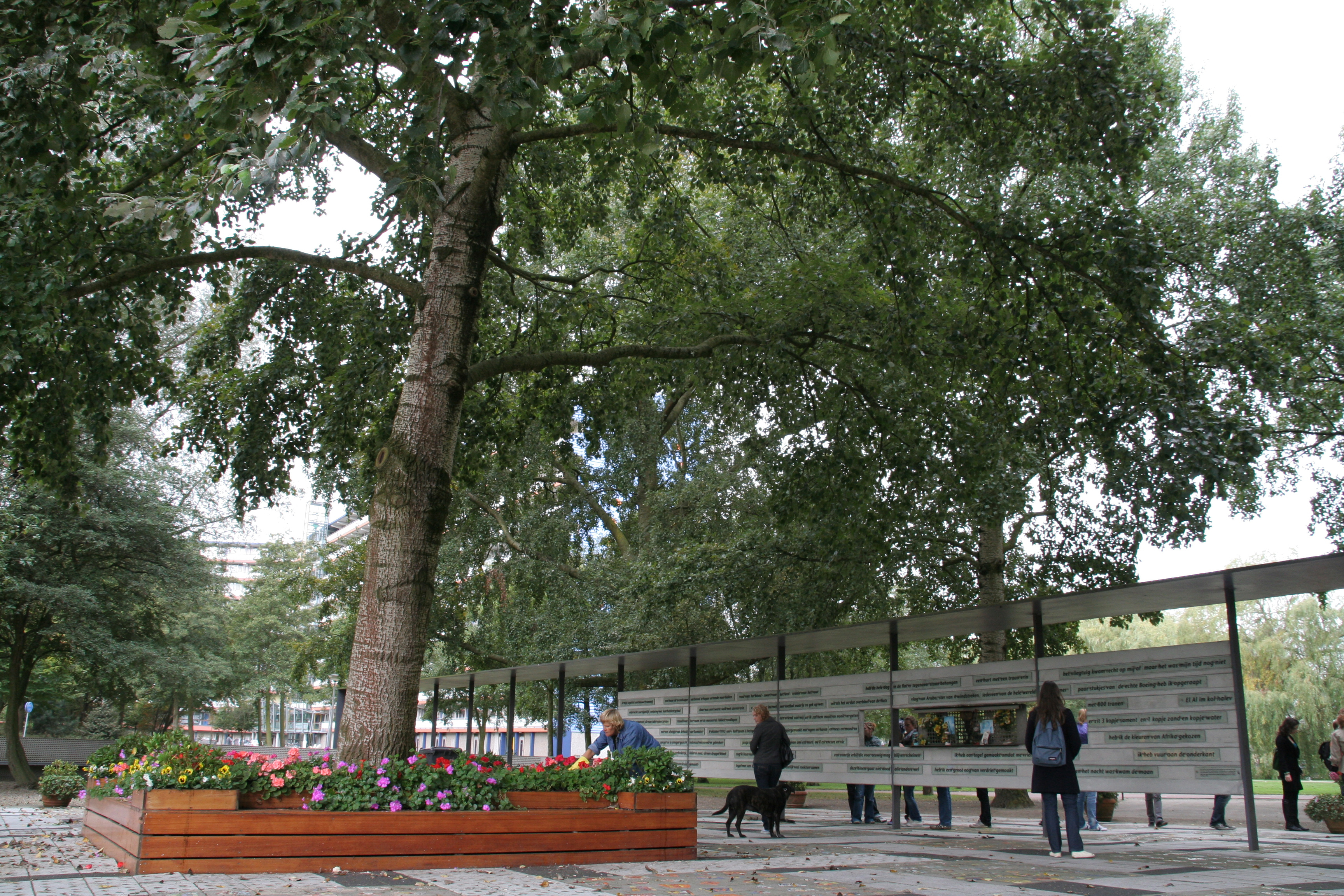
De Boom Die Alles Zag
Grey poplars carry dark almond-shaped marks on their bark, scars left where lower branches once grew and then dropped away. The Dutch have a name for the species - ogenboom, eye-tree - because if you stand close enough the trunk looks like it is watching you. On a footpath called the Nellesteinpad, in the southeast Amsterdam neighborhood of Bijlmermeer, one particular grey poplar stands a few meters from where two eleven-story apartment blocks used to be. The eyes on its trunk are pointed, more or less, toward the empty space.
Planted Into a Plan
The tree was put in the ground sometime in the late 1960s, in the early years of the Bijlmermeer experiment - the modernist superblock the Dutch government had built in the polder south of Amsterdam as a vision of utopian housing. The grey poplar was not chosen for any particular reason. It was a fast-growing utility tree planted along a walkway, one of thousands around the neighborhood. For almost a quarter century it was unremarkable. The flats it stood near, Groeneveen and Klein-Kruitberg, filled with families - many of them Surinamese, Ghanaian and Antillean residents who had moved in as Dutch middle-class tenants moved out. The tree was background. The neighborhood was a place where people lived.
Six Minutes
On 4 October 1992, an El Al cargo Boeing 747 took off from Schiphol at 6:21 in the evening, bound for Tel Aviv. About six minutes into the flight, two engines tore off the right wing. The damaged aircraft circled back toward the airport, struggling to maintain control, and at 6:35 it came down at an angle into the corner where Groeneveen met Klein-Kruitberg. Forty-seven people died, forty-three of them on the ground. Many of the residents in those blocks were undocumented immigrants whose names were not on any lease, so the true number has always been contested. The fire that followed melted aluminum into the soil. The grey poplar, ten meters away, lost some of its bark and most of its lower branches. It did not fall.
What Stayed in the Ground
In the months after the crash, much of the surrounding soil was excavated. The site had absorbed jet fuel, charred building material, and - according to investigations that took years to surface - undisclosed cargo that included depleted uranium counterweights from the aircraft's tail. A medical study by Amsterdam's Academic Medical Center later linked roughly a dozen cases of autoimmune disease among first responders and residents to chemical exposure at the site. During the soil cleanup the poplar's roots were partly cut away. The tree began to lean. Workers attached cables to two neighboring trees to hold it up. It should have been removed. It was not removed, because by then the residents had decided that this particular tree was going to stay.
The Tree That Saw
Almost immediately after the disaster, neighbors began leaving flowers and candles at the base of the poplar. The eye-shapes on its trunk meant something they had not meant before. In Dutch newspapers and in the small commemorations every 4 October, the tree became known as De Boom Die Alles Zag - the tree that saw it all. Sociologists who study urban memorials sometimes write about the difference between a monument and a witness, and the Bijlmer community had chosen the latter. The official Growing Monument - Het Groeiend Monument - was built around the tree rather than in place of it. A 2017 Dutch documentary on the disaster, made for the program Andere Tijden, took the tree's name as its title. In 2020 it was voted Tree of the Year for the province of North Holland. In 2022 the municipality named it the third most beautiful tree in Amsterdam.
Insurance for a Witness
The poplar is now in its sixth decade and not entirely well. A parasitic fungus has settled in the base of the trunk. Pulling tests at 265 kilonewtons in 2021 showed that its condition had improved since the sand under it was replaced with proper soil four years earlier, but the cables remained, loosened rather than removed. The neighborhood is not ready to take them off. In February 2021 the Municipality of Amsterdam quietly arranged a contingency plan: cuttings from the poplar were sent to a tree nursery in Glimmen, in Groningen province, to be grown for at least five years. If the original tree falls, its descendants will come back to the Nellesteinpad. The residents wanted to make sure that whatever happens, there will always be a tree on that spot with eyes on its trunk, watching the space where the buildings used to be.
From the Air
De Boom Die Alles Zag stands at approximately 52.319 N, 4.974 E, on the Nellesteinpad in the eastern Bijlmermeer neighborhood of Amsterdam-Zuidoost. From the air the location reads as the gap between the remaining honeycomb apartment slabs - the empty footprint where Groeneveen and Klein-Kruitberg once stood is still visible as an open green wedge. Amsterdam Schiphol (EHAM) lies 13 nautical miles west; the silver bowl of the Johan Cruyff Arena, less than a kilometer northwest, is the easiest visual reference. Low and slow over Zuidoost on a clear day, the memorial garden around the tree is identifiable by its small circular plaza.