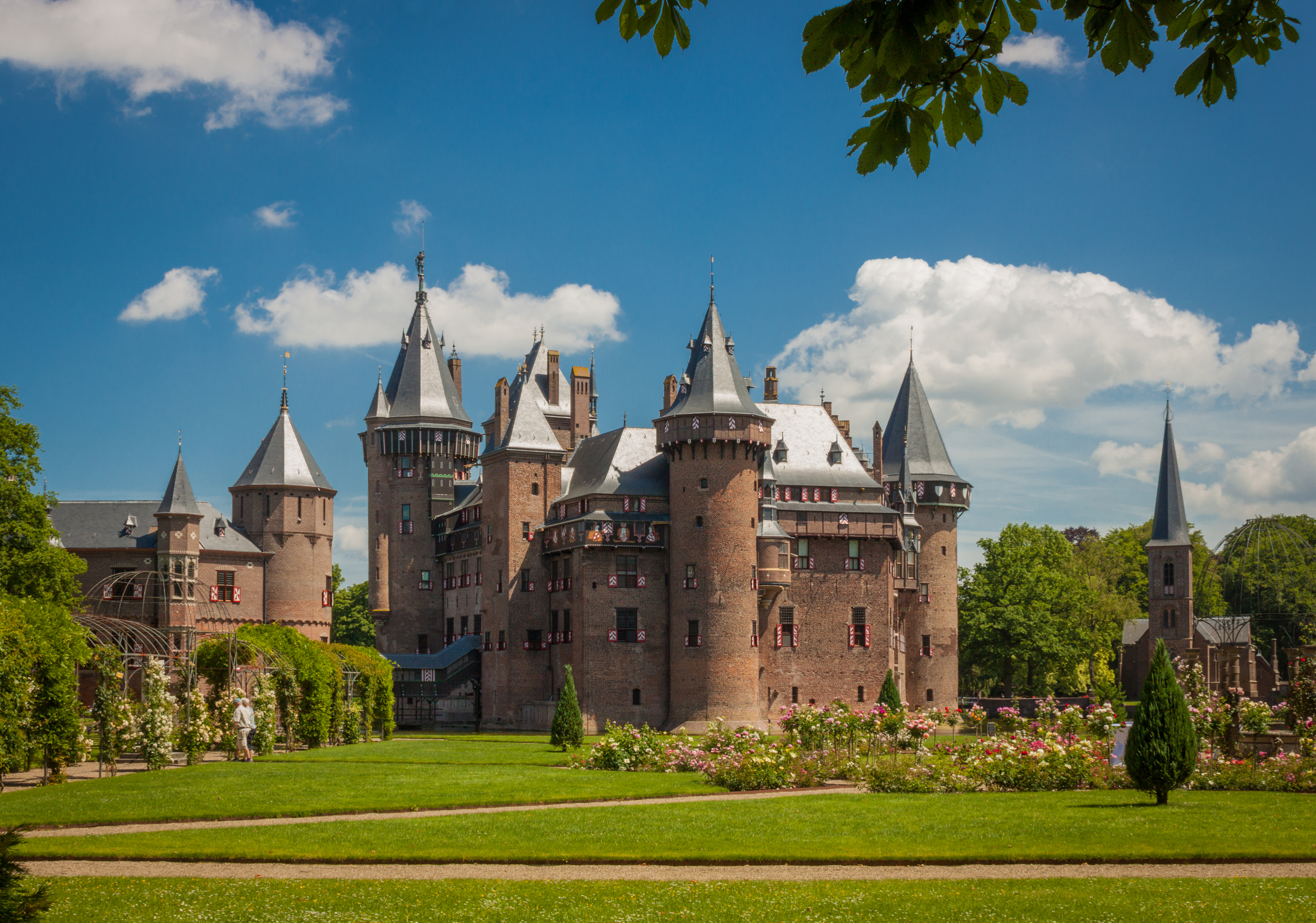
De Haar Castle
Helene de Rothschild brought a fortune to her marriage. Her new husband, Etienne van Zuylen, brought a ruin. The castle his family had held since 1440 was a roofless wreck west of Utrecht, the last male heir of an earlier branch having died childless in 1641 and the building having quietly collapsed in the centuries since. The Rothschilds did not deal in modest projects. Within five years of the wedding, the couple had hired the most famous architect in the Netherlands and given him an open checkbook, and Pierre Cuypers spent the next two decades turning rubble into the largest castle in the country. Today the towers of De Haar rise above 400 hectares of forest like something assembled from a child's drawing of what a castle ought to be.
Six Centuries of Ownership
The story starts with a fiefdom granted in 1391. The De Haar family received the castle and its lands from Hendrik van Woerden, and they held the place for nearly fifty years before the male line died out and the property passed by marriage to the Van Zuylens. The Van Zuylens have owned it, in one branch or another, ever since - more than 580 years, an almost unbroken chain of inheritance through a country that has seen Spanish armies, French armies, German armies, and several centuries of internal upheaval. The castle was burned to its military walls in 1482. It was rebuilt during the early sixteenth century. It escaped destruction during the French Rampjaar of 1672. Then, after Johan van Zuylen van de Haar died childless in 1641, it slowly fell apart, and stood as a romantic ruin for two hundred and fifty years while its owners lived elsewhere.
The Marriage That Rebuilt It
Etienne Gustave Frederic, Baron van Zuylen van Nyevelt van de Haar, inherited the ruin in 1890. He had married Helene de Rothschild three years earlier - a union between two branches of European wealth that operated on different scales. The Rothschilds owned banks and chateaux across the continent; the Van Zuylens owned crumbling walls and an idea. Helene's family financed the rebuilding entirely. The architect chosen for the work was Pierre Cuypers, the man who had already designed the Rijksmuseum and Amsterdam's Central Station, the most recognizable Dutch architect of his generation. Cuypers worked on De Haar from 1892 to 1912 - twenty years, almost his entire late career. He gave the project something close to total attention. In a corner of the first-floor gallery, he placed a small statue of himself, watching the rooms he had built.
Two Hundred Rooms
What Cuypers produced has two hundred rooms and thirty bathrooms. Only a handful on the lower floors are open to the public. The castle was equipped, when it opened, with electrical lighting from its own generator, steam-based central heating, and a six-meter furnace in the kitchen that could be fed peat or coal. The installation is now recognized internationally as an industrial monument - a snapshot of what cutting-edge domestic engineering looked like in 1900. The kitchen still holds its original copper batterie, the largest preserved set of copper pots in the Netherlands, hanging from racks above tiles baked specially in Franeker and decorated with the Van Zuylen and De Haar coats of arms. Cuypers, who had a Catholic sensibility for surface and ornament, covered the interiors in woodcarving so dense it reads like the inside of a parish church. The carving was made in his Roermond workshop, where he even designed the tableware.
Stars of David in the Stone
The Rothschild fortune left its signature throughout the building. Stars of David ornament the balconies of the knight's hall. The Rothschild coat of arms sits on the library hearth, directly below them. Among the furnishings, brought from Rothschild collections across Europe, are old Flemish tapestries, Japanese and Chinese porcelain, and the ceremonial carriage of the wife of a Japanese shogun - reportedly one of only two such carriages in the world, the other in Tokyo. Japanese visitors still come to De Haar specifically to see it. The Van Zuylen arms - three red columns on white, with the motto A majoribus et virtute, from the ancestors and by virtue - are scattered everywhere else. During the Second World War the Nazi occupation tried repeatedly to seize the castle on the grounds that its owners were Jewish. Every attempt was thwarted by the property's steward, Hendrik de Greef.
A Village Moved Aside
The park around the castle was almost as ambitious as the building. Van Zuylen ordered seven thousand mature trees for the grounds, and when it turned out they could not be moved through the streets of Utrecht, he bought a house in the city and demolished it to clear a path. The village of Haarzuilens, which sat in the way of the planned vistas, was relocated wholesale a kilometer down the road - everything except the church, which stayed where it was. The displaced inhabitants were given new houses in pseudo-medieval style, designed largely by Cuypers and his son Joseph, around a green that still feels invented rather than grown. Today the castle is owned by a foundation, the surrounding 400-hectare estate belongs to the Dutch conservation society Natuurmonumenten, and the Van Zuylen family retains the right to live in the castle one month each year - a small reservation in the place their ancestors once owned outright.
From the Air
Located at 52.12 degrees N, 4.99 degrees E, about 10 km west of Utrecht city center near the village of Haarzuilens. From altitude, look for the distinctive cluster of red-and-white towers rising above a moated forested estate, with the planned formal gardens forming geometric patterns to the south. The 400-hectare estate stands out as a large wooded block in otherwise open polder country. Best viewing altitude 2,000 to 3,500 feet. Nearest airports: Schiphol (EHAM) about 30 km northwest, Rotterdam The Hague (EHRD) about 45 km southwest, Hilversum (EHHV) about 20 km northeast.