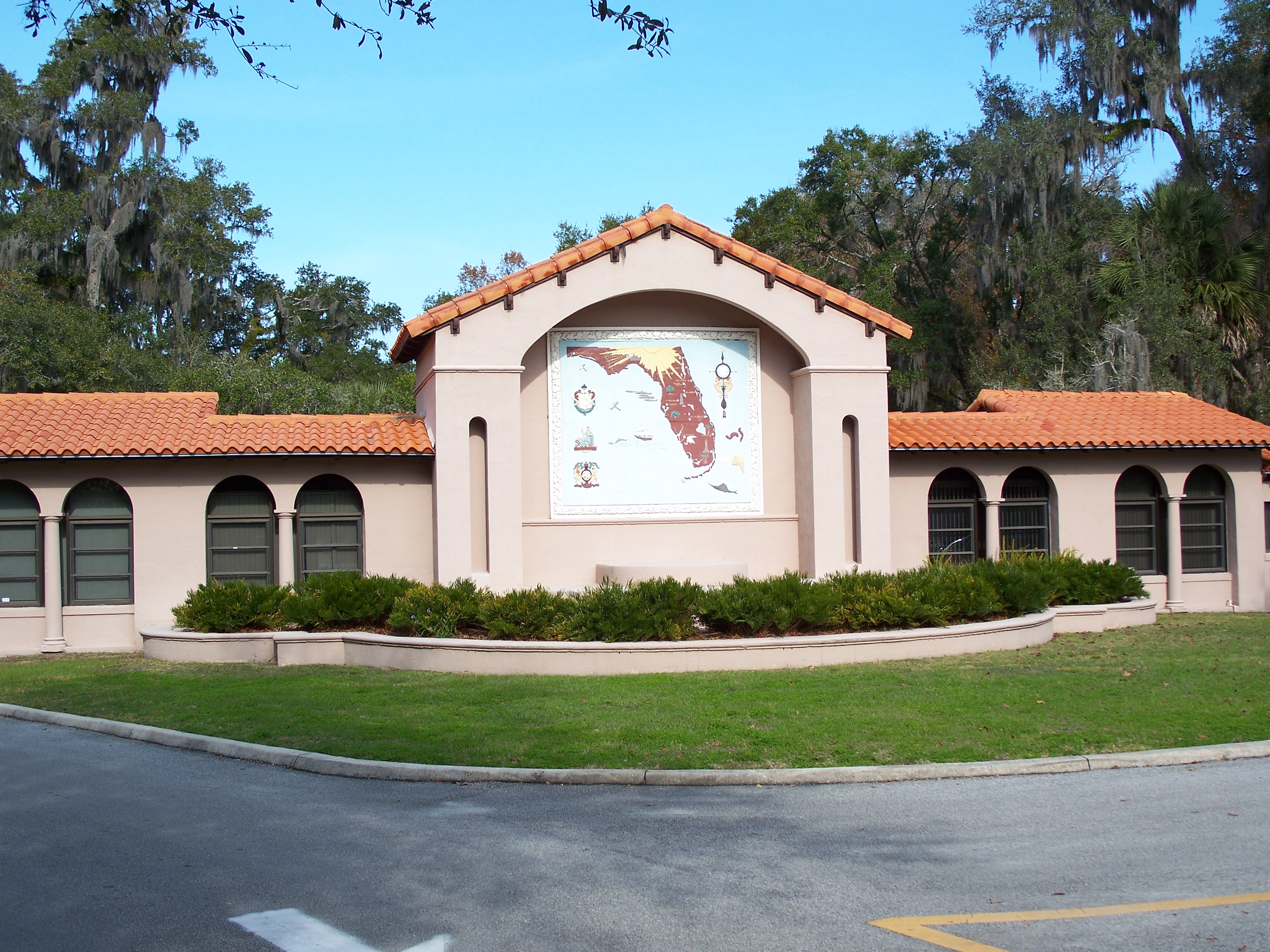
De Leon Springs State Park
The oldest canoes ever discovered in the Western Hemisphere were pulled from this spring. Two dugout canoes, one 5,000 years old and the other 6,000, surfaced in 1985 and 1990 from the depths of a natural spring in Volusia County, Florida, a spring that pushes 20 million gallons of 72-degree water per day from the limestone aquifer beneath it. De Leon Springs State Park sits on 625 acres of land that people have inhabited for at least six millennia, a timeline that makes its more recent history as a sugar plantation, a tourist trap with waterskiing elephants, and a state park feel like recent footnotes.
Six Thousand Years at the Spring
The native people who lived here were the Mayaca, distinct from the neighboring Timucuans in that they were fisher-hunter-gatherers rather than sedentary agriculturalists. Spanish missions arrived in the late 1500s. The land changed hands between empires: Spain held it, ceded it to Great Britain in 1763, took it back in 1783, then granted it to William Williams in 1804. Williams established the first plantation on the site, calling it Spring Garden, where enslaved Africans grew corn, cotton, and sugar cane. Florida became a U.S. territory in 1821, and the Woodruffs owned the plantation from 1823 to 1830, selling it to Colonel Orlando Rees, who built the only water-powered sugar mill in Florida. John James Audubon visited Spring Garden in January 1836, where he first painted the limpkin. That same season, the Seminoles destroyed the plantation at the start of the Second Seminole War. Union troops destroyed it again in 1864.
The Fountain of Youth Con
There are no known records linking Ponce de Leon to this spring. The connection is pure marketing. In 1886, after the Jacksonville, Tampa, Key West Railway was constructed nearby, the area's name was changed from Spring Garden to Ponce de Leon Springs to lure tourists. The springs' alleged healing powers were advertised as the Fountain of Youth. A hotel rose near the spring, and a small steamboat ferried visitors by water. In 1925, the fourteen-room Ponce de Leon Hotel was constructed, the first resort with full amenities, drawing upscale northern clientele. The operation reached peak spectacle in 1953, when a million-dollar attraction opened featuring exotic birds, alligator pens, an Audubon trail, a jungle cruise, a SCUBA school, and two waterskiing elephants named Sunshine Sally and Queenie. The attraction closed in the mid-1960s. The termite-infested hotel was torn down.
A Mill That Refuses to Die
Colonel Rees's sugar mill stopped operating in 1864 after the Civil War destruction. The building deteriorated until only the waterwheel remained in the late 1800s. Then, for reasons no one has documented, someone rebuilt the mill structure in the early 1900s. It fell into disrepair again until the Schwarze family renovated it in 1961 and opened the Old Spanish Sugar Mill Restaurant. The restaurant has operated continuously since then, and it has become the park's most beloved quirk. Guests do not order pancakes and wait for them to arrive. Instead, each table comes equipped with its own griddle, and diners pour their own batter and flip their own pancakes while seated. The experience turns breakfast into participation, a hands-on ritual that draws visitors who have never heard of Ponce de Leon or the Mayaca but who will remember cooking their own meal inside a building with a history of repeated destruction and resurrection.
The Living Spring
The spring pool reaches 30 feet deep at the boil, and the water holds at 72 degrees Fahrenheit regardless of the season. Swimming is permitted only in the spring pool; canoeing, kayaking, and fishing extend into the spring run. The four-mile Wild Persimmon Hiking Trail winds through hardwood hammock, cypress swamp, and old agricultural fields where hikers encounter white-tailed deer, wild turkeys, hogs, and occasionally the Florida black bear. A half-mile paved nature trail leads along a boardwalk to a 600-year-old bald cypress tree. The park connects to both Lake George State Forest and Lake Woodruff National Wildlife Refuge, expanding the wild corridor for bears, manatees in winter, migratory birds, and the anhingas, limpkins, ospreys, and bald eagles that inhabit the waterways year-round. Guided eco-history boat tours carry visitors from the park into the adjacent refuge, threading through a landscape that has drawn people to its waters since before recorded history.
From the Air
Located at 29.14N, 81.37W in Volusia County, Florida, near the community of DeLeon Springs off County Road 3. From altitude, the park appears as a dense green patch amid central Florida's mix of forest and development, with the spring run visible as a light-colored waterway feeding into the broader St. Johns River system. Lake Woodruff National Wildlife Refuge lies adjacent to the north and east. Daytona Beach International Airport (KDAB) is approximately 22 nm to the east. Orlando Sanford International (KSFB) is about 25 nm to the south. Flat terrain with extensive wetlands. Best viewed at 2,000-3,000 feet AGL to spot the spring pool and surrounding park structures.