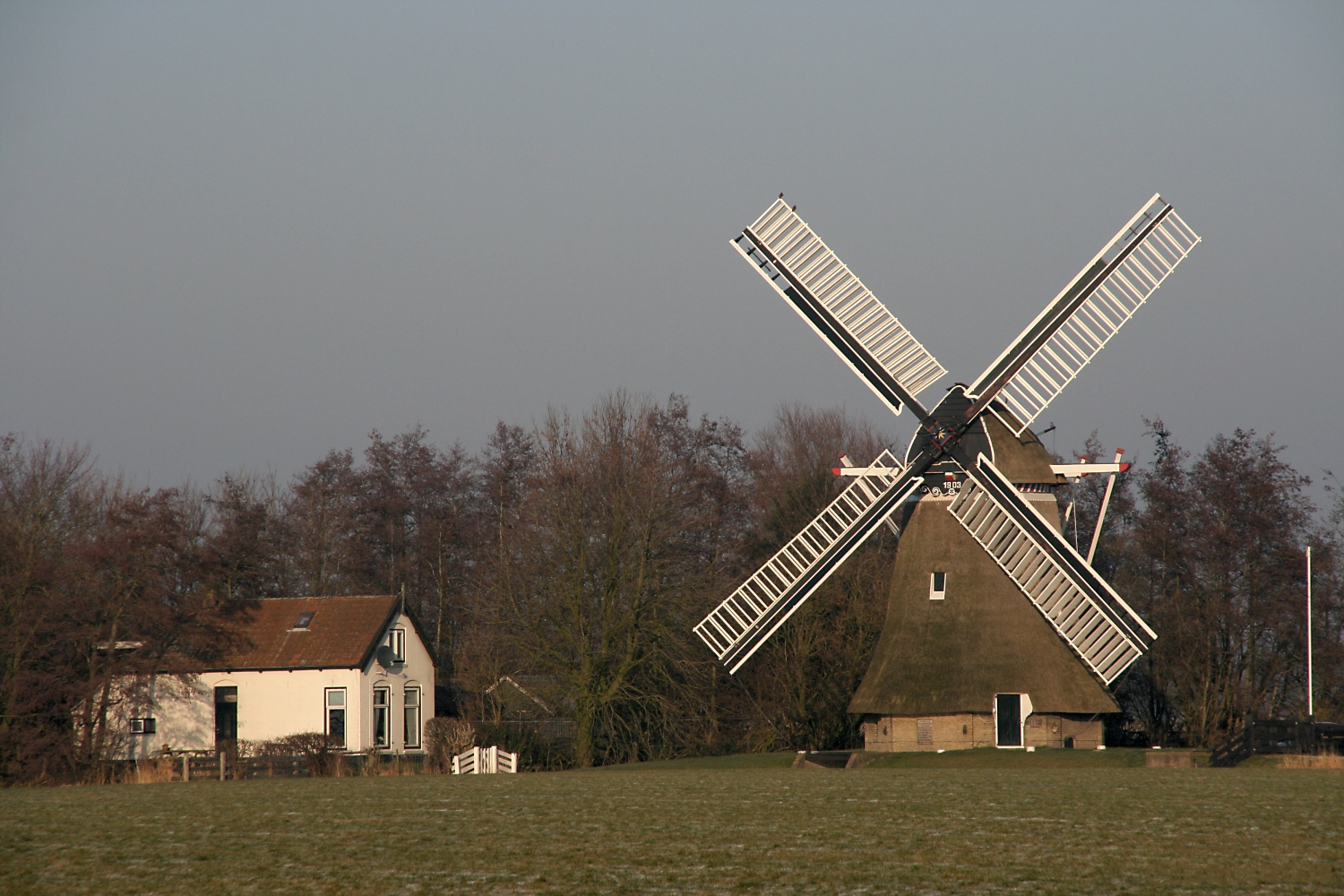
De Marssumermolen
Most Dutch polder mills do one job: they pump water out. De Marssumermolen, built in 1903 on the edge of the village of Marsum just northwest of Leeuwarden, does three. Two Archimedes screws turn at the bottom of its upright shaft. One drains the polder. The other floods it back. And by clever use of the gearing, the same mill can also run the water in a closed circuit, doing nothing in particular except keeping itself in trim. That mechanical flexibility is unusual enough that, when Friesland needed somewhere to train new millers, this was the first mill in the province they picked.
A Mill With Two Screws
Inside the thatched smock, the machinery branches. Patent sails 22 meters across turn a cast-iron windshaft cast in 1903 by De Muinck Keizer at Martenshoek in Groningen province. The shaft drives a 57-cog brake wheel into a 31-cog wallower at the top of the upright shaft. At the bottom is where the design gets interesting: there are two crown wheels rather than one. The upper crown wheel, with 17 cogs, drives a small Archimedes' screw — axle 70 millimeters in diameter, 2.25 meters long — used to pump water into the polder when the fields need flooding. The lower crown wheel, with 43 cogs, drives a much larger screw through a 38-cog gearwheel: axle 60 centimeters across, 5.25 meters long, the screw itself 1.75 meters in diameter, inclined at 17 degrees. Each revolution of the larger screw lifts 1,995 liters of water out of the polder.
Why Pump Water In?
To anyone outside the Low Countries, pumping water into a polder sounds backwards. It is not. Frisian polder land is often peat or peat-mixed clay, and if you let it dry out completely it shrinks, cracks, and oxidizes — the surface sinks, the carbon goes into the air, and the ground gets harder to manage. In hot summers, water boards deliberately flood land back to slow that subsidence and protect the soil. Marsum's mill, with its dual screws, lets the same single building handle the wet season and the dry season: drain in winter and spring, top up in midsummer, then quietly recirculate when neither is needed. It is the Frisian flatland's idea of a thermostat, run on wind.
Built by Westra, Reborn Twice
The mill was built by J. H. Westra, a millwright from nearby Franeker, and it is a grondzeiler — a ground-sail mill of two-storey smock on a single-storey base, with the sails sweeping down almost to the grass. There is no stage; the miller turns the cap into the wind from the ground, using tailpole and winch. Over the twentieth century it twice came close enough to disuse that restorations were needed: one round in 1976, then a more comprehensive program in 1992 through 1994, returning the mechanism to full working order. The Netherlands lists it as Rijksmonument number 28624. Today it stands beside the small village of Marsum at the edge of the polder country, the thatched smock easy to see from the A31 motorway that runs past on its way out of Leeuwarden.
The Province's First Training Mill
What sets the Marssumermolen apart from the dozens of other surviving Frisian polder mills is its second career as a school. When Friesland began formally training new millers, this was the first mill in the province designated for that purpose — partly because its mechanism, with both an upstream and a downstream screw, lets students learn polder pumping in both directions on the same equipment. Working a Dutch windmill safely is not a skill anyone is born with: it involves reading shifting winds, setting cloth on patent sails, engaging the heavy wooden brake before the sails over-speed, and tracking water levels in a polder that can flood a hundred hectares if you misjudge. New millers in Friesland have, for decades now, learned the work here — turning the same two screws that have moved water in and out of this corner of the province since 1903.
From the Air
Located at 53.212°N, 5.719°E at the edge of the village of Marsum, about 6 km northwest of central Leeuwarden and immediately adjacent to the A31 corridor. The mill is a low thatched smock with 22-meter Patent sails that reach almost to the ground — distinctive from the air against the regular grid of polder ditches and dairy pasture. Leeuwarden Air Base (EHLW) lies only a few kilometers east; expect controlled airspace and possible fast-jet traffic. Groningen Airport Eelde (EHGG) is about 60 km east. Best viewed from low altitude in clear weather; in summer, late-afternoon sunlight catches the thatch and the polished thatch ridge.