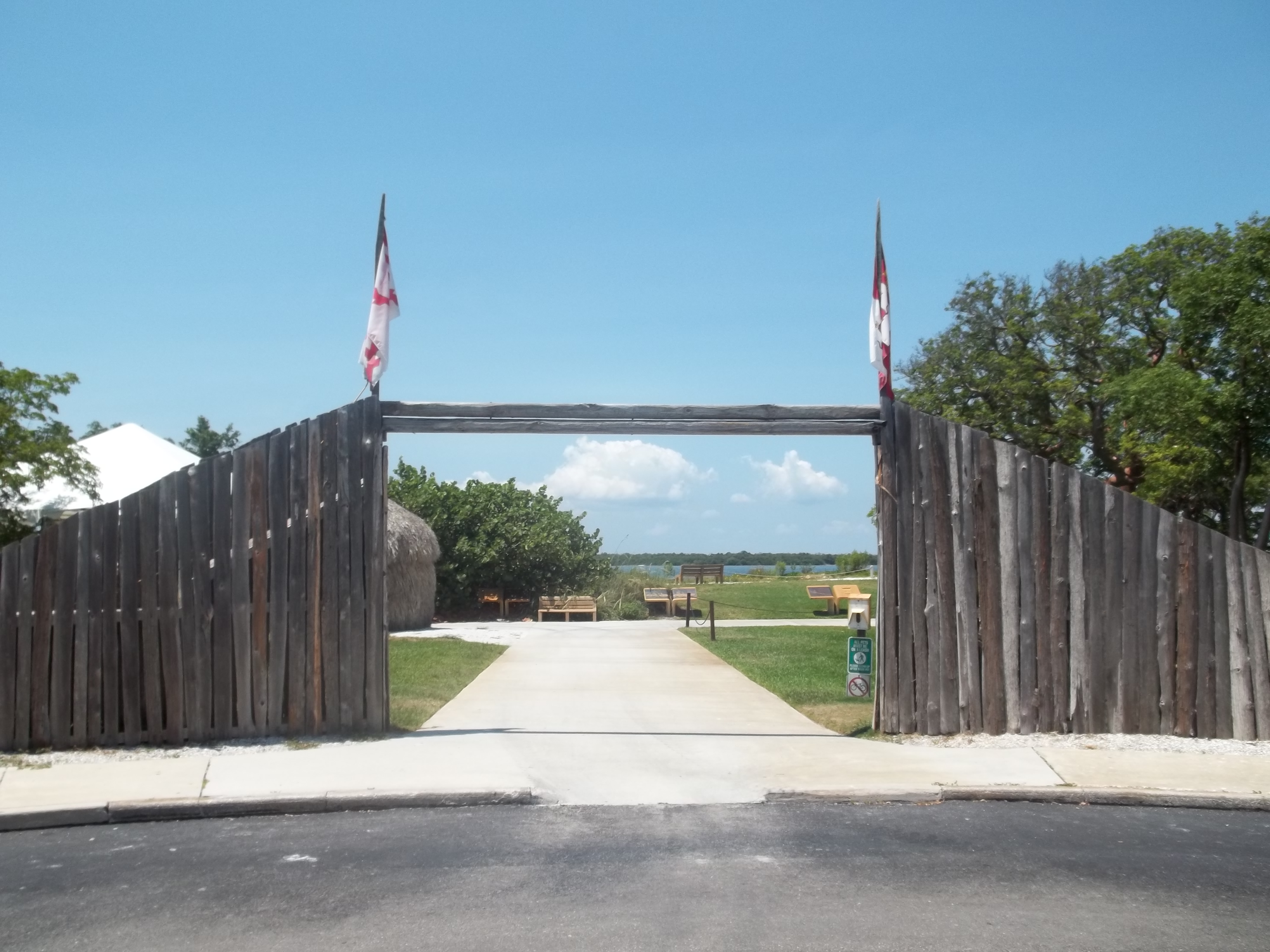
De Soto National Memorial
Nine ships appeared in Tampa Bay in May 1539, carrying over 600 Spanish soldiers, 220 horses, a herd of pigs, war dogs, cannon, matchlock muskets, armor, tools, and enough rations to begin a conquest. Hernando de Soto had come to La Florida under orders from King Charles V to "conquer, populate, and pacify" the land. He would accomplish none of these things. Instead, his expedition would become one of the most consequential disasters in the history of European exploration, and the small spit of mangrove and shoreline where he likely stepped ashore is now De Soto National Memorial, a quiet park at the mouth of the Manatee River west of Bradenton.
The Order to Conquer
Hernando de Soto was not arriving blind. He had already made his fortune as a conquistador in Central and South America, serving under Francisco Pizarro in the conquest of the Inca Empire. The Spanish Crown granted him the title of Governor of Cuba and adelantado of La Florida, with a royal mandate to claim and settle the vast, unmapped territory stretching north from the Gulf Coast. De Soto assembled his expedition with meticulous ambition: his nine ships carried not just soldiers but the entire apparatus of colonial occupation. The horses alone represented an enormous logistical investment, transported across the Atlantic and then across the Caribbean to Tampa Bay. The pigs were intended as a self-replenishing food supply. Every detail pointed toward a permanent enterprise, not a raid.
Four Years of Ruin
What followed the landing was a relentless, calamitous march that would cover thousands of miles across what is now Florida, Georgia, the Carolinas, Tennessee, Alabama, Mississippi, Arkansas, and Louisiana. De Soto's army moved from one Indigenous village to the next, seizing food stores and enslaving people to serve as guides and porters. The expedition encountered powerful chiefdoms and complex societies, fought pitched battles, and left devastation in its wake. Hundreds of people died on both sides. De Soto himself died of fever on the banks of the Mississippi River in May 1542. His men, reduced and desperate, eventually built boats and floated down the Mississippi to the Gulf of Mexico, reaching Spanish territory in Mexico in 1543. The gold and treasure that had motivated the entire enterprise were never found.
The Accounts That Survived
The expedition failed by every measure its organizers would have recognized. But it produced something the Spanish Crown had not anticipated: detailed first-hand accounts from survivors that described the native cultures, the geography, and the extraordinary richness of the interior of the continent. These narratives became the journey's enduring legacy, providing the earliest European documentation of dozens of Indigenous peoples and their societies. The accounts also demonstrated to Spain that La Florida was not another Peru. There was no empire to topple, no centralized treasury to seize. Spain reevaluated its approach to the region, eventually shifting from conquest to mission-building, a strategic change that shaped the next two centuries of colonial history in the Southeast.
Mangroves and Memory
De Soto National Memorial sits where the Manatee River empties into Tampa Bay, a landscape that would be recognizable to the soldiers who waded ashore in 1539. Eighty percent of the memorial's grounds are mangrove swamp, the dense tidal forest that lines much of Florida's Gulf Coast. The visitor center displays historic armor, 16th-century weapons, and period artifacts. A film called Hernando de Soto in America tells the story of the expedition and the Native American peoples it encountered. During the cooler months from December through April, the park operates Camp Uzita, a living history encampment where costumed interpreters demonstrate 16th-century Spanish military life. The season culminates with a reenactment of De Soto's landing on the beaches of Tampa Bay. Nature trails wind through the mangroves, and the park offers fishing, bird watching, and picnicking. Admission is free.
A Landing That Changed a Continent
From the air, De Soto National Memorial is a small green finger of land at the junction of river and bay, easy to overlook amid the suburban sprawl of greater Bradenton. But the event it commemorates was enormous in consequence. The de Soto expedition was the first extensive, organized European exploration of the interior of North America. It introduced European diseases to populations with no immunity, set in motion demographic catastrophes that would reshape the continent, and produced the written record through which those lost societies are partially known. The memorial does not celebrate conquest. It marks a beginning, a point where two worlds collided on a mangrove shoreline, and nothing was the same afterward.
From the Air
Located at 27.524N, 82.644W on the south shore of Tampa Bay where the Manatee River enters the bay, west of Bradenton in Manatee County, Florida. The memorial appears as a small green peninsula jutting into the bay. Best viewed at 1,000-3,000 ft AGL. Nearest airports: Sarasota-Bradenton International Airport (KSRQ) approximately 8 nm south, Albert Whitted Airport (KSPG) approximately 15 nm north across the bay in St. Petersburg, and Tampa International Airport (KTPA) approximately 30 nm north. The park is surrounded by residential development along the southern Tampa Bay shoreline.