De Stijl
Six hundred guilders. That is what it cost, in 1916, to launch the art movement that would eventually decide what your kitchen chair looks like. The money came from a Swiss collector named Karl Friedrich Meyer-Fierz, who handed it to Theo van Doesburg, a Dutch painter who had decided he was a better critic than artist and a better organizer than either. Van Doesburg used it to rent a studio in Leiden, recruit a small circle of fellow abstractionists, and, in October 1917, publish the first issue of a magazine called De Stijl. The Netherlands was neutral in the First World War. Paris was unreachable. Belgian refugees were drifting north. Inside that bubble of neutrality, a tiny group of painters, architects, and one furniture maker quietly invented twentieth-century design.
A Magazine, Not a Movement
De Stijl is remembered as a collective, but it was really a magazine with a very persistent editor. Piet Mondriaan and Gerrit Rietveld, two of its most famous contributors, never met each other in person. Most members communicated by letter. The group held only two exhibitions during the magazine's entire run. Van Doesburg was the spine that held it all together, writing, editing, hounding contributors, and quarrelling with them. When the painter Bart van der Leck wanted curved or diagonal lines, Van Doesburg threw him out. When Jan Wils began writing for a rival publication promoting the rival Amsterdam School, he too was shown the door. The movement that preached harmony was held together by one man's stubbornness and a steady trickle of resignations.
Primary Colors and Right Angles
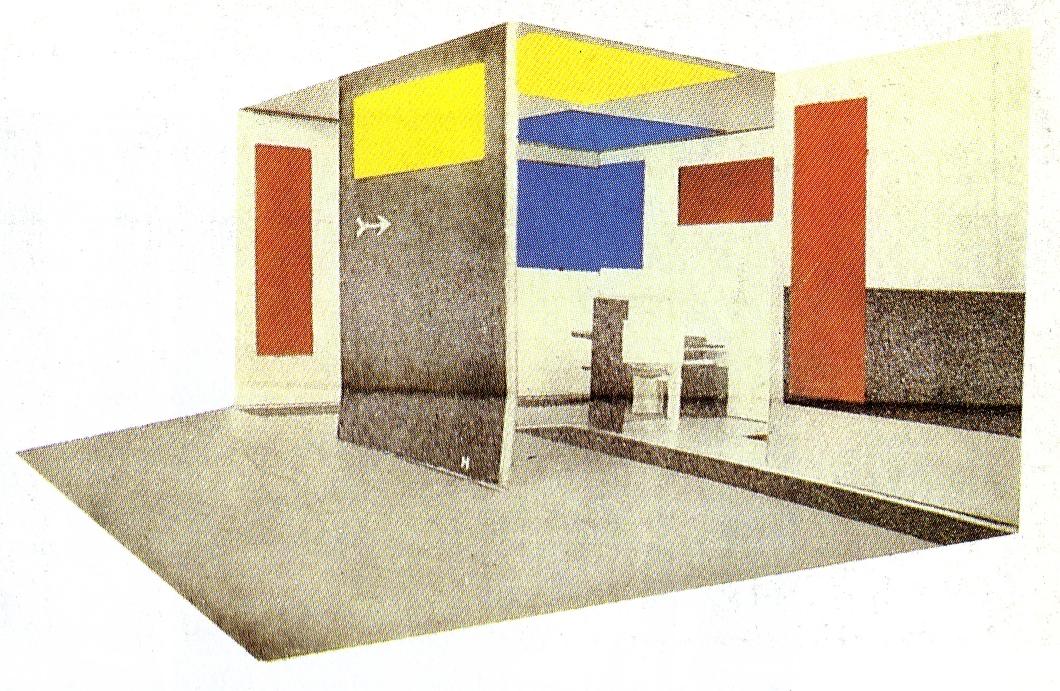
The aesthetic that emerged was ruthless in its simplicity: only horizontal and vertical lines, only the three primary colors plus black, white, and grey. Mondriaan's grid paintings are the public face of this idea, but the philosophy ran deeper. The Netherlands was deep in a postwar housing crisis. Architects had to build cheaply and quickly. The De Stijl members argued that good design was a social duty, not a luxury, and that simple geometry was the honest answer. The architect J.J.P. Oud designed worker housing in Rotterdam and asked Rietveld to colour and furnish it. Rietveld, in turn, built the Red Blue Chair, an object so reduced to its essentials that sitting in it is, by most accounts, slightly uncomfortable. The chair was never the point. The point was an idea you could sit in.
Internationalism and Estrangement
By 1920, most of the original members had drifted away, but Van Doesburg refused to let the magazine die. He took the gospel on the road, capital to capital, meeting Bauhaus artists in Berlin and following them to Weimar. He never officially joined the Bauhaus, but he organized De Stijl courses in Weimar that pulled away some of its students and ideas. In Clamart, a suburb of Paris where he eventually settled, he developed a new variant called Elementarism that allowed diagonals. That was the final break with Mondriaan, who left in protest. The Dutch establishment, almost by accident, ended up sending De Stijl to represent the country at the 1925 World Fair in Paris, much to Van Doesburg's irritation. The movement he had built from a Leiden studio was being absorbed by the very world it set out to remake.
The Long Shadow
Van Doesburg died in 1931, at forty-seven. A few former members gathered in 1932 to publish one final memorial issue of De Stijl, and that was the end of the magazine. The ideas, though, had escaped. Bauhaus had taken them, and through Bauhaus they reached the entire modernist world: the International Style, mid-century furniture, corporate logos, the grids underneath every newspaper and website you read. Mondriaan kept painting until his death in New York in 1944; his final, unfinished work, Victory Boogie Woogie, hangs in the Kunstmuseum Den Haag. Rietveld kept building, including the Rietveld Schroder House in Utrecht, now a UNESCO World Heritage Site. Look at a budget bookcase, an IKEA kitchen, a flat tech-company logo, the Mondrian-print dress that turns up in fashion every decade. The Leiden studio is gone. The style outlived everyone.
From the Air
De Stijl was founded in Leiden, Netherlands, at approximately 52.09 N, 4.28 E. Cruise the Randstad at FL080-FL100 in clear weather; the canal grid of the old city is visible from the air, and Mondriaan's flat polders below are the landscape that arguably taught him to see in horizontals and verticals. Nearest airports: Rotterdam The Hague (EHRD) about 25 km southwest, Amsterdam Schiphol (EHAM) about 35 km north.