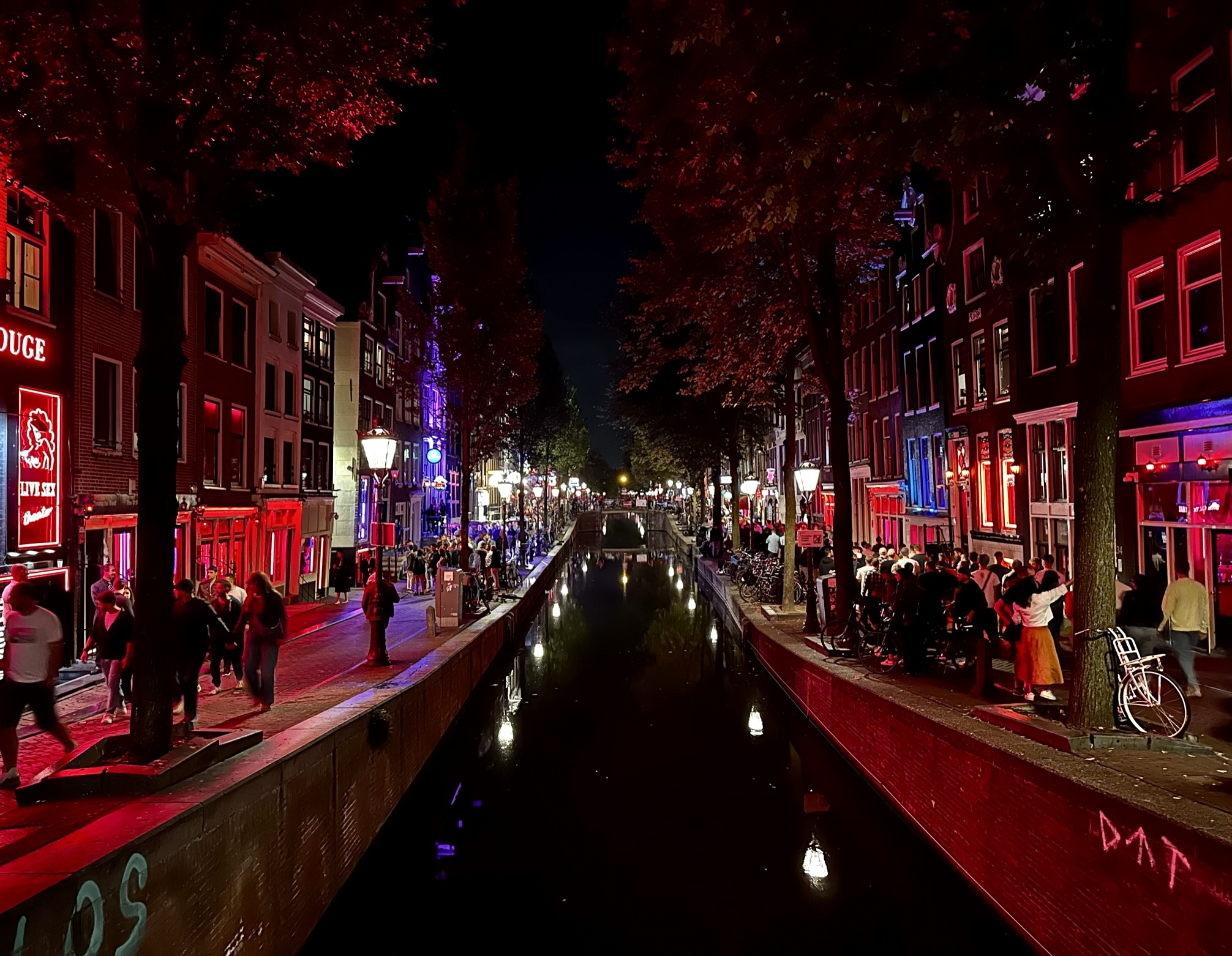
De Wallen
In 1270, somebody built a bridge across the Amstel. The bridge had doors that could be closed to dam the river when the IJ flooded, and the spot where the doors hung eventually became Dam Square. The Damrak, just north of the dam, became a working harbor. Sailors came in. They wanted food, drink, and company. The alleys around the Oude Kerk - the Old Church, finished in the early 1300s - became where they found it. Seven hundred and fifty-six years later, those same alleys are still working. The lights are red and ultraviolet now, the glass is plate, and the women in the windows are mostly from somewhere else. But the geography is medieval, and so is the argument about what kind of place this should be.
The Walls That Gave the Name
De Wallen means the walls, and the walls are the canal-side walls that line the Oudezijds Voorburgwal and Oudezijds Achterburgwal - the streets that frame the neighborhood. Locals also say Walletjes, little walls. The medieval city ran its trade out of this district because the harbor was here. The Oude Kerk, around which the windows cluster, predates the rest of the city by centuries. In 1578, during the Dutch Revolt, the new Protestant city board declared fornication punishable. Sex work was driven underground, but the underground was barely below the surface. Madams provided room, board, and protection. They paid bribes when necessary. Most of the city tolerated the arrangement and pretended otherwise.
The Red Card
In 1811, under Napoleonic rule, the Dutch lifted the ban on prostitution. The French Imperial Naval Corps was garrisoned in Amsterdam and its sailors were the main clientele in De Wallen. Sex workers were given red cards - permits to work, conditional on passing compulsory health inspections aimed at protecting soldiers from syphilis. There was no real treatment for syphilis in 1811. Workers who tested positive lost their card and were subjected to mercury baths that did nothing for the disease and a great deal of damage to the worker. The red card is the ancestor of every harm-reduction policy that has ever tried, with mixed results, to make sex work safer rather than illegal.
The Window
Window prostitution - a worker in her own rented room with a glass door onto the street - is what De Wallen is famous for, but it was not always legal. In 1911 the Netherlands banned brothels and pimping, though not sex work itself. The trade was driven back behind closed curtains. Workers stood inside their rooms and peered through cracks to spot clients. Standing in the doorway meant arrest. This continued for most of the twentieth century until, in 2000, the Netherlands legalized brothels and window work was finally brought above-board. Mariska Majoor, who had done the work and then founded the Prostitution Information Center, organized open days in 2006 and 2007 so the public could see what the windows were actually like. In March 2007, the bronze statue Belle by Els Rijerse was unveiled on the Oudekerksplein in front of the Oude Kerk. The inscription reads: Respect sex workers all over the world.
Who Works the Windows
The work is done mostly by migrants. TAMPEP research records that around 60% of sex workers in the Netherlands were foreign-born as of recent surveys, with 43% from elsewhere in the EU - mostly Eastern Europe. EU citizens have the right to work in the trade under internal market rules. Citizens of other countries need a valid residence permit. Many do not have one. Coercion exists. Trafficking exists. The numbers are contested - estimates of how many workers are in the industry against their will range, depending on who is doing the counting, from 10% to 90% of a population variously estimated at four to ten thousand. What is not contested is that the workers themselves have repeatedly told city hall that reducing the number of windows pushes workers into less visible, less safe arrangements. Metje Blaak, who worked in the trade for twenty-five years before becoming a filmmaker, put it directly: "In the window is safe, open. You can see your clients. You can see everything."
Halsema's Proposal
The political pressure has built across two decades. In 2007, mayor Job Cohen forced the closure of 51 windows, arguing the area had been captured by organized crime; the workers' rights group De Rode Draad and Mariska Majoor's PIC said it would only raise rents on the remaining windows. By 2008, plans were in motion to halve the city's 400 windows. The Yab Yum brothel was closed. Coffeeshops in the area were squeezed. In July 2019, mayor Femke Halsema proposed something different - including, possibly, ending window prostitution in De Wallen entirely and relocating workers to a purpose-built indoor facility elsewhere in the city. A prostitution hotel, the press called it, mostly in Amsterdam Zuid. The reaction from the workers has been the obvious one: they remember what happened the last time the work was moved, and the time before, and the time before. The argument continues. The Oude Kerk continues. The statue Belle continues. The neighborhood, still, is working.
From the Air
De Wallen occupies the medieval core of Amsterdam at 52.373N, 4.898E, immediately east of Dam Square and centered on the Oude Kerk. The neighborhood is small - roughly 6,500 square meters of streets and alleys - and almost invisible from the air, tucked into the same brick-and-step-gabled fabric as the rest of the old city. Nearest airport: Amsterdam Schiphol (EHAM), 14km southwest. Best viewing: from below, on foot, with respect for the people who live and work there.