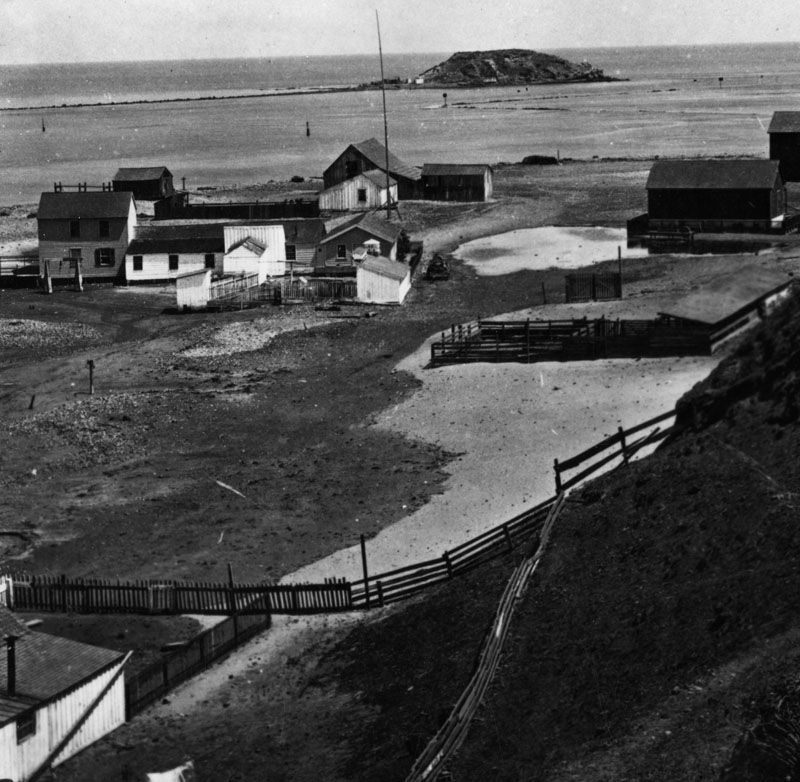
Deadman's Island (San Pedro)
Richard Henry Dana Jr. saw Deadman's Island in 1835 and found poetry in its desolation. A single grave marked the steep, conical hump of clay, he wrote in Two Years Before the Mast, containing an English ship captain rumored to have been poisoned by his own crew. It was the only thing in California from which I could extract anything like poetry, Dana wrote. Then, too the man had died far from home, without a friend near him. Nearly a century later, dynamite and dredgers would erase the island from San Pedro Bay. In the process, they uncovered two dozen skeletons, evidence that many more lonely deaths had accumulated on that desolate rock.
The Eagle's Nest
French sea captain Auguste Bernard Duhaut-Cilly visited the small islet on April 10, 1827, eight years before Dana's voyage. Climbing to its highest point, he discovered something unexpected: the eyrie of a sea eagle with two eaglets, the birds black with yellowish-white patches on tail and head. From this description, the birds were almost certainly bald eagles, then common along the California coast. The island they nested on sat in San Pedro Bay alongside another islet called Rattlesnake Island, which would eventually become the industrial sprawl of Terminal Island. But in 1827, these were wild places, inhabited by eagles and little else.
Isla del Muertos
On October 8, 1846, American soldiers fought local Californios in the Battle of the Old Woman's Gun, a skirmish during the Mexican-American War. As many as six Americans died in the fighting. Their bodies were buried on the islet the Spanish called Isla del Muertos, adding military graves to whatever earlier burials the island already held. The name stuck. Deadman's Island, Dead Man's Island, Reservation Point, it accumulated aliases like it accumulated the dead, becoming a convenient cemetery for a harbor town that had little use for elaborate graveyards.
Whale Oil and Barrels
A whaling station operated on Deadman's Island beginning in 1860. The Los Angeles Star reported in January 1861 that a whaling party from San Diego had located on the island and captured two whales, extracting forty-five barrels of oil. Business improved. In March 1861, they caught a right whale plus five others in two weeks, each estimated at $300 value. The following season brought twenty-five whales, probably grays migrating along the coast. Captain Hart ran the station from 1860 to 1862; Captain Henry Johnson of San Diego backed the operation financially. A second whaling venture tried again in 1865-66 under Captain Jack Smith, lasting only one season before the industry moved elsewhere.
Free Harbor Wars
In the late nineteenth century, Deadman's Island became ammunition in the free port wars, a political battle over where to build Southern California's major deepwater harbor. Powerful interests backed either San Pedro or Santa Monica Bay. Senator William P. Frye of Maine, arguing against San Pedro before the Senate Committee on Commerce, seized on the island's ghoulish names. Deadman's Island! Rattlesnake Island! I should think it would scare a mariner to death to come into such a place! The mockery failed. San Pedro won the harbor fight, and plans soon emerged to dredge and expand the port, even if it meant erasing inconvenient geography.
Erased from the Map
Harold Lloyd filmed the comedy short Lonesome Luke's Wild Women on Deadman's Island in late 1916, one of the last records of the islet as a recognizable landmark. Beginning in 1928, dynamite, dredgers, and bulldozers went to work. The expanded Port of Los Angeles needed the space, and Deadman's Island stood in the way. As workers broke apart the rock, they uncovered up to two dozen skeletons. The dead included the sailors and marines from the 1846 battle, Black Hawk, one of the Native Americans forcibly removed from San Nicolas Island in 1835, two Spanish soldiers possibly dating to the seventeenth century, a blonde woman of unknown origin, and a man with an arrowhead lodged in his skull. The island had served as a burial ground for centuries. Now it exists only in photographs and old charts, a ghost landmark in a harbor that no longer remembers its names.
From the Air
Deadman's Island no longer exists. Its former location at approximately 33.72N, 118.27W now lies within the expanded Port of Los Angeles, near the modern Terminal Island and the Vincent Thomas Bridge. From altitude, this area appears as industrial port infrastructure with container terminals, shipping channels, and the Long Beach-Los Angeles harbor complex. The nearest airports are Long Beach (KLGB) and Los Angeles International (KLAX). Torrance (KTOA) and Compton-Woodley (KCPM) offer closer general aviation options.