Death and Legacy of Tom Thomson
His watch had stopped at 12:14. When searchers finally pulled Tom Thomson's body from the dark waters of Canoe Lake on July 16, 1917, eight days after he vanished, the timepiece on his wrist offered the only precise detail in what would become one of Canada's most debated mysteries. A four-inch bruise marked his right temple. Fishing line was carefully wrapped around one ankle. His upturned canoe had been spotted drifting the same afternoon he disappeared, yet it took more than a week for the lake to surrender the man who had painted it so faithfully. Thomson was 39 years old, just months shy of his fortieth birthday, and on the cusp of an artistic maturity that would never fully arrive.
The Painter Who Fished Like a Guide
Tom Thomson arrived at Algonquin Park for the first time around 1912, and the place seized him completely. He returned every spring, camping on Canoe Lake or boarding at Mowat Lodge, splitting his days between sketching and working as a fishing guide. His reputation through the park was equally divided between art and angling. While most visitors relied on hired guides, Thomson moved through the backcountry alone, and many of his fishing spots became the subjects of his paintings. When A. Y. Jackson visited Canoe Lake for the first time in 1914, he wrote to J. E. H. MacDonald: "It appears that Tom Thomson is some fisherman, quite noted round here." The image of Thomson as an expert canoeist, however, was likely romanticized. Park ranger Mark Robinson recorded that Thomson admitted in 1913 he did not know much about canoeing, and there are multiple accounts of him capsizing. After one spill on the Mississagi River in 1912, his friend John McRuer wrote back: "You might have been drowned you devil; and that was not the first time you were bumped, eh!"
A Final Spring of Masterful Work
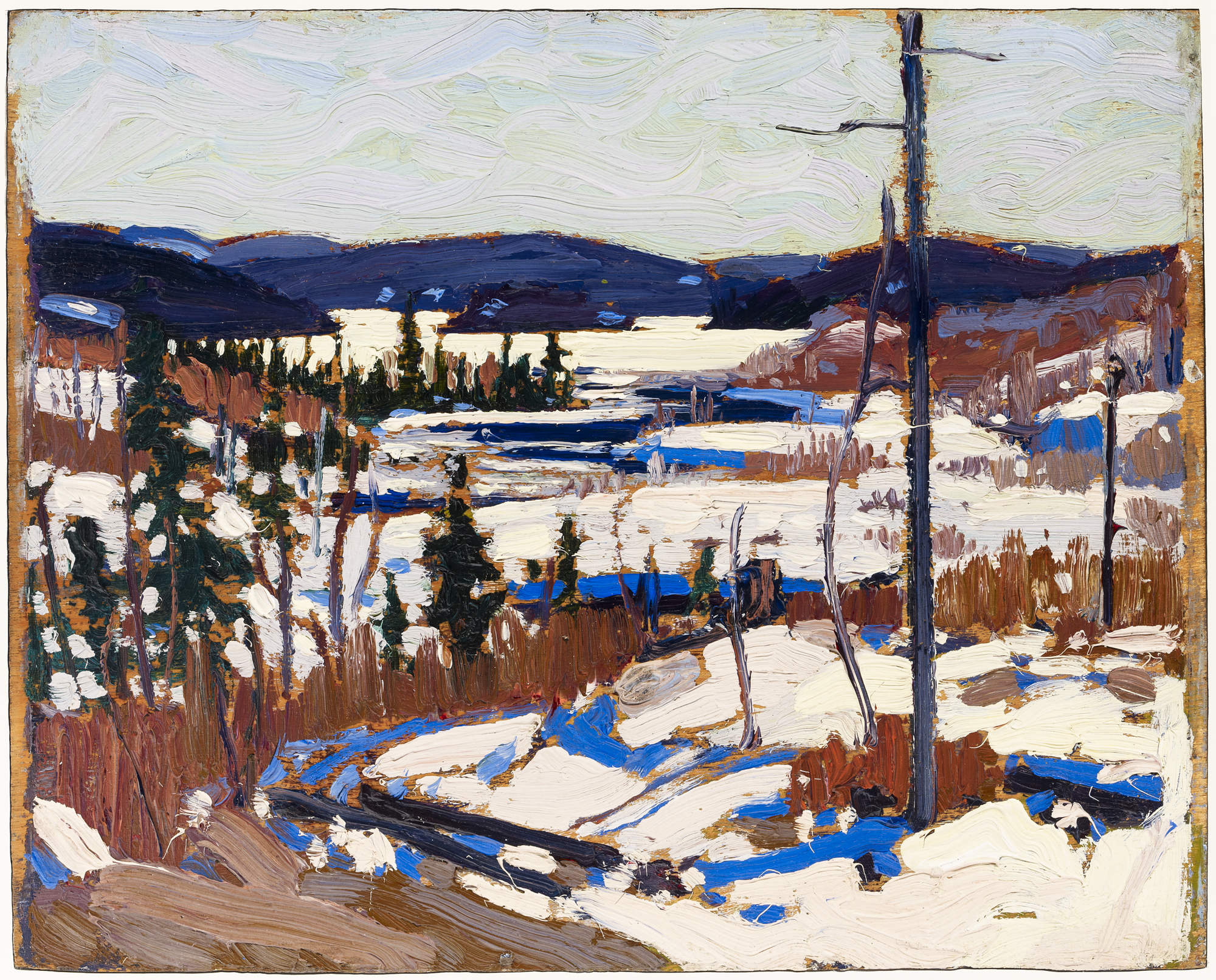
Thomson returned to Canoe Lake in early April 1917, arriving in time to paint the last snow and the ice breaking up across the surrounding lakes. The sketches became a visual diary, what he called "a record of the weather for 62 days, rain or shine, or snow, dark or bright." The works from that spring display extraordinary control of colour, painted with a crispness and freshness that marked his growing command. Bold, expressive brushstrokes are evident in paintings like Path Behind Mowat Lodge and Tea Lake Dam. His final work, After the Storm, edges toward pure abstraction: viewed up close, the thick application of paint dissolves into generalized form. Art historians David Silcox and Harold Town would later identify in these last canvases an Expressionist intensity that anticipated movements following his death. In his final letter to his patron James MacCallum, sent just one day before he vanished, Thomson complained about the flies and mosquitoes but expressed eagerness for sketching trips planned over the coming months. He never sent the winter sketches he had promised.
The Day on Canoe Lake
On the morning of July 8, 1917, Thomson was seen walking to Joe Lake Dam with Shannon Fraser, owner of Mowat Lodge. Park ranger Mark Robinson noted in his diary that Thomson "left Fraser's Dock after 12:30 pm to go to Tea Lake Dam or West Lake." He set out by canoe and was never seen alive again. His overturned canoe appeared that afternoon. Eight days later, searchers recovered his body from the lake. Dr. Goldwin Howland examined the remains and ruled death by drowning. The coroner, Dr. Arthur E. Ranney, concurred, writing that the temple bruise was "no doubt caused by stricking some obstacle, like a stone, when the body was drowned." The next day Thomson was buried in Mowat Cemetery near Canoe Lake. Under the direction of his older brother George, the body was exhumed two days later and shipped to Owen Sound, where it was re-interred in the family plot beside Leith Presbyterian Church on July 21.
The Mystery That Would Not Rest
Accidental drowning was the official verdict, but speculation began almost immediately and has never stopped. Murder theories, suicide theories, and allegations of foul play have swirled around Thomson's death for over a century. In 1956, Judge William Little and three friends dug up Thomson's original gravesite in Mowat Cemetery, claiming the remains they found were his, a suggestion that Thomson's body had never actually left Canoe Lake. Historians David Silcox and Harold Town methodically debunked the most persistent claims, noting that the supposed wire tangled around Thomson's feet was actually a fishing line carefully bound around a sprained ankle, a common remedy for joint pain. Silcox proposed a scenario in which Thomson stood in his canoe to cast a line, lost his balance, struck his head on the gunwale, and fell unconscious into the water. In 2011, historian Gregory Klages assessed the secondary accounts against primary evidence and concluded that Thomson's death was consistent with the original finding of accidental drowning.
Canada's First Old Master
Thomson's friends in what became the Group of Seven were so devastated by his death that they could not bear to return to Algonquin Park. They moved on to Algoma, Lake Superior, the Arctic, and the Yukon. On September 27, 1917, J. E. H. MacDonald, John William Beatty, Shannon Fraser, and local residents erected a memorial cairn at Hayhurst Point on Canoe Lake. In death, Thomson grew larger than any single painting. Scholar Sherrill Grace called him a "haunting presence" who "embodies the Canadian artistic identity." The National Gallery of Canada staged a major exhibition of his work in 2002, giving Thomson the same prominence previously afforded Picasso and Renoir. His sketch Early Spring, Canoe Lake sold in 2009 for $2,749,500. A previously lost painting discovered in an Edmonton basement in 2018 fetched nearly half a million dollars. Visitors to his grave near Leith still leave pennies and small art supplies as tribute. In 2018, a section of Ontario Highway 60 through Algonquin Park was renamed Tom Thomson Parkway. Poets, novelists, filmmakers, and musicians have all returned to his story, including The Tragically Hip in their 1991 single "Three Pistols." Dennis Reid wrote that Thomson's death was seen "almost as a sacrifice to the idea of an indigenous Canadian art." He became Canada's first Old Master, and the wilderness he painted became inseparable from the nation's sense of itself.
From the Air
Canoe Lake sits at 45.56°N, 78.73°W within Algonquin Provincial Park in Ontario's Nipissing District. From cruising altitude, the park's vast network of lakes and forests stretches across the landscape. The nearest airports include Pembroke/Petawawa (CYPQ) to the northeast and Muskoka/CYQA to the southwest. Hayhurst Point and the Thomson memorial cairn are on the north end of Canoe Lake. Best viewed at 3,000-5,000 feet AGL to appreciate the lake-dotted wilderness Thomson painted.