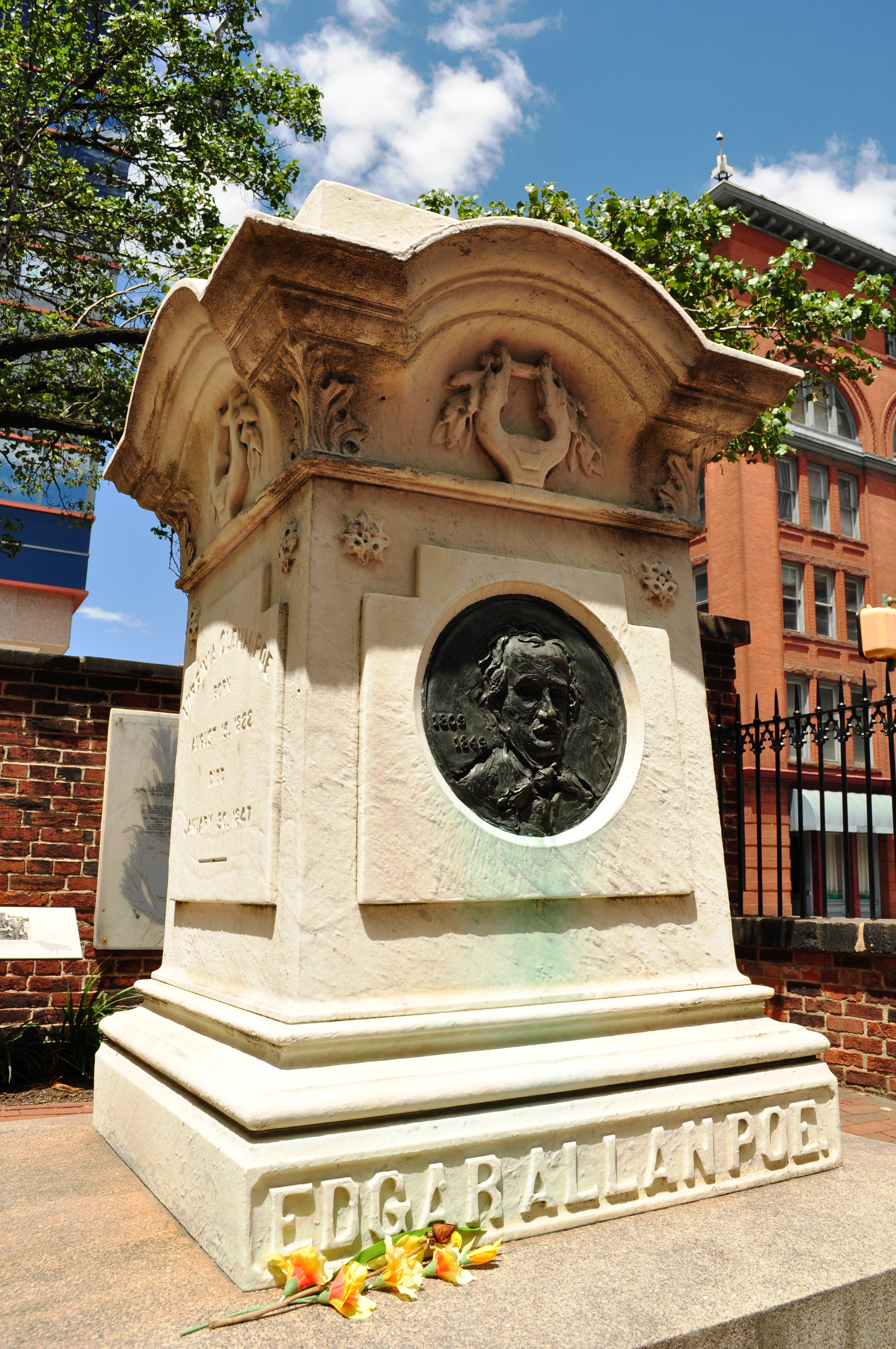
Death of Edgar Allan Poe
On October 3, 1849, a printer named Joseph W. Walker found a man slumped in a chair at Ryan's Tavern in Baltimore, barely conscious and wearing clothes that were not his own -- a stained, faded bombazine coat, worn-out shoes run down at the heels, an old straw hat. The man was Edgar Allan Poe, America's foremost writer of horror and mystery. He was 40 years old. He had left Richmond, Virginia, six days earlier in good spirits, headed for New York to start a new editorial job and remarry. No one knows what happened to him in between. He never regained enough coherence to explain. Four days later, on October 7, Poe was dead. The cause has never been determined. It is the kind of ending even Poe could not have scripted better.
The Missing Week
Poe departed Richmond on September 27, 1849, after a productive summer. He had given well-received lectures and readings, joined the Sons of Temperance, and proposed to his childhood sweetheart Sarah Elmira Royster. He was headed home to the Bronx to fetch his mother-in-law, Maria Clemm, before returning to Richmond for the wedding. Then he vanished. No reliable evidence exists about his whereabouts for the next six days. When Walker found him at Ryan's Tavern -- also known as Gunner's Hall -- on Election Day, he sent an urgent note to Joseph E. Snodgrass, a magazine editor and Poe acquaintance. Poe was taken to Washington College Hospital on Broadway and Fayette Street, where he was confined to a barred room in the wing reserved for intoxicated patients. He was denied all visitors.
Reynolds, Reynolds
According to his attending physician, Dr. John Joseph Moran, Poe repeatedly called out the name "Reynolds" on the night before he died. No one has ever identified with certainty who he meant. Some scholars point to Jeremiah N. Reynolds, a newspaper editor and explorer whose work may have inspired Poe's novel The Narrative of Arthur Gordon Pym of Nantucket. Others suggest Henry R. Reynolds, a judge overseeing the election polls at Ryan's Tavern. Still others believe Poe was actually crying out for "Herring" -- he had an uncle-in-law in Baltimore named Henry Herring. During one lucid moment, Moran claimed he tried to encourage the dying man by promising that friends would soon visit. Poe's alleged reply was bleak: "The best thing his friend could do would be to blow out his brains with a pistol." Moran's credibility, however, is suspect. His accounts changed dates and details across multiple retellings over the decades.
A Catalog of Theories
The list of proposed causes reads like a medical encyclopedia: alcoholism, cholera, rabies, syphilis, brain tumor, diabetes, epilepsy, delirium tremens, heart disease, meningeal inflammation. Because Poe was found on Election Day, a theory emerged as early as 1872 that he was the victim of cooping -- a brutal ballot-stuffing scheme in which gangs abducted people off the street, drugged them or beat them into compliance, disguised them with wigs or false beards, and marched them to multiple polling stations to vote for a particular party. It would explain the unfamiliar clothes. In 1996, cardiologist R. Michael Benitez published an analysis in the Maryland Medical Journal arguing that the symptoms best matched rabies: delirium, difficulty drinking water, an incubation period that could stretch for months. The evidence against alcoholism is substantial -- Thomas Dunn English, who disliked Poe personally but was a trained physician, insisted Poe was not a drug or alcohol abuser. The mystery endures.
A Three-Minute Funeral
Poe's funeral, held at 4:00 p.m. on October 8, lasted exactly three minutes. The sexton, George W. Spence, remembered it as "a dark and gloomy day, not raining but just kind of raw and threatening." The Reverend W. T. D. Clemm, a cousin of Poe's late wife Virginia, presided. The mourners numbered fewer than ten, including Snodgrass and Poe's cousin Elizabeth Herring. The coffin was cheap -- no handles, no nameplate, no cloth lining, no cushion for his head. He was buried in an unmarked grave in the rear of the Westminster Presbyterian churchyard, near his grandfather David Poe Sr. A white marble headstone was ordered, but before it could be delivered a train derailed and plowed through the stone mason's yard, destroying it. For years, the grave bore only a sandstone block reading "No. 80."
The Rival's Revenge
The day after the burial, an obituary appeared in the New York Tribune signed only "Ludwig." It praised Poe's brilliance while systematically shredding his character, claiming he walked the streets in delirium, was excessively arrogant, and assumed all men were villains. Ludwig was Rufus Wilmot Griswold, a literary rival who became executor of Poe's estate. In 1850, Griswold published a biography depicting Poe as a depraved, drug-addled madman, much of it fabricated. Historian Arthur Hobson Quinn proved in 1941 that Griswold had forged letters attributed to Poe. But by then the damage was permanent. In 1875, Poe was finally reburied near the front of the churchyard with a proper monument designed by George A. Frederick and carved by Hugh Sisson. Walt Whitman was the only major poet who attended the dedication. Virginia's remains were placed beside her husband's in 1885. Today, the grave at Westminster Hall and Burying Ground -- now part of the University of Maryland School of Law -- draws visitors from around the world, many of whom leave coins and roses at the stone.
From the Air
Located at 39.29°N, 76.62°W in downtown Baltimore. Ryan's Tavern, where Poe was found, stood near the present-day intersection of Lombard and High Streets. Washington College Hospital was at Broadway and Fayette Street. Westminster Hall and Burying Ground, where Poe is interred, is at the corner of West Fayette and North Greene Streets, identifiable from low altitude by its churchyard surrounded by University of Maryland School of Law buildings. Baltimore/Washington International Airport (KBWI) is approximately 9nm south. Martin State Airport (KMTN) is roughly 12nm northeast. Best viewed in the context of Baltimore's historic downtown at 1,500-2,500 feet AGL.