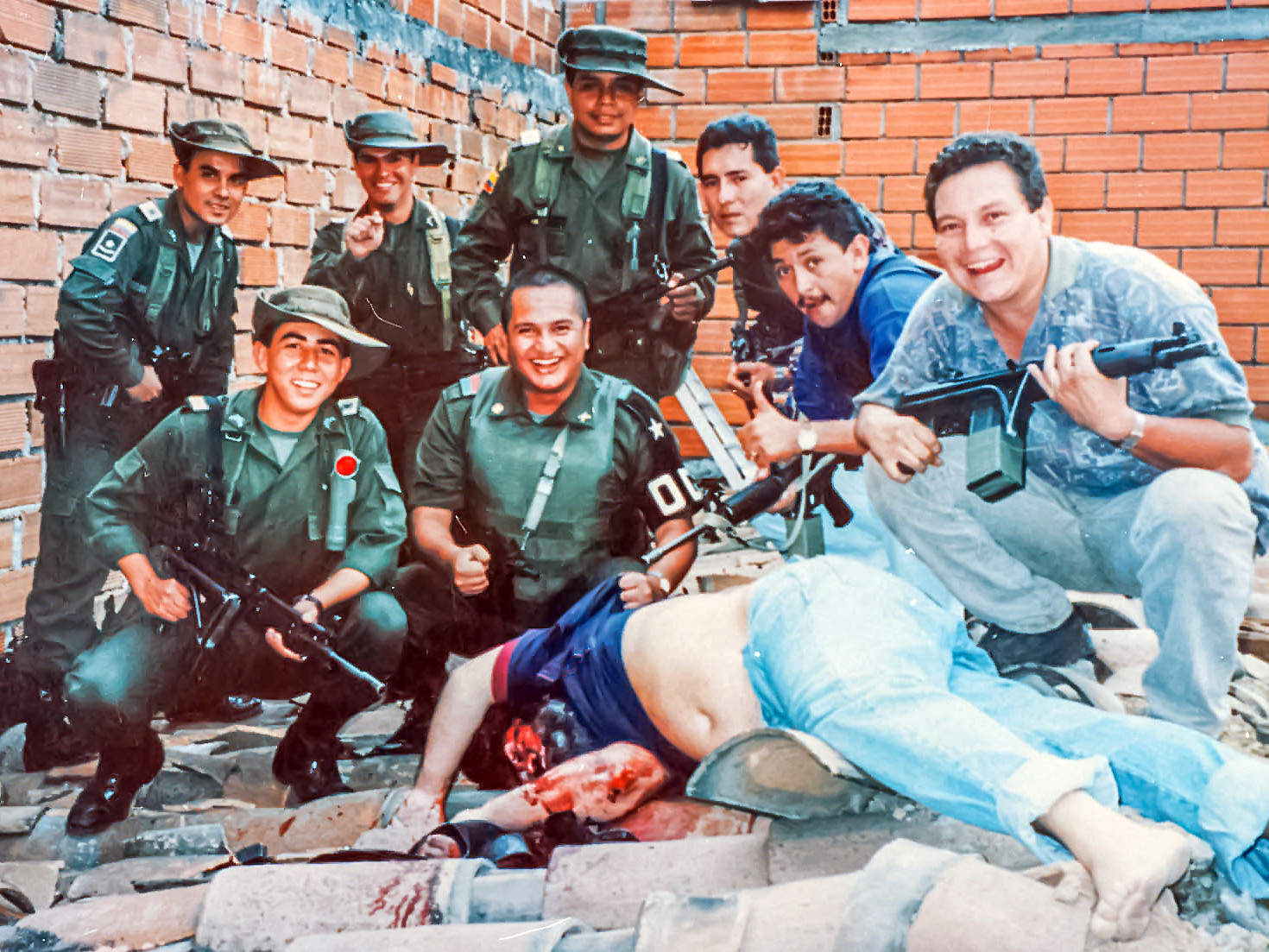
Death of Pablo Escobar
Escobar knew the rule: two minutes. Any phone call longer than that gave the tracking technology enough time to triangulate his position. For months he had followed the discipline, calling the Hotel Tequendama Residences in Bogotá where his wife and children were confined under police surveillance, disguising his voice as a journalist's, hanging up before the signal could be pinned. On December 2, 1993 -- one day after his 44th birthday -- he broke the rule. The second call ran long. Within minutes, Colombian special forces were converging on a house in Los Olivos, a middle-class neighborhood in Medellín, and the most powerful drug trafficker in history had less than an hour to live.
The Unraveling
By late 1993, Pablo Escobar was nothing like the man who had once ranked as the seventh-richest person in the world. His Medellín Cartel had been dismantled. His bodyguards were dead or captured -- the last chief of security, known as El Angelito, had been killed by police in October 1992 along with his brother. Escobar's own family was under siege: his mother survived multiple assassination attempts by Los Pepes, a shadowy vigilante group with suspected ties to rival cartels and Colombian security forces. His brother Roberto, already in prison, lost the sight in one eye from a letter bomb sent by the same group. Escobar tried repeatedly to negotiate surrender in exchange for his family's safety, but found no support from the government. He attempted to send his wife Victoria Henao and their children to the United States, then to Germany, but each time they were turned back -- deported from Frankfurt after the DEA alerted German authorities with agents aboard the plane.
The Last Birthday
On December 1, 1993, Escobar celebrated his 44th birthday in hiding with a gathering that measured how far he had fallen. His only companions were his cousin Luzmila Gaviria, his mother, and his last remaining bodyguard, Álvaro de Jesús Agudelo, known as Limón -- a man who had previously served as his brother Roberto's driver. No cartel lieutenants. No entourage. No lavish estate. Escobar had been moving between safe houses by taxi, sharing cramped quarters with Limón, a fugitive so isolated that he had explored becoming an accountant for the FARC guerrillas. By the time he made the birthday call to his family at the Tequendama, the Colombian government was using French and British signal-tracking technology, acquired with DEA assistance, that could not only identify calls but triangulate the caller's location in real time.
Two Minutes Too Many
The fatal call came on the afternoon of December 2. Following his routine, Escobar phoned the Tequendama Residences, disguising his voice. But the second call stretched past the two-minute threshold. The tracking equipment locked onto his signal. Members of the Search Bloc -- the elite Colombian police unit that had hunted Escobar for years, operating with U.S. intelligence support -- moved immediately to the Los Olivos neighborhood. The house sat in a modest residential area near the Atanasio Girardot Sports Complex. When the Search Bloc surrounded the building, Limón fled through a window and dropped to a lower roof. He was hit multiple times while running and fell to the ground below. Escobar attempted to escape across the rooftops. He was struck by bullets in the torso and feet, and then by a single round to the head that killed him.
Questions That Linger
Who fired the fatal shot has never been settled. At least five competing accounts have circulated in the decades since. Escobar's family maintains he killed himself with a shot below the right ear, consistent with the cartel motto of Los Extraditables: "We prefer a grave in Colombia than a prison in the United States." Others attribute the killing to a sniper from Los Pepes, or to a DIJIN officer embedded in the Search Bloc. Colonel Hugo Heliodoro Aguilar, who led the assault team, was also named, though he was later convicted of ties to paramilitary groups in an unrelated case. A former paramilitary fighter claimed that Carlos Castaño Gil, the leader of the United Self-Defense Forces of Colombia, fired the shot. The physical evidence -- a bullet wound behind the right ear on a man running across a rooftop -- is consistent with multiple scenarios, and Colombia has never conducted a definitive forensic inquiry.
A Complicated Mourning
Escobar's death fragmented the Medellín Cartel and shifted the cocaine trade's center of gravity to the rival Cali Cartel, which dominated the market until its own leaders were captured in the mid-1990s. But in Medellín itself, the reaction was not the celebration one might expect. Over 25,000 people attended Escobar's funeral at Monte Sacro Cemetery in Itagüí. Many were from the city's poorest neighborhoods, communities where Escobar had built housing, funded soccer fields, and distributed cash -- a calculated generosity that earned him a Robin Hood reputation among people the Colombian state had largely ignored. Decades later, that complicated legacy persists. Some residents still pray to Escobar as a folk saint. Others, particularly the families of his thousands of victims, see the mourning as an insult to the dead. The rooftop in Los Olivos where he fell has been demolished. The neighborhood moved on. The debate has not.
From the Air
Located at 6.25°N, 75.60°W in the Los Olivos neighborhood of Medellín, Colombia, a middle-class residential area near the Atanasio Girardot Sports Complex. The specific house where Escobar was killed has been demolished. From the air, the neighborhood is part of Medellín's dense urban grid in the Aburrá Valley. Monte Sacro Cemetery in nearby Itagüí, where Escobar is buried, lies to the south. Nearest major airport: José María Córdova International Airport (SKRG), approximately 29 km southeast. Olaya Herrera Airport (SKMD) is the in-city alternative. Best viewed at lower altitudes (3,000-6,000 ft) where the valley geography and the surrounding hillside neighborhoods are visible.