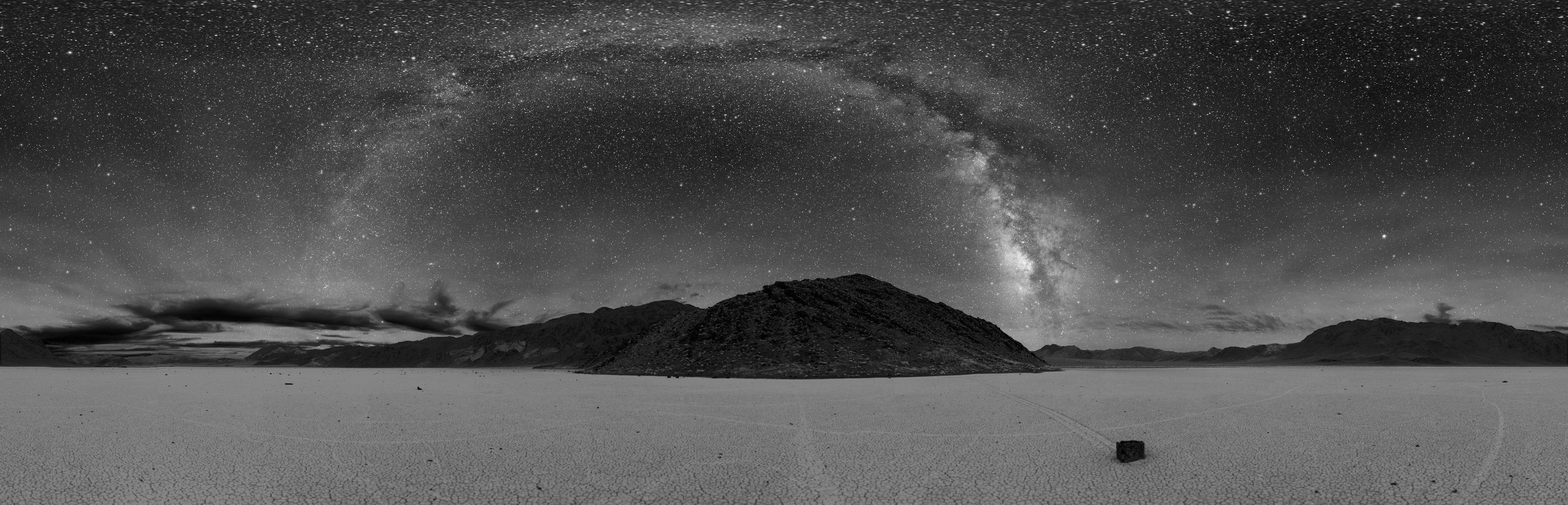
Racetrack Playa Sailing Stones
In one of the most remote corners of Death Valley National Park, rocks move across a dry lakebed without human or animal intervention. The Racetrack Playa is home to the 'sailing stones' - rocks ranging from pebbles to boulders that leave long trails behind them as they travel across the flat, cracked surface. For decades, no one had ever seen the stones move, but the trails proved they did - some tracks stretch over 1,500 feet. The mystery spawned theories from magnetic fields to aliens to elaborate hoaxes. The truth, revealed in 2014 when researchers finally caught the stones on video, was stranger and more mundane: ice sheets forming on flooded playa, pushed by light winds, carrying the rocks along. The stones sail on frozen water.
The Playa
Racetrack Playa is a dry lakebed in the northern part of Death Valley National Park, at 3,700 feet elevation - relatively cool by Death Valley standards. The playa is remarkably flat - one of the flattest places on Earth - measuring about 2.8 miles long and 1.3 miles wide. When wet, the lakebed becomes slick mud; when dry, it cracks into polygonal patterns. Dolomite rocks from the surrounding mountains fall onto the playa and begin their mysterious journeys. The trails they leave can be inches or feet wide, perfectly straight or curved, parallel or diverging. Some rocks sit at the end of long trails; others seem to have moved and stopped without pattern.
The Mystery
The sailing stones were documented at least as early as 1915, and the mystery captured scientific and public imagination for a century. The stones clearly moved - their trails proved it - but no one had ever witnessed the motion. Theories proliferated: strong winds (but some rocks weighed hundreds of pounds), magnetic fields (but the rocks weren't magnetic), pranksters (but no human tracks appeared). Some stones moved while nearby identical stones stayed put. Some turned mid-trail. Some traveled together, then separated. The phenomena seemed to defy physics, inviting paranormal explanations. Scientists were frustrated; they couldn't catch the stones in the act.
The Solution
In 2014, researchers Ralph Lorenz and Richard Norris finally caught the sailing stones moving. Using GPS trackers and time-lapse cameras, they documented the mechanism. In winter, rainwater can flood the playa to a few inches depth. On cold nights, thin ice sheets form. As the ice begins to break up on sunny days, light winds push the ice sheets across the water. Rocks embedded in the ice are carried along. The movement is subtle - inches per second - and occurs only under specific conditions: flooding, freezing, partial thaw, and wind in alignment. A single movement event might occur every few years. The stones sail on ice.
The Access
Reaching Racetrack Playa is an adventure in itself. The playa lies at the end of a 27-mile rough dirt road that requires high-clearance vehicles and often 4WD. There are no services, no water, and no cell signal. Flat tires are common; rescue is difficult. Visitors who reach the playa find it eerily beautiful - the flat expanse, the cracked surface, the mysterious rocks and their trails. The National Park Service asks visitors not to touch the rocks or walk on wet playa (footprints persist for years). The mystery is solved, but the experience remains otherworldly.
Visiting Racetrack Playa
Racetrack Playa is located in the northern part of Death Valley National Park, accessible via Racetrack Valley Road from Ubehebe Crater. The road is 27 miles of rough dirt requiring high-clearance vehicles; check current conditions at the Furnace Creek Visitor Center. Allow 2-3 hours each way plus time at the playa. Bring multiple spare tires, water, food, and emergency supplies - there is no help available. The playa is best visited in winter when temperatures are bearable and ice events are possible (though rarely witnessed). The nearest services are at Stovepipe Wells (50+ miles) or Furnace Creek (60+ miles). Death Valley entrance fees apply. The sailing stones are worth the journey for those prepared for the road.
From the Air
Located at 36.68°N, 117.56°W in northern Death Valley National Park, California. From altitude, Racetrack Playa is visible as a nearly white flat oval surrounded by dark mountains - one of the flattest surfaces visible in the rugged terrain. The playa is at 3,700 feet elevation, cooler than the valley floor. The Cottonwood Mountains border the east; the Last Chance Range to the west. Ubehebe Crater is visible to the north. The extreme isolation is apparent - no roads are visible except the faint track approaching the playa. Death Valley's floor is visible to the south and east, including the salt flats of Badwater Basin.