Deccan Traps
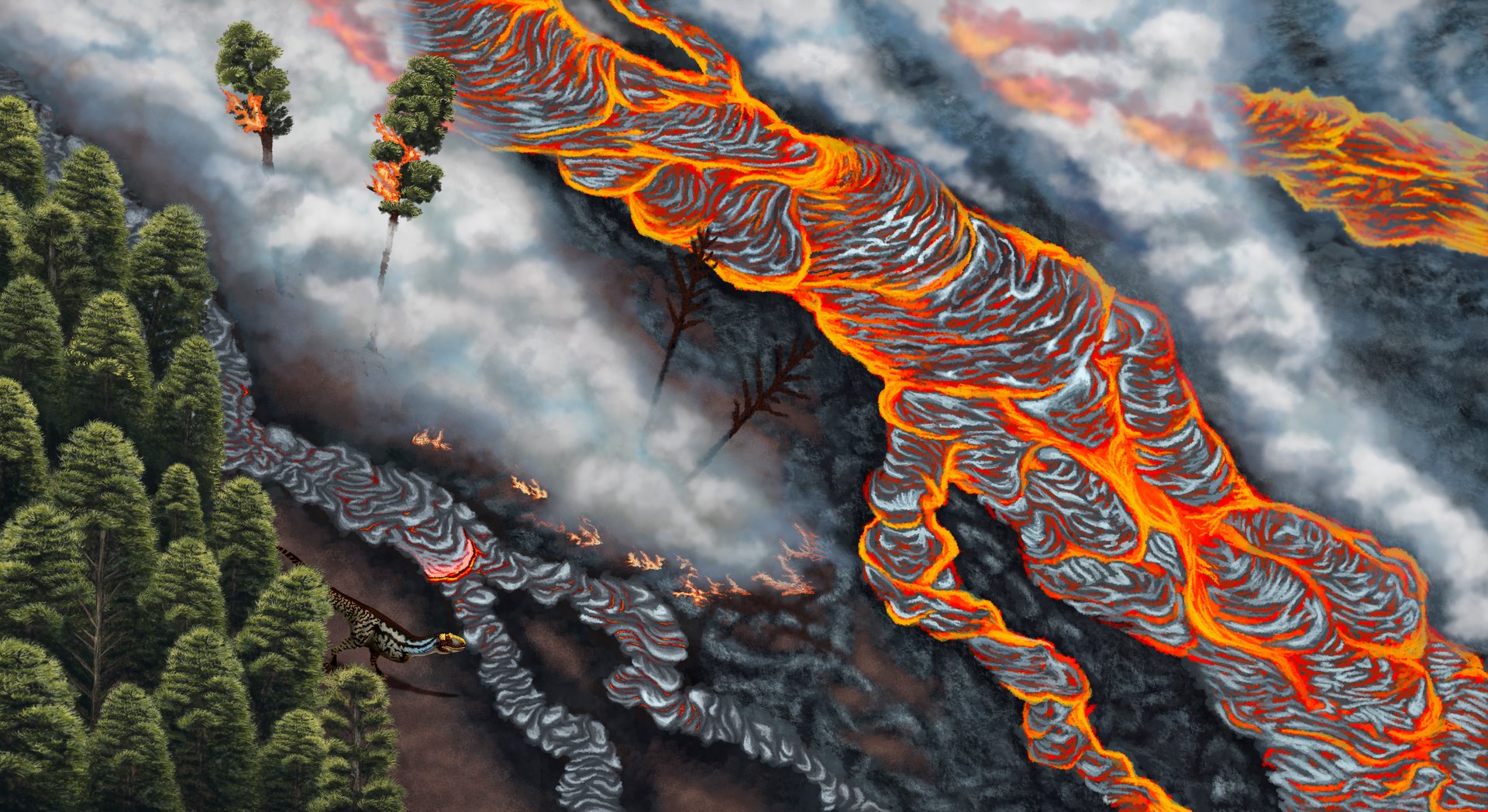
The word comes from Swedish: trapp, meaning stairs. Fly over western India and you can see why. The landscape descends in enormous terraced steps, each one a layer of solidified lava stacked on the last, the whole formation more than two kilometers thick in places. The Deccan Traps are not a volcano in the conventional sense. They are the remnant of something far larger: a flood basalt eruption that began roughly 66 million years ago and poured lava across an area estimated at 1.5 million square kilometers, approximately half the size of modern India. That timing, coinciding almost exactly with the extinction of the dinosaurs, has fueled one of geology's longest-running debates.
A Staircase Built by Fire
The numbers are almost incomprehensible. The Deccan Traps currently cover about 500,000 square kilometers of west-central India, reduced from their original extent by millions of years of erosion and the slow grinding of plate tectonics. Their total volume approaches one million cubic kilometers of basalt. The eruptions occurred over a span of 600,000 to 800,000 years, straddling the Cretaceous-Paleogene boundary between 66.3 and 65.6 million years ago. The name Deccan itself derives from Sanskrit, meaning "southern," and the province divides into four subregions: the main Deccan, the Malwa Plateau, the Mandla Lobe, and the Saurashtran Plateau. Geologists segment the formation into three stratigraphic units - Upper, Middle, and Lower traps - though current thinking ties these layers more to ancient topography and distance from the eruption center than to distinct eruptive phases. The basalt is composed primarily of olivine, pyroxenes, and plagioclase, along with iron-titanium-rich oxides, a mineral signature characteristic of deep-mantle origin.
The Extinction Question
Did the Deccan Traps kill the dinosaurs? For decades, some scientists, notably Princeton geologist Gerta Keller, argued that the volcanic gases released during the eruptions played a major role in the Cretaceous-Paleogene mass extinction. Sulfurous emissions could have caused sudden cooling, while carbon dioxide would have driven longer-term warming. A 2024 study of fossilized peat chemistry found that the Traps caused roughly 3 degrees Celsius of warming over the final 100,000 years of the Maastrichtian age, along with a sharp 5-degree temperature drop lasting less than 10,000 years during the peak Poladpur eruptive phase. But by the time of the actual extinction boundary, global temperatures had returned to previous levels. The current scientific consensus points firmly to the Chicxulub asteroid impact in what is now Mexico's Yucatan Peninsula as the primary extinction trigger. A 2020 study went further, suggesting the Deccan eruptions may have partially counteracted the climatic effects of the impact rather than compounding them. The debate has quieted, though it has not entirely ended.
Born from a Plume
The engine behind the Deccan Traps was a mantle plume, a column of superheated rock rising from deep within the Earth. The same hotspot is now located beneath Reunion Island in the Indian Ocean, thousands of kilometers from India, because the Indian tectonic plate has been moving northward ever since. Helium isotope ratios in the erupted basalts carry the chemical fingerprint of deep-mantle material, supporting the plume origin theory. The correlation between volcanism and plate motion is striking: marine magnetic profiles show that India's northward drift accelerated sharply at the onset of the eruptions around 67 million years ago, reached peak velocity during the most intense volcanism, and slowed again by 63 million years ago as the main eruptive phase ended. Even the African Plate's rotation slowed in tandem, both plates apparently driven by the force of the Reunion plume head. The plume also opened the rift that separated the Mascarene Plateau from India, a tectonic scar still visible in the ocean floor.
The Shiva Crater Mystery
Off the west coast of India, a geological structure on the sea floor has been proposed as another impact crater, dated to approximately 66 million years ago. Dubbed the Shiva crater, it would, if confirmed, represent a second major asteroid strike at the time of the extinction. Proponents suggest such an impact could have triggered or intensified the Deccan volcanism, since the proposed crater sits near the eruption zone. The idea is tantalizing but unresolved. The current consensus among Earth scientists holds that the feature is unlikely to be an actual impact crater, and without stronger evidence, the Shiva hypothesis remains speculative. What is not speculative is the landscape itself. The step-like hills of western India, the dark basalt cliffs of the Western Ghats, the flat-topped plateaus stretching east toward Nagpur - all of it is solidified lava from eruptions that reshaped a continent and coincided with one of life's great turning points.
From the Air
Centered around 18.85N, 73.72E in western India, the Deccan Traps span an enormous area from the Western Ghats eastward across Maharashtra. From cruising altitude, look for the distinctive step-like topography of the Western Ghats escarpment, where layered basalt creates terraced cliff faces visible even from 30,000 feet. The hill station of Matheran sits atop characteristic trap geology. Pune Airport (VAPO) lies within the formation. Mumbai's Chhatrapati Shivaji International Airport (VABB) sits on the coastal plain at the western edge of the Traps. The flat-topped plateaus and dark basalt exposures are most visible in the dry season (October-May) when vegetation is sparse.