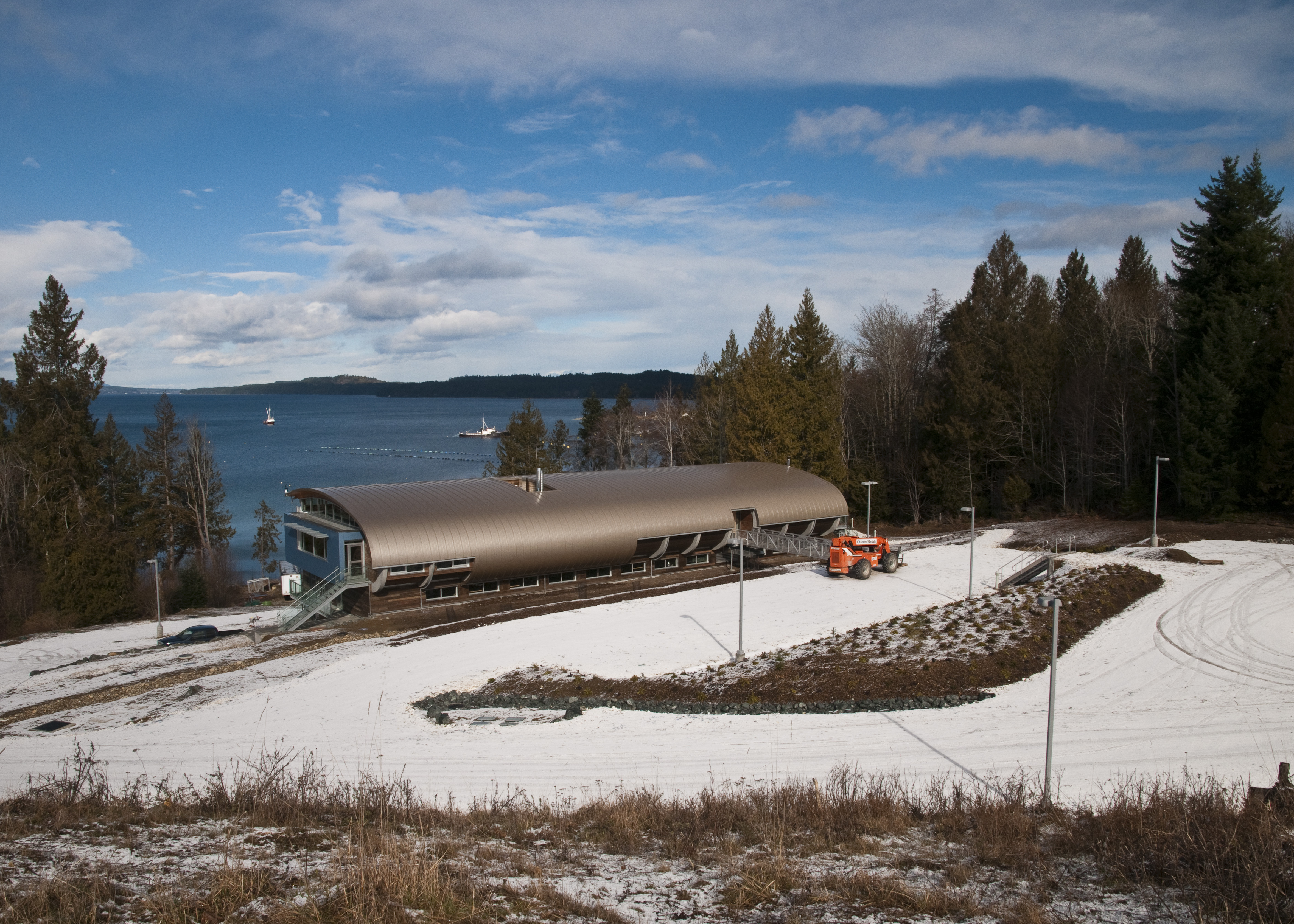
Deep Bay Marine Field Station
The ocean is becoming more acidic, and oyster larvae are struggling to form their shells. That single fact drives much of the work at Deep Bay Marine Field Station, a research and education facility perched on the shore of Baynes Sound on Vancouver Island, 78 kilometers northwest of Vancouver Island University's main campus in Nanaimo. When the station opened in 2011, it was the first building at any Canadian university to earn a LEED Platinum certification, an architectural statement about sustainability that matched the mission of the research happening inside.
Breeding for Survival
The station's flagship research program is oyster broodstock conditioning, a long-term partnership between Vancouver Island University and the BC Shellfish Growers Association. Ocean acidification, driven by rising atmospheric carbon dioxide dissolving into seawater, has made it increasingly difficult for shellfish larvae to build the calcium carbonate shells they need to survive. Wild oyster stocks have declined, and commercial hatcheries struggle to produce healthy seed. The Deep Bay team is working on selective breeding, identifying oyster lines that show natural resistance to changing water chemistry while maintaining enough genetic diversity to avoid the pitfalls of inbreeding. The goal is practical: a pool of broodstock that performs well in Baynes Sound and the broader Salish Sea.
From Geoducks to Kelp Forests
The station's earliest research focused on geoduck clams, those improbable bivalves with necks that can extend over a meter, and on the possibility of restoring native Olympia oysters to Baynes Sound. A NextGen Shellfish Hatchery was created to supply local shellfish farmers with oyster seed, connecting academic research directly to the livelihoods of coastal communities. In 2025, the station expanded its scope further, hosting kelp forest restoration research through the Kelp Rescue Initiative. Kelp forests are critical marine ecosystems that provide habitat, sequester carbon, and buffer coastlines, but they are disappearing along the Pacific coast at an alarming rate. The station's seawater tank farm, four laboratories, and demonstration shellfish farm provide the infrastructure for research that spans from microscopic larvae to entire marine ecosystems.
Where the Whales Are on the Wall
Deep Bay is not just a research station. Two display aquaria, touch tanks, exhibits on local whales including two whale skeletons, and guided tours make the facility accessible to anyone willing to drive the winding road along Baynes Sound. School groups from kindergarten through grade 12 come for hands-on marine science field trips. VIU students in the Fisheries and Aquaculture program work alongside researchers in algal and larval labs, while students from other programs contribute data analysis, computer systems development, and business analysis for the shellfish industry. The station bridges a gap that many research facilities struggle with: connecting rigorous science to public understanding without dumbing down either.
The Sound That Feeds the Coast
Baynes Sound, the narrow channel between Vancouver Island and Denman Island, produces roughly half of British Columbia's farmed shellfish. The Deep Bay Marine Field Station exists because this particular stretch of coast matters enormously to the provincial economy and to the ecological health of the Salish Sea. What happens in these waters, whether oyster larvae can form shells, whether kelp forests recover, whether invasive species gain footholds, ripples outward to affect fisheries, tourism, and Indigenous food sovereignty across the region. The platinum-certified building on the shore is a statement of intent: that the science of sustaining marine ecosystems deserves the same investment and seriousness as the industries that depend on them.
From the Air
Located at 49.456N, 124.735W at Deep Bay on the east coast of Vancouver Island, along the shore of Baynes Sound. The station is a modern building visible at the waterline near the small community of Deep Bay. Denman Island lies directly across Baynes Sound to the east. Nearest airport is Comox Valley Airport (CYQQ), approximately 20 km northwest. Recommended viewing altitude 2,000-4,000 ft AGL to see the station in context with Baynes Sound and the shellfish farms visible as grid patterns in the water.