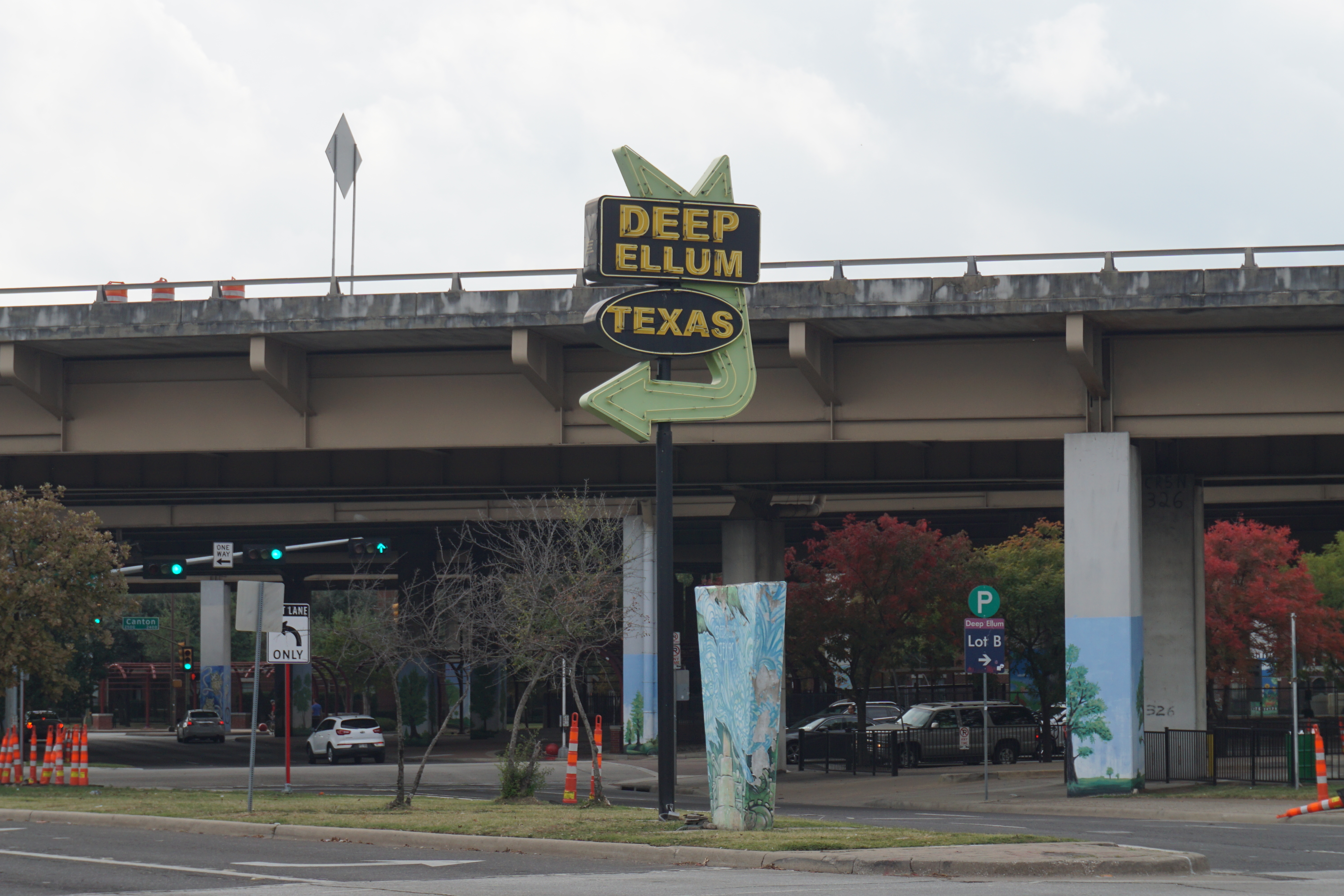
Deep Ellum, Dallas
While Conrad Hilton was building the whites-only Dallas Hilton downtown and the Adolphus Hotel was hosting Benny Goodman and Glenn Miller, the Boyd Hotel on Elm Street in Deep Ellum was drawing a different clientele. Lead Belly stayed there. So did Blind Lemon Jefferson. The two neighborhoods -- gleaming downtown and gritty Deep Ellum -- sat barely a mile apart across the dry Trinity River bed, but they occupied different worlds. Deep Ellum's name is a local corruption of 'Deep Elm,' after the stretch of Elm Street that ran past the railroad junction on the east side of town. The neighborhood was founded by formerly enslaved people in the 1870s, became one of the largest African-American communities in the South, and spent the next 150 years cycling between vitality and erasure.
Where the Tracks Crossed
Deep Ellum traces its origin to the meeting point of the Houston and Texas Central railroad track and the Texas and Pacific line, which were connected by 1873. When the first train came into Dallas in 1872, roughly 500 African Americans were already living in the area. The railroad junction spurred a local economy around the shipping industry, and families settled along the stretch of Elm Street just east of downtown. Together with the nearby Freedman's Town, Deep Ellum became one of the largest African-American communities in the South. The neighborhood is still sometimes called Central Track, after the rail line that gave it life. By the 1890s, theaters and entertainment venues had sprung up to serve the growing community. The railroad junction's historical importance can still be read in the street grid and building orientation of the surrounding blocks.
The Sounds That Came Up from Elm Street
In the 1920s and 1930s, Deep Ellum became a hotbed for early jazz and blues. Blind Lemon Jefferson, Blind Willie Johnson, T-Bone Walker, Lightnin' Hopkins, Whistlin' Alex Moore, and Bessie Smith all performed on its streets and in its clubs -- The Gypsy Tea Room, The Harlem, The Palace. Robert Johnson recorded 27 tracks with producer Don Law in a nearby Vitagraph recording studio in downtown Dallas. A 1937 newspaper columnist described the neighborhood as a place where you could find gun shops, tattoo studios, pawn shops, domino halls, pool halls, and walk-up hotels, while on the sidewalks 'pigeon droppers, reefer men, craps shooters, card sharps, and sellers of cocaine and marijuana' mingled with the foot traffic. From 1920 to 1950, the number of nightclubs, cafes, and domino parlors in Deep Ellum grew from 12 to 20.
Erased by Concrete
The Central Expressway, begun in 1947 and completed by 1949, cut through Deep Ellum and scattered its African-American population. In the early 1940s, the railway that had birthed the neighborhood was torn out over the strong objections of residents. Two decades of conflict between the city and remaining residents followed. By 1968, freeway construction had commenced, and most residents were displaced. The neighborhood that had produced some of America's most important early blues musicians was largely demolished to make room for highway on-ramps and parking lots. What remained were empty warehouses, shuttered storefronts, and the bones of an industrial district -- including Robert S. Munger's Continental Gin Company complex, which by 1888 had become the largest manufacturer of cotton-processing equipment in the United States.
Architects of Deep Ellum
Deep Ellum's built environment carries layers of unexpected history. Henry Ford selected the neighborhood in 1914 as the site for one of his earliest automobile assembly plants, a four-story brick and terracotta building at 2700 Canton Street designed by architect John Graham for the Ford Model T. The plant operated until the mid-1930s. The Knights of Pythias Temple at 2551 Elm Street, opened in 1916, was designed by William Sidney Pittman -- the state's first Black architect and son-in-law of Booker T. Washington. The temple housed some of Dallas's earliest offices for Black doctors, dentists, and lawyers and served as the social and cultural center for the African-American community until the late 1930s. Both structures survived the highway era. The Ford plant became Adam Hats in 1959 and loft apartments in 1997. The Knights of Pythias Temple was converted into a hotel, becoming the first to newly operate in Deep Ellum in the modern era.
Warehouses into Stages
By the mid-1980s, artists, musicians, and entrepreneurs began moving into Deep Ellum's abandoned shops and warehouses. The 1980s and 1990s marked the neighborhood's return as Dallas's liveliest entertainment district -- streets blocked to traffic on weekends, 57 bars and nightclubs by 1991, tattoo parlors and loft spaces filling in the gaps. Venues like Trees, Club Dada, The Curtain Club, and Deep Ellum Live became fixtures of the Texas music scene. The Lizard Lounge stood for 28 years as a mecca of electronic music and Goth before closing in 2020. The neighborhood has endured cycles of decline and reinvention since -- crime scares in the mid-2000s, infrastructure improvements in 2014 and 2015, an influx of corporate tenants. But the underlying pattern repeats: empty buildings attract creative people, creative people attract crowds, crowds attract investment, investment displaces the people who came first. Deep Ellum has lived this cycle since the 1870s.
From the Air
Located at 32.784°N, 96.781°W, directly east of downtown Dallas across the I-345 freeway corridor. The neighborhood occupies a grid of low-rise brick warehouses and commercial buildings easily distinguishable from the modern high-rises of downtown to the west. Best viewed from 1,500-3,000 ft AGL. Nearest airports: KDAL (Dallas Love Field, 6 nm NW), KDFW (Dallas/Fort Worth International, 22 nm NW). The elevated freeway dividing Deep Ellum from downtown is a clear visual marker. Look for the cluster of older brick buildings and mural-covered walls east of the freeway.