Deepwater Horizon Oil Spill
Scientists call it a dirty blizzard. In the months after the Deepwater Horizon wellhead ruptured on April 20, 2010, oil in the water column began clumping around suspended sediments and falling to the ocean floor in what researchers described as an underwater rain of oily particles. The crude did not simply float on the surface and wash ashore. It infiltrated every layer of the Gulf of Mexico, from the deep-sea sediments to the zooplankton at the base of the food chain. Estimated to be 8 to 31 percent larger in volume than the previous record-holder, the Ixtoc I spill of 1979, the Deepwater Horizon oil spill became the largest accidental marine oil spill in the history of the petroleum industry and one of the largest environmental disasters in world history.
Eighty-Seven Days of Crude
For nearly three months, oil gushed from the broken Macondo Prospect wellhead on the floor of the Gulf of Mexico. BP initially attempted to close the blowout preventer valves using remotely operated underwater vehicles, but every effort failed. The fundamental strategies were containment, dispersal, and removal. At the peak of the response, approximately 47,000 people and 7,000 vessels were mobilized. Containment booms stretching over hundreds of miles were deployed to corral oil and protect marshes, mangroves, and shellfish habitats. Controlled burns blackened the sky over the Gulf. Skimmer ships worked the surface. By early June 2010, oil had washed up on Louisiana's coastline and spread to the shores of Mississippi, Florida, and Alabama. The well was not effectively sealed until September 2010. By October 2012, federal response costs alone had reached $850 million, and BP's total cleanup expenditure had exceeded $14 billion.
The Corexit Experiment
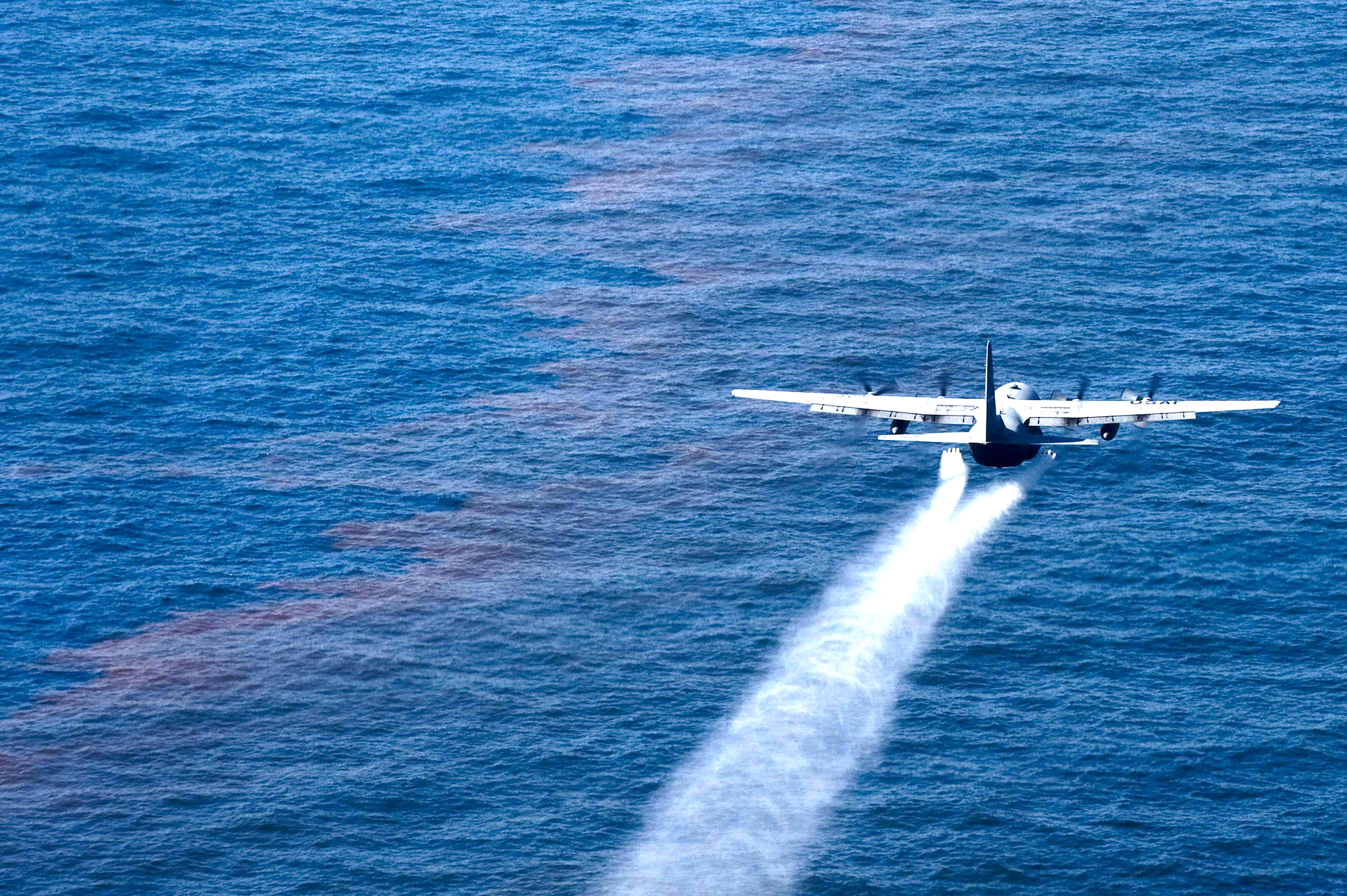
The spill became notable not just for the volume of oil released, but for the unprecedented quantities of chemical dispersant used to combat it. Corexit, the primary dispersant applied, was deployed in methods described as purely experimental, including injection directly at the wellhead on the seafloor. According to a NALCO manual obtained through freedom of information requests, Corexit 9527 is an eye and skin irritant that can cause injury to red blood cells, kidneys, and the liver. The manual warned against skin contact and advised protective clothing. Yet neither the protective gear nor the safety manual were distributed to Gulf oil spill cleanup workers. Scientists later concluded that mixing oil with dispersant increased toxicity to ecosystems and effectively made the spill worse. The dispersant pushed oil below the surface, creating subsurface plumes of dissolved hydrocarbons that extended horizontally across vast stretches of the northern Gulf, reaching as far as the continental shelf off Tampa Bay.
A Gulf Ecosystem Unraveled
The spill area hosted 8,332 species, including more than 1,270 fish species, 218 bird species, 4 sea turtle species, and 29 marine mammal species. The damage to this ecosystem was staggering and long-lasting. Researchers estimated that over one million coastal birds died as a direct result of the spill. Endangered Kemp's ridley sea turtles, which had averaged about 100 strandings per year before the disaster, began stranding at a rate of roughly 500 per year. In 2013, a study found that half of 32 dolphins captured near southeastern Louisiana were seriously ill or dying. By April 2016, researchers reported that 88 percent of approximately 360 baby or stillborn dolphins within the spill area had abnormal or underdeveloped lungs, compared to 15 percent in unaffected areas. Former NASA physicist Bonny Schumaker, who flew over the area repeatedly after 2010, described a dearth of marine life in a wide radius around the wellsite. Oil on the seafloor showed no signs of degrading even years later.
The Human Toll Beyond the Rig
The disaster did not end at the waterline. By June 2010, 143 spill-exposure cases had been reported in Louisiana alone, most involving cleanup workers. A Louisiana physician called it the biggest public health crisis from chemical poisoning in the country's history. Cleanup workers reported eye, nose, and throat irritation, respiratory problems, seizures, and skin lesions. Many said they were forbidden from using respirators on the job and threatened with termination if they did. Investigations by Newsweek and ProPublica found that BP failed to distribute the legally required safety manual for Corexit and did not provide adequate safety training or protective gear. Studies of children living within 10 miles of the coast found that more than a third of parents reported physical or mental health symptoms, including unexplained bleeding and early onset of menstruation. The economic toll was equally severe: an estimated $22.7 billion in lost tourism, $247 million in closed fisheries, and a projected $8.7 billion impact on Gulf fisheries by 2020.
Accountability at the Bottom of the Sea
In September 2014, US District Judge Carl Barbier ruled that BP had acted with gross negligence and willful misconduct, describing the company's actions as reckless and driven primarily by a desire to save time and money rather than ensuring the well was secure. He apportioned 67 percent of blame to BP, 30 percent to rig owner Transocean, and 3 percent to cementer Halliburton. BP pleaded guilty to 11 felony counts related to the deaths of the 11 rig workers and paid a $4 billion criminal fine. In July 2015, the company agreed to an $18.7 billion settlement with the US government and five Gulf states. BP's total costs for cleanup, environmental and economic damages, and penalties reached $54 billion. A 2018 analysis estimated the ultimate cost at $145.93 billion. No individual executives served prison time. The Gulf continues to recover, but tar balls still wash ashore, and the oil embedded in the seafloor remains part of the food chain, a slow-motion consequence measured not in quarters but in generations.
From the Air
Located at 28.74N, 88.37W in the open Gulf of Mexico, approximately 40 nautical miles southeast of the Louisiana coast at the Macondo Prospect site. No surface features mark the location today. Oil spread across coastlines from Louisiana to the Florida Panhandle and into Tampa Bay. Nearest airports include Venice Heliport (LA34) and the New Orleans area airports KNEW (Lakefront) and KMSY (Louis Armstrong International), approximately 100 nm northwest. During the spill, the FAA implemented a temporary flight restriction zone over the operations area. The area is open Gulf water with offshore weather patterns. Best appreciated at low altitude along the Louisiana coastal marshes where the impact was most visible, particularly around Bay Jimmy in Plaquemines Parish and the barrier islands.
Sources
- Wikipedia - Deepwater Horizon oil spill
- Audubon - More Than One Million Birds Died During Deepwater Horizon Disaster
- Wikipedia - Health consequences of the Deepwater Horizon oil spill
- Oceana - 87 Days Too Late, BP Finally Stops Deepwater Horizon Blowout
- Journal of Corporate Accounting & Finance - Ultimate Costs (2018)