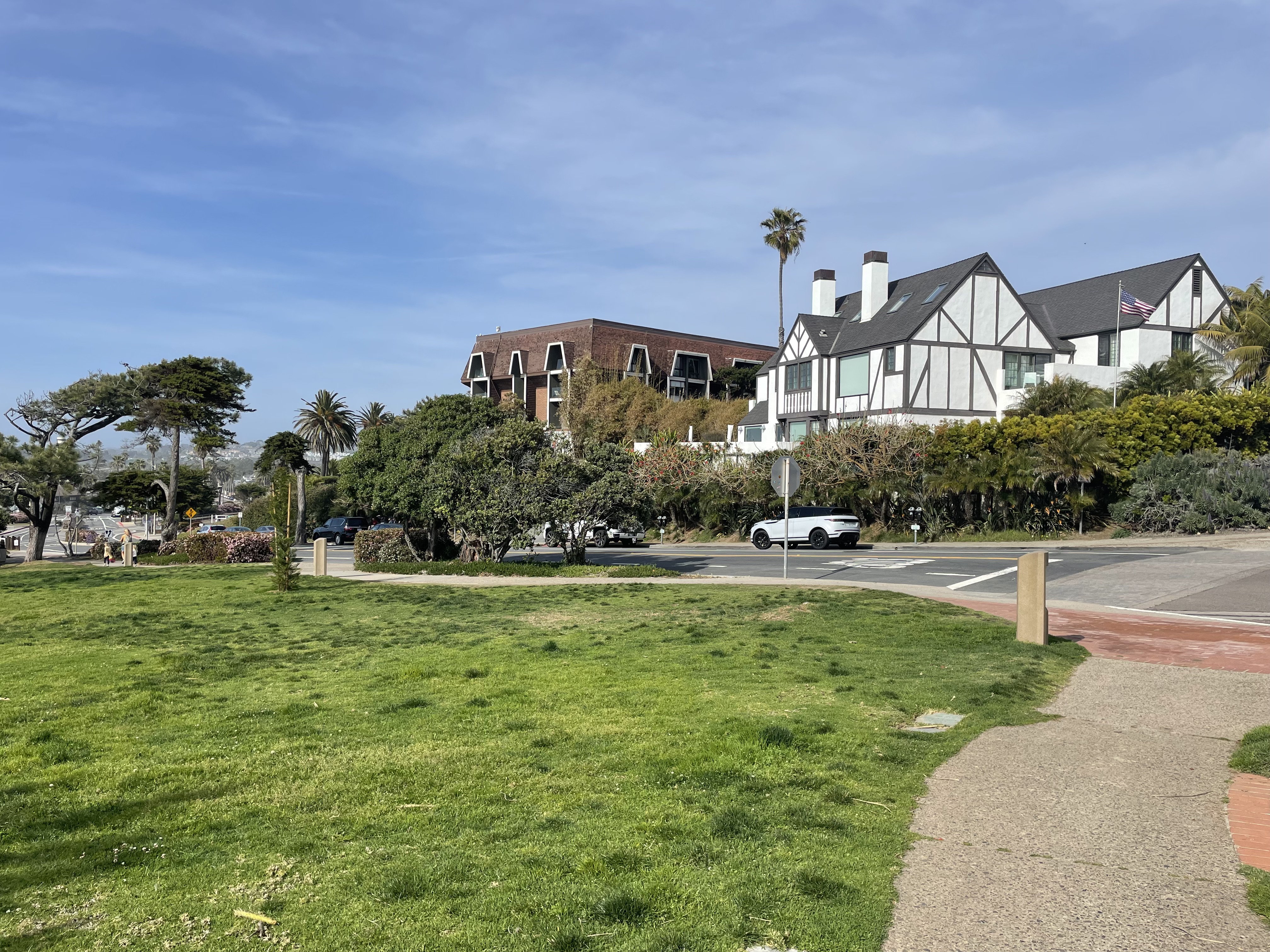
Del Mar, California
The Torrey pine grows naturally in exactly two places in the world: the coastal bluffs above Del Mar and the interior of Santa Rosa Island, fifty miles offshore. It is the rarest native pine tree in the United States. The trees are gnarled by coastal winds, salt-tolerant, and adapted to the thin sandstone soils of the Torrey Pines mesa. They were here long before the Spanish, the ranchos, the railroad, and the racetrack. They will likely be here after all of those things have run their course.
A Town on the Coast
Del Mar incorporated as a city in 1959, but its history as a settlement goes back much further — to the Kumeyaay people who inhabited this stretch of coast, to the Spanish missions, and to the cattle ranches of the Mexican and early American periods. The town's modern character took shape with the arrival of the railroad in the 1880s, which made the coast accessible to visitors from Los Angeles and San Diego. A resort hotel opened. Lots were sold. The town that emerged was small — Del Mar has never exceeded 5,000 residents — and oriented entirely around its coastal location. The bluffs above the Pacific, the beaches below, and the valley of the San Dieguito River to the south define the city's geography.
The Racetrack and the River Valley
Del Mar Racetrack, which sits in the San Dieguito River valley on the northern edge of the city, opened in 1937. Bing Crosby was among its founders and used his celebrity to draw attention to what was then a new venture. The track became one of the premier horse racing venues on the West Coast, hosting graded stakes races and drawing horses and bettors from across the country. 'Where the surf meets the turf' became its advertising slogan — a phrase that captured the proximity of the ocean to the track's rail. The Del Mar Fairgrounds, which surrounds the track, hosts the San Diego County Fair each summer and various other events throughout the year. The racetrack and fairgrounds occupy a flat valley floor that contrasts with the blufftop residential neighborhoods that define the city's visual character from the sea.
The Trees on the Mesa
Torrey Pines State Natural Reserve encompasses the bluffs north of Del Mar and preserves the largest natural stand of Torrey pines — Pinus torreyana — in existence. The species was identified and named by John Torrey, a nineteenth-century botanist, though it was already known to the Kumeyaay. The trees are slow-growing, twisted by the prevailing onshore winds into shapes that look sculptural from a distance and ancient up close. They grow in soil so thin and nitrogen-poor that few other conifers could survive; the Torrey pine has adapted to conditions that exclude competition. The reserve also contains coastal sage scrub, chaparral, and some of the best-preserved examples of Torrey Pines sandstone formation, the layered coastal cliff geology that defines the visual character of this entire stretch of coast.
Living at the Edge
Del Mar's bluff-top neighborhoods are among the most desirable — and most geologically precarious — residential locations in San Diego County. The sandstone cliffs erode. Houses that once had generous setbacks from the cliff edge have less generous ones than they did before. The city and the county have managed coastal bluff erosion through various means, with varying success. The beach at Del Mar — a wide strand that gets crowded in summer and wide and empty in winter — is accessed by stairs cut into the cliffs or by the Camino Del Mar road that descends from the bluff. The combination of bluff erosion, rising sea levels, and high property values makes Del Mar a useful case study in the pressures facing California's coastal communities. The Torrey pines, rooted in the thin sandstone, are watching all of it.
From the Air
Located at 32.955°N, 117.264°W on the San Diego North County coast, approximately 18 miles north of downtown San Diego. The city's coastal bluffs and the Torrey Pines mesa to the north are clearly visible from the air. The Del Mar Racetrack and Fairgrounds occupy the San Dieguito River valley just north of the city center. The Los Peñasquitos Lagoon lies to the south. San Diego International Airport (KSAN) is approximately 16 miles to the south-southeast.