Delft University of Technology
A coffee machine caused the fire. That, at least, was the leading theory: a short circuit in the machine, possibly triggered when a water pipe ruptured nearby, set off a blaze on 13 May 2008 that consumed the building of the Faculty of Architecture. By the end of the day, the second floor and everything above it was gone. People had time to evacuate, and the items on the lower floors survived, including chairs by Gerrit Rietveld and Le Corbusier, the architecture library, and many of the architecture models. But for one of the most respected architecture schools in Europe, losing your faculty building to a coffee maker is the kind of indignity nobody quite plans for. TU Delft moved the program into the university's former main building, where it still operates. The fire is now a story the students tell each other. The university, which had survived two centuries of crises larger than this one, kept building.
Founded to administer a colony
King William II of the Netherlands established the institution on 8 January 1842 as a royal academy. The original purpose, baldly stated, was to train civil servants for work in the Dutch East Indies. The colonial government needed engineers, surveyors, and administrators who could run things in the far end of the empire, and the new academy in Delft was meant to supply them. Over the following decades the mission broadened. The school became a polytechnic in 1864, an institute of technology with full university status in 1905, and the Delft University of Technology in name in 1986. The Dutch colonial era ended along the way, but the university kept growing. Today TU Delft educates around 27,000 students across eight faculties, with another 3,500 doctoral candidates and close to 4,500 teaching, research, and support staff. International student numbers have climbed steadily. The biggest cohorts in 2022 came from China, India, and Belgium. About 46 percent of Aerospace Engineering students that year were not Dutch.
The faculty of consequence
Two TU Delft alumni have won Nobel Prizes. Jacobus van 't Hoff received the first Nobel Prize in Chemistry in 1901 for his work on solutions; Simon van der Meer shared the 1984 Prize in Physics for stochastic cooling. A third Nobelist, Heike Kamerlingh Onnes, taught at Delft as an assistant to Johannes Bosscha before going on to liquefy helium and discover superconductivity, work that earned him the Physics Prize in 1913. Martinus Beijerinck, working at TU Delft in 1898, identified the cause of tobacco mosaic disease and in doing so discovered the existence of viruses. Albert Kluyver, his successor at the university, founded comparative microbiology and gave the Delft School of Microbiology its name. Engineering had its own pantheon. Bernard Tellegen invented the pentode vacuum tube and the gyrator. Balthasar van der Pol gave his name to the Van der Pol oscillator. Vic Hayes, sometimes called the father of Wi-Fi, was on the Faculty of Technology, Policy and Management. Wubbo Ockels, the first Dutch astronaut, was a professor in Aerospace Engineering.
What gets built here
TU Delft research produces things you have probably used without knowing it. GLARE, a fibre-metal laminate, makes up part of the skin of the Airbus A380. Cees Dekker's laboratory built the first transistor from a single carbon nanotube in 1998. Jaap Haartsen, a TU Delft alumnus, developed Bluetooth. The Delta Works, the massive system of dams and storm-surge barriers that protect the southwestern Netherlands from the sea, was partly the work of TU Delft graduates including Johan Ringers and Victor de Blocq van Kuffeler. The Nuna solar-powered car has won the World Solar Challenge eight times. The DUT Racing team once held the Guinness record for fastest-accelerating electric vehicle. The Stratos II+ rocket, built by Delft Aerospace Rocket Engineering, broke the European amateur altitude record in 2015 at 21,457 meters. The Ocean Cleanup, a project to remove plastic from ocean gyres, started here. Quantum computing research at QuTech, the Kavli Institute of Nanoscience, the Reactor Institute Delft, all sit on the same campus that started as a finishing school for colonial bureaucrats.
Mekelpark, a campus in a park
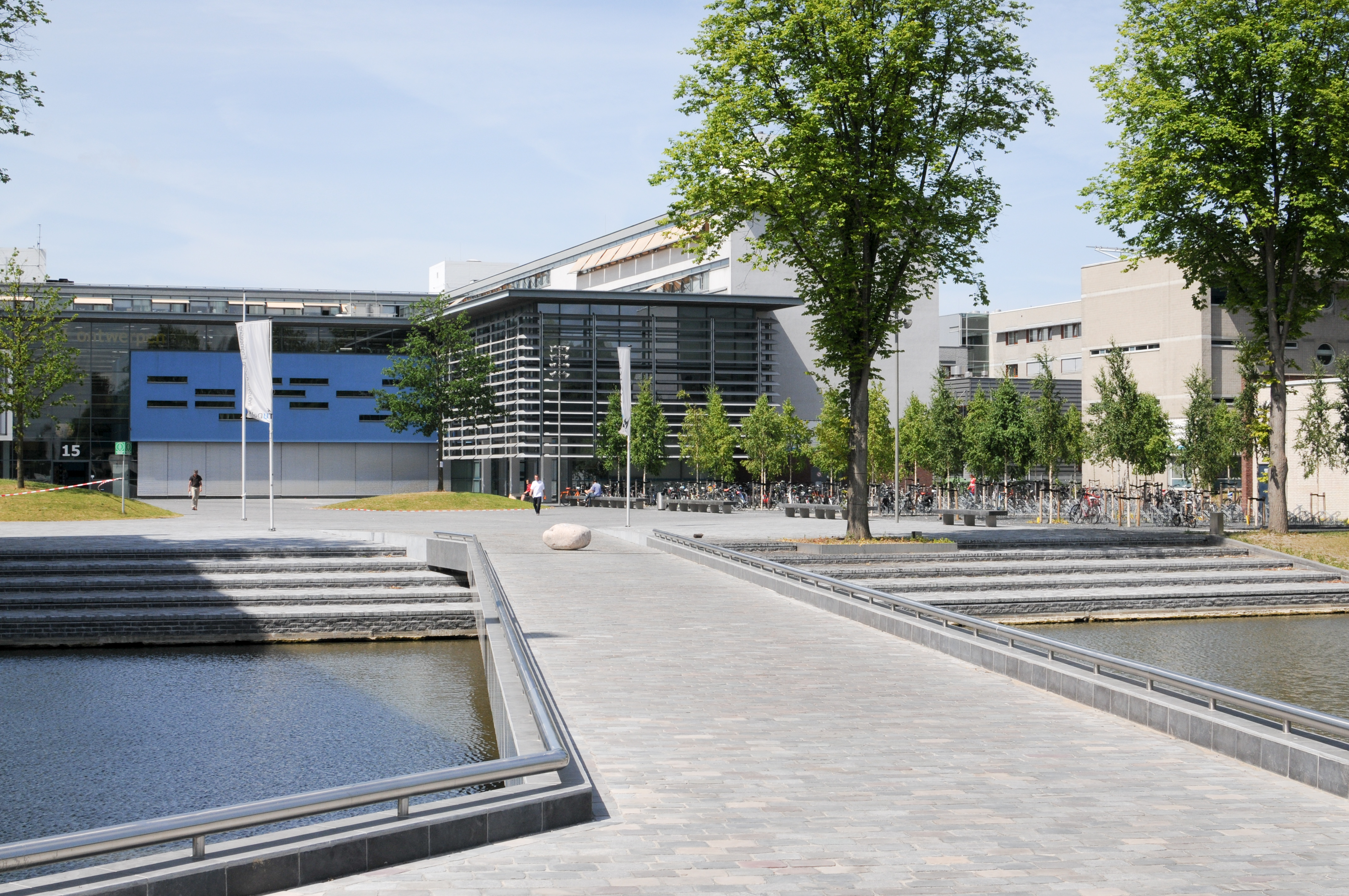
The university spent its first century in the historic center of Delft, scattered through old buildings along the city's canals. The last institute moved out in 1997. The new center of gravity is Mekelpark, opened on 5 July 2009, an 832-meter promenade running between the faculty buildings on the Mekelweg. The park is named for Jan Mekel, a Delft physics professor and World War II resistance fighter who was executed by the Nazis at Sachsenhausen on 2 May 1942. Where parking lots and a service road once cut between the buildings, there is now a long pedestrian spine flanked by stone benches that stretch a kilometer and a half end to end. The Hortus Botanicus, dating to 1917 and originally established by Gerrit van Iterson Jr. as a Proof Garden for Technical Plantation, sits at the edge of campus. Echo, the campus's energy-positive education building, won the Prix Versailles in the Campuses category in 2023. The Science Centre Delft, near the old geodesy building, exhibits ongoing research alongside historical instruments. Mecanoo, the firm founded by TU Delft alumna Francine Houben, designed the library: a grass-covered roof rising toward a cone that pierces the lawn like a steel finger pointing at the sky.
The architects who never left
TU Delft's Architecture faculty has produced a generation of Dutch architects whose work shaped the country. Francine Houben co-founded Mecanoo. Winy Maas and Nathalie de Vries co-founded MVRDV. Aldo van Eyck and Jacob Bakema, both Delft faculty, were core figures in Team 10. Herman Hertzberger and Jo Coenen taught here. Marinus Jan Granpré Molière founded the Traditionalist School of Dutch architecture from a Delft chair. After the 2008 fire, the faculty moved into the former main university building on the Julianalaan, and the new architecture school is now arguably more central to the institution than the old one ever was. The students, the alumni, and the buildings they design have spread outward from this small Dutch city into the firmament of contemporary architecture. The university's founding mission, training engineers to run a colonial administration, has been replaced by something quieter and considerably more interesting: making a place where people learn to build things that other people will live in, fly in, drive across, or be cured by, for the next hundred years.
From the Air
TU Delft's main campus sits at 52.0006 N, 4.3737 E, just south of central Delft in the South Holland province of the Netherlands. Best viewed from 2,000 to 4,000 feet. Mekelpark forms the campus spine, flanked by major faculty buildings; the cone-topped library and the EWI tower are visible landmarks. Nearest airport is Rotterdam The Hague Airport (EHRD), 7 km southeast. Amsterdam Schiphol (EHAM) is 50 km north. The historic city of Delft, with its Old and New Churches, sits 1 km north of campus.