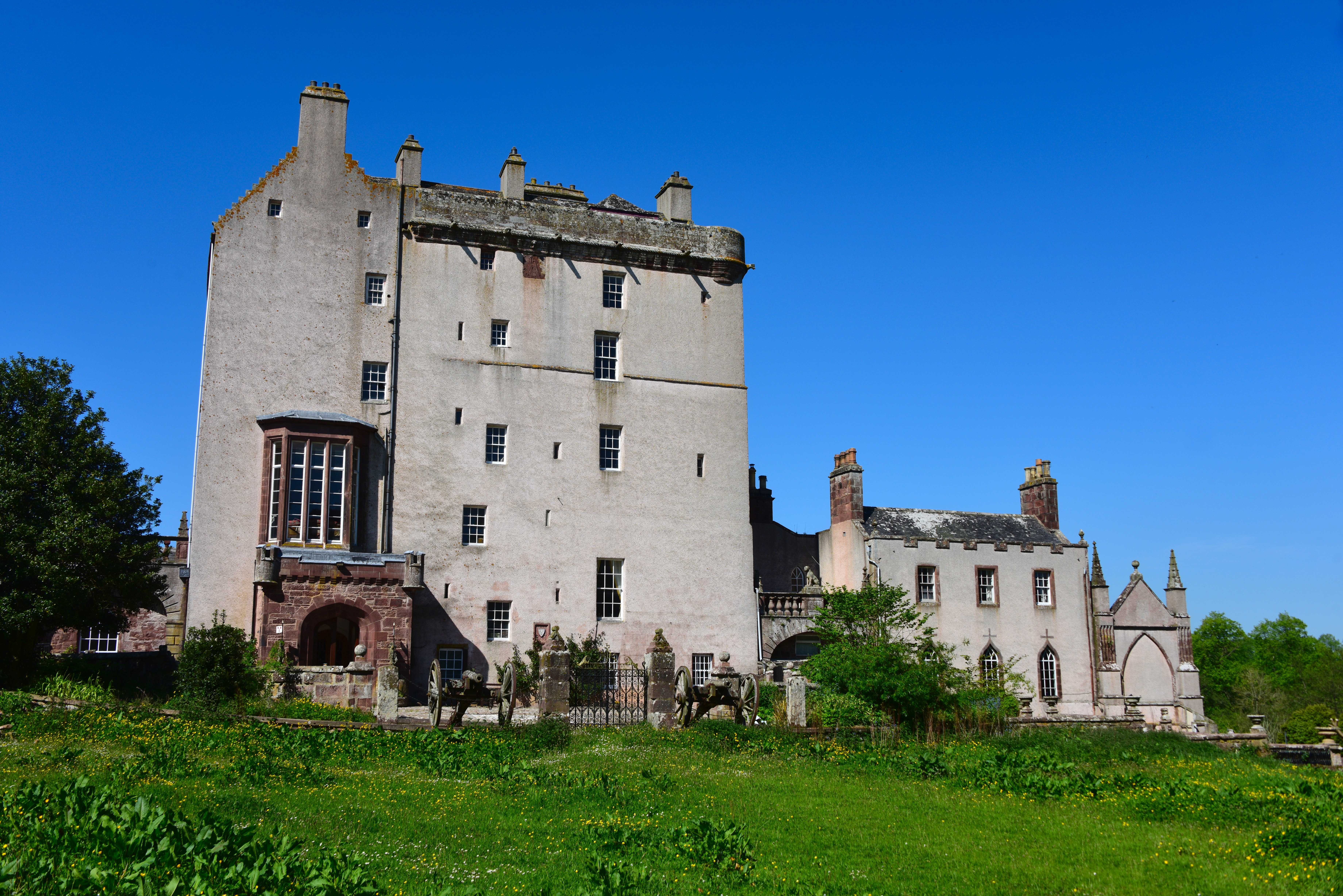
Delgatie Castle
In the early 1950s, assessors examined Delgatie Castle near Turriff and concluded the building was beyond repair. They were wrong. The five-storey white-harled tower, with its painted ceilings dating from the 1590s and a history stretching back to 1030, would not only survive but eventually win Tearoom of the Year at Scotland's national cafe awards. Between those two verdicts lies a story about stubbornness, loyalty, and the remarkable endurance of plaster and paint.
A Thousand Years on One Site
A castle has occupied this ground since 1030, though the oldest stonework standing today dates from between 1570 and 1579. Additional wings and a chapel arrived in 1743, giving the building its current shape: a central keep flanked by later extensions that sprawl comfortably across the Aberdeenshire landscape. The castle's history is inseparable from the Hay family, who received it after the Battle of Bannockburn in 1314. Before that, it had belonged to Henry de Beaumont, Earl of Buchan, who backed the wrong side. Robert the Bruce's victory cost Beaumont his lands, and Clan Hay -- later the Earls of Erroll -- made Delgatie their own for centuries to come.
The Queen's Visit
In 1562, Mary, Queen of Scots, arrived at Delgatie as a guest following the Battle of Corrichie, in which her forces defeated the rebellious Earl of Huntly. What she made of the castle is unrecorded, but her presence is remembered. The Hays' connection to Scottish royalty ran deep -- the family arms appear throughout the building, including three cattle yokes that recall a legend about a farmer and his two sons who helped defeat a Danish raiding party at Cruden Bay. Heraldry at Delgatie is less decoration than autobiography, each symbol encoding a chapter of the family's long entanglement with Scotland's wars and monarchs.
Ceilings That Survived Everything
Delgatie's most remarkable features are its painted ceilings, dating from 1592 and 1597. Scottish Renaissance painted ceilings are rare survivors -- pigment on plaster in a damp climate, vulnerable to leaks, neglect, and the simple passage of centuries. That two complete sets endure at Delgatie is extraordinary. The wide turnpike stair that connects the tower's floors is another notable survival, broad enough to feel generous rather than defensive. Together, these interior details reveal a castle that was evolving from fortress to home during the late sixteenth century, its owners investing in comfort and beauty even as the building retained its martial silhouette.
Rescued from Ruin
After the 1950s assessment declared Delgatie beyond saving, someone disagreed. Preservation and restoration work began, and on 9 July of a subsequent year, the castle opened to visitors for the first time. A trust now oversees public access, a tearoom, and holiday accommodation within the castle grounds. In 2018, a memorial garden dedicated to animals that served and died in wartime was opened in front of the building. The Delgatie Castle Tearoom has since collected national recognition, winning awards at the Scottish Cafe Awards in 2022 and claiming Tearoom of the Year in 2025. For a building once written off as unsalvageable, the comeback is complete.
From the Air
Located at 57.54N, 2.41W near Turriff in Aberdeenshire. The white-harled tower is visible against the surrounding green farmland at lower altitudes. Nearest airport: Aberdeen (EGPD), approximately 35 miles southeast.