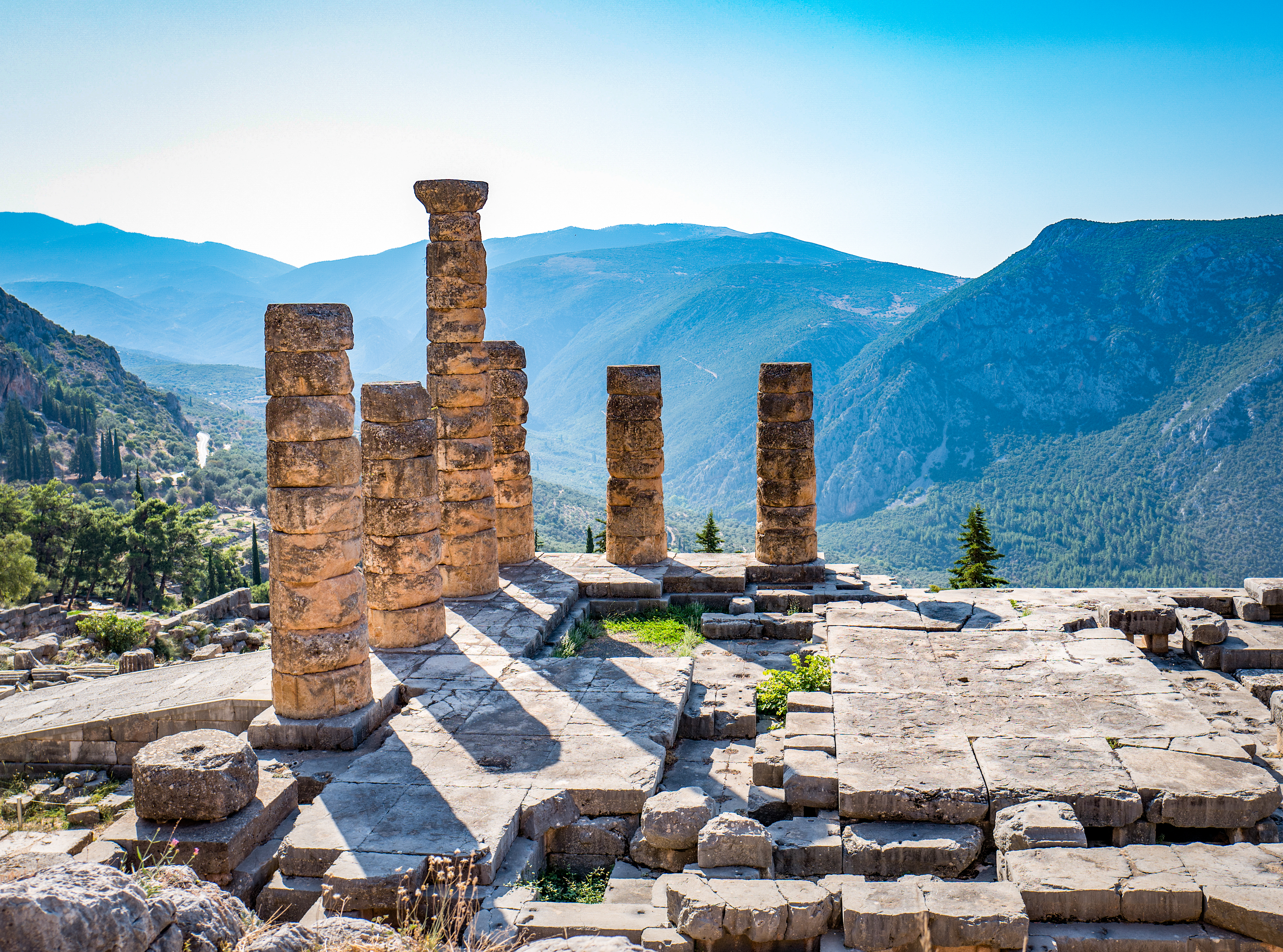
Delphi
Three short phrases were carved into the wall of the Temple of Apollo at Delphi: gnothi seauton, know thyself; meden agan, nothing in excess; and engya para d'ate, make a pledge and trouble follows. Plato attributed them to the Seven Sages of Greece, but the truth is probably duller and more interesting at once. They were popular proverbs that had been circulating for centuries before someone decided to chisel them into the most prestigious religious building in the Greek world. They are not bad summaries of how the place worked. Delphi was a sanctuary that asked you to be honest about your limits, to avoid extremes, and to think hard before swearing oaths to gods who took their promises seriously.
The Road Up Parnassus
Delphi sits on the south slope of Mount Parnassus, about 600 meters above sea level, looking out across a steep valley of olive groves toward the Gulf of Corinth. The site is awkward to reach. There is no harbor, no plain, no obvious agricultural reason to build a city here. The reason it became the sanctuary it did has to do with that very inaccessibility: the Greeks decided this was the omphalos, the navel of the earth. According to the founding myth, Zeus released two eagles from opposite ends of the world and they met above this spot. A carved stone called the omphalos, marking the spot, sat inside the temple; copies survive in museums today. Pilgrims and ambassadors climbed the path from the coast at Itea, passed through the village now called Kastri, and approached the sanctuary along a Sacred Way lined with treasuries built by Greek city-states to hold the offerings they had given to Apollo. The Athenian Treasury, rebuilt in marble, still stands.
The Pythia and the Vapors
The oracle herself was called the Pythia, and she was a local woman of unblemished reputation chosen for the role. She sat on a tripod over a fissure in the floor of the inner sanctum, the adyton, and breathed whatever rose from the cleft below. According to ancient writers including Plutarch, who served as a priest at Delphi in the second century AD, a sweet-smelling pneuma - breath, vapor - emerged from the rock and induced her trance. Modern geological work in the 1990s and 2000s identified two fault lines crossing under the temple and showed that limestone strata in the area can release ethylene and ethane, both of which are anesthetic in low doses and sedating in higher ones. The theory remains debated, but the chemistry is consistent with the ancient descriptions. What the Pythia spoke, the priests rendered into hexameter verse, often deliberately ambiguous. Croesus of Lydia was famously told that if he attacked Persia he would destroy a great empire. He attacked. The empire he destroyed was his own.
Treasuries, Athletes, and the Charioteer
Every four years, beginning in 586 BC, athletes came to Delphi for the Pythian Games, second in prestige only to Olympia. Winners received a crown of laurel cut ceremonially from a sacred tree, which is why these competitions are called the stephantic games, after stephanos, the Greek word for crown. Delphi was the only Panhellenic site that hosted musical competitions in addition to athletic ones. Among the bronze offerings that survived the centuries is the Charioteer of Delphi, a life-size figure dedicated around 470 BC by a tyrant of Sicily named Polyzalos to commemorate a victory in the chariot race. The face has inset glass eyes, the eyelashes are individually cast bronze, and the figure stares straight ahead with an expression of complete composure. The chariot, the horses, and the rest of the group are gone. Only the driver remains, holding the reins of vanished animals, in the museum at the site.
Looters, Earthquakes, Theodosius
Delphi was rich, and rich sanctuaries attract attention. In 278 BC a band of Celtic raiders looted the temple, burned it, and carried off the eternal flame from the altar; the same year, an earthquake brought down part of the roof. The oracle's prestige declined for centuries afterward, then revived under the emperor Hadrian in the second century AD. Constantine the Great looted the site again in 324 AD, hauling treasures back to his new capital. Among them was the Serpent Column, a bronze tripod made from the melted weapons of Persians defeated at Plataea in 479 BC and inscribed with the names of the thirty-one Greek cities that had fought in the war. The base of that column still stands in what was the Hippodrome of Constantinople, now Sultanahmet Square in Istanbul. The oracle continued operating through the rise of Christianity until 381 AD, when the emperor Theodosius I shut down the temples as part of his persecution of pagan worship. The Pythian Games continued for another forty years. The site was abandoned and gradually buried until French archaeologists, who began excavating in 1893, moved the village of Kastri off the ruins and began bringing the sanctuary back into the light.
From the Air
Coordinates: 38.4824 N, 22.5010 E. Suggested viewing altitude 4,000-7,000 ft AGL over the south slope of Mount Parnassus. The sanctuary clings to the hillside between two cliffs called the Phaedriades; look for the Tholos at Athena Pronaia just east of the main precinct, then the long terrace of the Sanctuary of Apollo with the Temple of Apollo, the theatre carved into the slope above, and the stadium at the highest level. The valley falls away steeply toward the Pleistos River and the Gulf of Corinth 12 km south. Nearest airports: Athens International (LGAV) about 130 km east-southeast, Tanagra military (LGTG) about 90 km east. Mountain wave conditions and rotor turbulence are common in winds above 20 kt; smoothest flying is early morning.