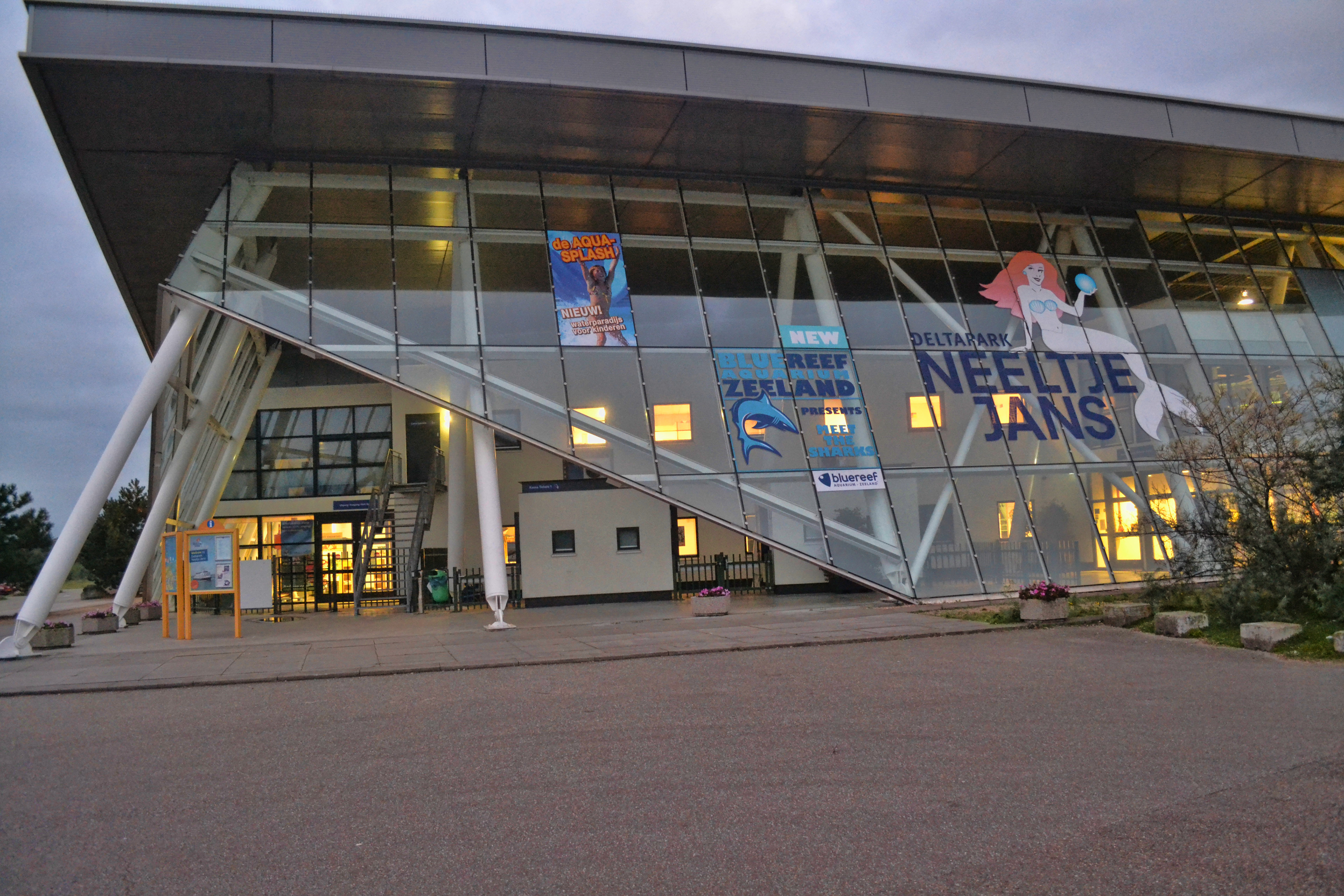
Deltapark Neeltje Jans
There is a hurricane machine on Neeltje Jans. You step inside a Swiss-built cocoon fifteen metres long, put on goggles, and in ten seconds a hidden fan spins you from a flat calm to 133 kilometres an hour — roughly the wind that broke the dykes of Zeeland in 1953. The hurricane is a ride now. So is the waterslide, the seal show, the boat tour into the Oosterschelde, and the wandering through a building shaped like a whale. The island under your feet exists only because the Dutch needed a place to assemble the largest storm-surge barrier in the world. They built an island out of the sea to defeat the sea, and when they were done they kept the island.
An Island That Wasn't
Neeltje Jans is not a natural island. It was raised in the middle of the Eastern Scheldt estuary so that Dutch engineers could build the Oosterscheldekering, the nine-kilometre storm-surge barrier whose first stone was laid in 1976 and whose sluice gates closed for the first ceremonial time on 4 October 1986. The island served as a dry dock — a workyard where 65 vast concrete pillars were cast and a fleet of custom ships named after shellfish (Mytilus, Cardium, Ostrea, Macoma) carried them into place. When the barrier was finished, the workyard was no longer needed. Rijkswaterstaat, the Dutch waterworks agency, turned it into something between a science centre and a seaside attraction, and a generation of school children have come here since to learn what their grandparents lost and what their parents built.
From Delta-Expo to Theme Park
It began modestly. In 1979, during construction, Rijkswaterstaat opened a public information centre on the island so visitors could see the barrier rising in real time. Hundreds of thousands came through. When Queen Beatrix declared the barrier open in 1986 with her famous words — "Zeeland is veilig," Zeeland is safe — the centre became permanent and took the name Delta Expo. By 1997 it was running on its own as Waterland Neeltje Jans, with attractions added around the engineering exhibits. A fire in August 2002 destroyed the reception building; a new Delta Plaza opened in 2003. In 2007 the operators rebranded again to Deltapark Neeltje Jans, and in 2008 the Spanish company Aspro acquired it. The arc is a story in itself: an exhibit about a piece of infrastructure slowly turning into a place to spend a summer Saturday.
The Whale and the Waterway
Walk through the park and you can read the trade-off the Dutch made with their estuary. The H2O Expo is shaped like a whale, designed by Lars Spuybroek of NOX architects in Rotterdam: you enter through the silver tail, the floors tilt, geysers hiss, and rain falls indoors. Beside it, the Salt Water Pavilion designed by Kas Oosterhuis holds the educational exhibits about marine life. Outside, the Water Playground — completed in 1996 and built around an eight-metre windmill — turns hydraulic engineering into a sandbox: kids redirect streams, spin Archimedes screws, and feed water wheels. The Delta Experience puts you inside the 1953 flood with film and special effects. None of these rides exist without the disaster they describe. The park is, in a way, the Netherlands' coping strategy in miniature: take the catastrophe, build something useful from it, and let the next generation play on top.
Seals, Sea Lions, and the Real Ocean
Four harbour seals have lived in the park since 2000; three sea lions joined in 2012. Two wild seagulls have figured out that the show involves free fish and have made themselves regulars. The seals and sea lions are residents, but the real attraction is the water beyond the dam. Since May 2005, the park has run the Christiaan B, a 600-passenger boat that sails into the Oosterschelde National Park itself. The hour-long tour follows the coast where wild seals haul out on shoals and harbour porpoises break the surface, with commentary in Dutch, German, and English. It is one of the only ways the public can see what the Oosterscheldekering preserved by being a barrier rather than a dam: a living tidal estuary, complete with the largest national park in the Netherlands and a marine ecosystem that survived the engineers.
The Plaque and the Promise
If you walk to the barrier itself from the park, there is a plaque near the road. "Hier gaan over het tij, de maan, de wind en wij." Here, the moon, the wind, and we rule over the tide. It is a quietly arrogant line, and a quietly true one. Standing on Neeltje Jans, with the sluice gates rising from the water on either side and the sea making its usual sounds beyond them, the line feels less like a boast and more like a contract. The waterslide and the hurricane machine are entertainment. The island under them is a promise.
From the Air
Deltapark Neeltje Jans sits at 51.64°N, 3.71°E on the artificial island Neeltje Jans, mid-way along the Oosterscheldekering barrier between Schouwen-Duiveland (north) and Noord-Beveland (south). From altitude the island is a distinctive bulge in the middle of the nine-kilometre arc of the barrier. Best photographed from 3,000–6,000 ft. Nearest airports: Midden-Zeeland (EHMZ) just south on Walcheren, Rotterdam The Hague (EHRD) ~40 nm north, Antwerp (EBAW) ~55 nm east-southeast. Coastal haze common; clearest viewing typically after a frontal passage.