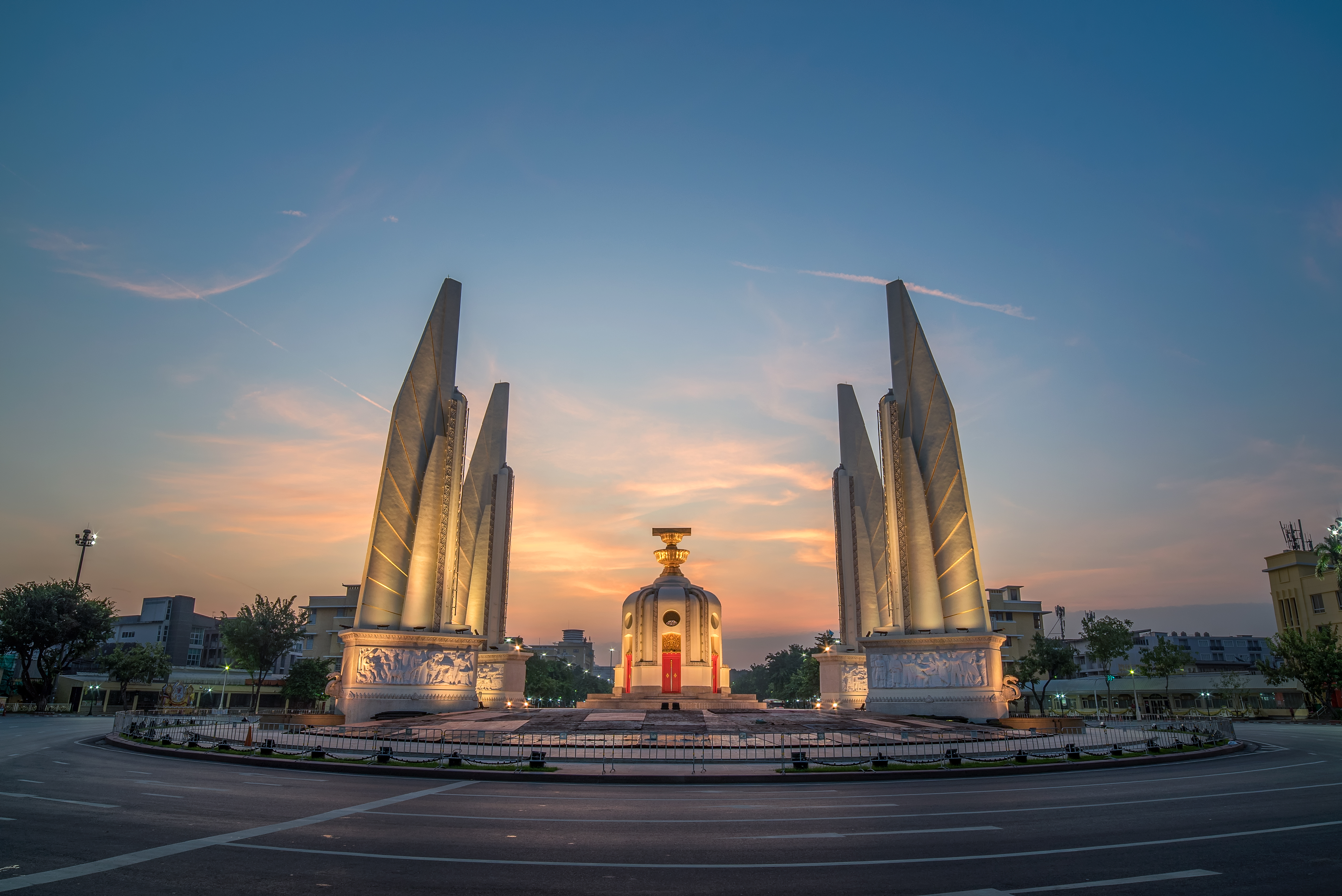
Democracy Monument
Field Marshal Plaek Phibunsongkhram wanted his own Arc de Triomphe. In 1939, Thailand's military ruler commissioned a monument on Ratchadamnoen Avenue to celebrate the 1932 coup that had ended absolute monarchy -- a coup that, by the time the monument was built, had produced not democracy but Phibun's own dictatorship. He envisioned Ratchadamnoen as Bangkok's Champs-Elysees, with the Democracy Monument as its triumphal centerpiece. Local residents and shopkeepers, mostly Chinese, were evicted with 60 days' notice. Hundreds of shade trees fell to widen the road into a ceremonial boulevard. The monument rose from their displacement, a propaganda piece dressed in the language of liberation.
Numbers Carved in Stone
Every dimension of the monument encodes a message. The four wing-like structures guarding the central turret stand 24 meters high -- the same number as the radius of the monument's base -- marking 24 June, the date of the 1932 coup. The turret itself rises 3 meters, representing June as the third month of the traditional Thai calendar. Originally, 75 cannonballs ringed the outer perimeter, signifying the year 2475 in the Buddhist calendar -- 1932 in the Western count. Six gates in the turret represent the six proclaimed policies of the People's Party: independence, internal peace, equality, freedom, economy, and education. At the monument's heart, a carved palm-leaf manuscript box holds a representation of the 1932 Constitution, resting on two golden offering bowls. The Italian sculptor Corrado Feroci -- who became a Thai citizen under the name Silpa Bhirasri in 1944 to avoid arrest by the occupying Japanese army after Italy surrendered -- executed the relief panels around the base.
The Story the Reliefs Tell
Feroci's bas-reliefs present a version of the 1932 revolution that the monument's commissioners wanted the public to believe. In the panel titled "Soldiers Fighting for Democracy," a heroic, unified military does battle -- against whom, the sculpture does not specify -- in the name of the people. "Personification of the People" shows a soldier protectively overseeing Thai civilians at their daily pursuits; the mother and child at the panel's left edge are the only women depicted anywhere on the monument. "Personification of Balance and Good Life" places an allegorical national figure in a Buddha-like posture, holding a sword and scales, flanked by representations of sport, education, religion, and the arts. The reality behind these images was considerably less heroic. The 1932 coup was planned and executed nearly without bloodshed by a small group of officers and civilian collaborators while King Prajadhipok was on holiday at the seaside. By 1939, Thailand was a military dictatorship.
The Monarchy's Conspicuous Absence
Perhaps the most revealing feature of the Democracy Monument is what it leaves out. The monarchy, which today dominates Thai national life and political culture, appears nowhere in the monument's iconography. This was deliberate. The military regime that built it subscribed to an ideology that mixed European liberal constitutionalism with military strongman politics -- an essentially republican worldview that paid lip service to the crown without centering it. When the monument was erected, King Prajadhipok had already abdicated and left the country. His successor, Ananda Mahidol, Rama VIII, was a schoolboy in Switzerland. The monument's naga fountains -- protective serpent creatures from Hindu and Buddhist mythology -- resemble Western dragons more than traditional Thai forms, another sign of the regime's desire to project a modernized, Westernized national image. Today, few Thais are aware of the propaganda content embedded in the sculptural details, partly because Bangkok's traffic makes it nearly impossible for pedestrians to reach the traffic island on which the monument stands.
Where Generations Rally
The monument's dubious origins have been overshadowed by what it became. In 1973, it was the focal point of mass student demonstrations against the military regime of Thanom Kittikachorn -- protests that succeeded in forcing democratic reforms. In 1976, it drew protesters again before a military coup reasserted authoritarian control. During Black May in 1992, scores of Thais died at and around the monument while protesting against General Suchinda Kraprayoon's unelected government. The 2013-2014 political crisis brought rival factions to its base, and in 2020, a new generation of young activists gathered here to challenge the political establishment. Each uprising added a layer of legitimacy that the monument's builders never intended. A structure designed to celebrate the military's seizure of power became, through the accumulated weight of protest and sacrifice, an authentic symbol of the democratic aspirations it was originally built to co-opt.
From the Air
Located at 13.7567N, 100.5017E on Ratchadamnoen Avenue in Bangkok's Phra Nakhon district. The monument sits in a large traffic circle, visible from the air as a circular structure with four symmetrical wing projections, roughly halfway between Sanam Luang and the Golden Mount temple. Best viewed at 2,000-3,000 feet. Nearest airport: Don Mueang (VTBD) approximately 15 nm north. Suvarnabhumi (VTBS) approximately 18 nm east-southeast.