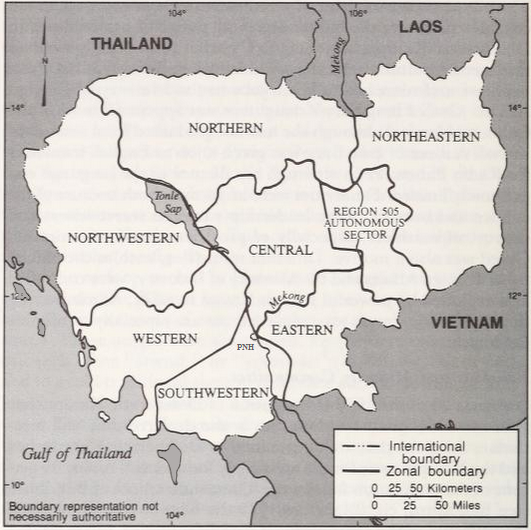
Democratic Kampuchea
On April 17, 1975, Khmer Rouge soldiers entered Phnom Penh to cheering crowds. Cambodians exhausted by years of civil war and American bombing believed the fighting was finally over. Within hours, the soldiers began emptying the entire city at gunpoint. Hospitals were evacuated mid-surgery. Families were separated on the road. The population of a capital city -- roughly two million people -- was marched into the countryside with little explanation. What followed over the next three years, eight months, and twenty days would become one of the most concentrated episodes of mass death in modern history.
Year Zero
The Khmer Rouge called their revolution "Year Zero" -- a total erasure of everything that came before. Under the general secretaryship of Pol Pot and the Communist Party of Kampuchea, the regime abolished money, private property, organized religion, and formal education. Cities were emptied and their residents forced into agricultural labor collectives. The goal was to transform Cambodia into a purely agrarian utopia, one that would leapfrog even Mao's China in revolutionary ambition. The regime renamed the country Democratic Kampuchea, though it was neither democratic nor recognizable as the Cambodia that had existed before. Professionals, intellectuals, and anyone who spoke a foreign language or wore glasses became targets -- suspected of harboring bourgeois sympathies. Pol Pot himself was a university dropout educated in Paris with a taste for French literature, an irony the regime preferred to overlook.
The Machinery of Terror
A security apparatus called the Santebal operated as the regime's instrument of purge and paranoia. Its most notorious site was Tuol Sleng, a former high school in Phnom Penh converted into an interrogation and torture center known as S-21. Under the command of Kang Kek Iew -- known as Duch -- the facility could hold up to 1,500 prisoners at a time. Of the roughly 20,000 people who entered Tuol Sleng, only a handful survived. The categories of "enemies" expanded continuously: former government officials, ethnic Vietnamese, ethnic Chinese, Thai, Muslims, Buddhists, Christians, and anyone deemed an "economic saboteur" for lacking agricultural skill. Confessions extracted under torture produced ever-widening circles of accused conspirators. The regime consumed itself from within, purging its own cadres with increasing frequency as Pol Pot's suspicion deepened.
Death in the Rice Paddies
The killing fields were not confined to prison walls. Across the countryside, forced labor camps worked people to death on starvation rations. Families were deliberately broken apart -- men, women, and children assigned to separate work brigades. The regime's radical communalization claimed to "liberate" women by putting them to work alongside men, but in practice it destroyed the social bonds that held communities together. Ethnic minorities faced targeted persecution driven by Khmer racial supremacy ideology that merged with Marxist class warfare. The Cham Muslim population, ethnic Vietnamese, and highland peoples suffered disproportionately. Estimates of the total death toll range from 1.5 to 2 million people -- roughly a quarter of Cambodia's entire population, killed in less than four years through execution, starvation, disease, and forced labor.
The Fall and Its Strange Aftermath
In December 1978, Vietnam invaded Cambodia and captured Phnom Penh on January 7, 1979, ending the Khmer Rouge's grip on power. But the story did not end cleanly. The Khmer Rouge retreated to the Thai border and, in a Cold War absurdity, retained Cambodia's seat at the United Nations until 1993 -- reforming under the name Coalition Government of Democratic Kampuchea in 1982, but continuing to hold the seat throughout. International recognition was extended to the regime that had just perpetrated genocide, largely because Vietnam's invasion was backed by the Soviet Union while China and the United States opposed it. The Khmer Rouge continued as a guerrilla force along the border for years. Former National Security Advisor Zbigniew Brzezinski later acknowledged that the United States had encouraged China to support the Khmer Rouge as a counterweight to Vietnamese influence -- geopolitics overriding the moral clarity that genocide should have demanded.
What Remains
Today, the Tuol Sleng Genocide Museum and the Choeung Ek Killing Fields memorial stand as Cambodia's most visited sites of memory. At Tuol Sleng, the torture and prison cells remain largely as they were found in 1979. At Choeung Ek, a glass stupa holds thousands of skulls excavated from mass graves. The Extraordinary Chambers in the Courts of Cambodia, established decades after the genocide, delivered convictions against senior Khmer Rouge leaders -- though Pol Pot himself died in 1998 without facing justice. Cambodia's reckoning with this period remains incomplete. Former Khmer Rouge cadres still hold political power, and the government has been cautious about promoting widespread remembrance. For the survivors and their descendants, the weight of what happened between 1975 and 1979 is not history. It is the ground they walk on.
From the Air
Centered on Phnom Penh at approximately 12.25N, 105.6E. The landscape below is the flat Cambodian rice plain crossed by the Tonle Sap and Mekong rivers. Phnom Penh Pochentong International Airport (VDPP) lies west of the city center. From altitude, the patchwork of rice paddies stretching to every horizon makes viscerally clear the agrarian landscape the Khmer Rouge tried to forge by force. The Tuol Sleng site is in central Phnom Penh; Choeung Ek lies roughly 15 km south of the city.