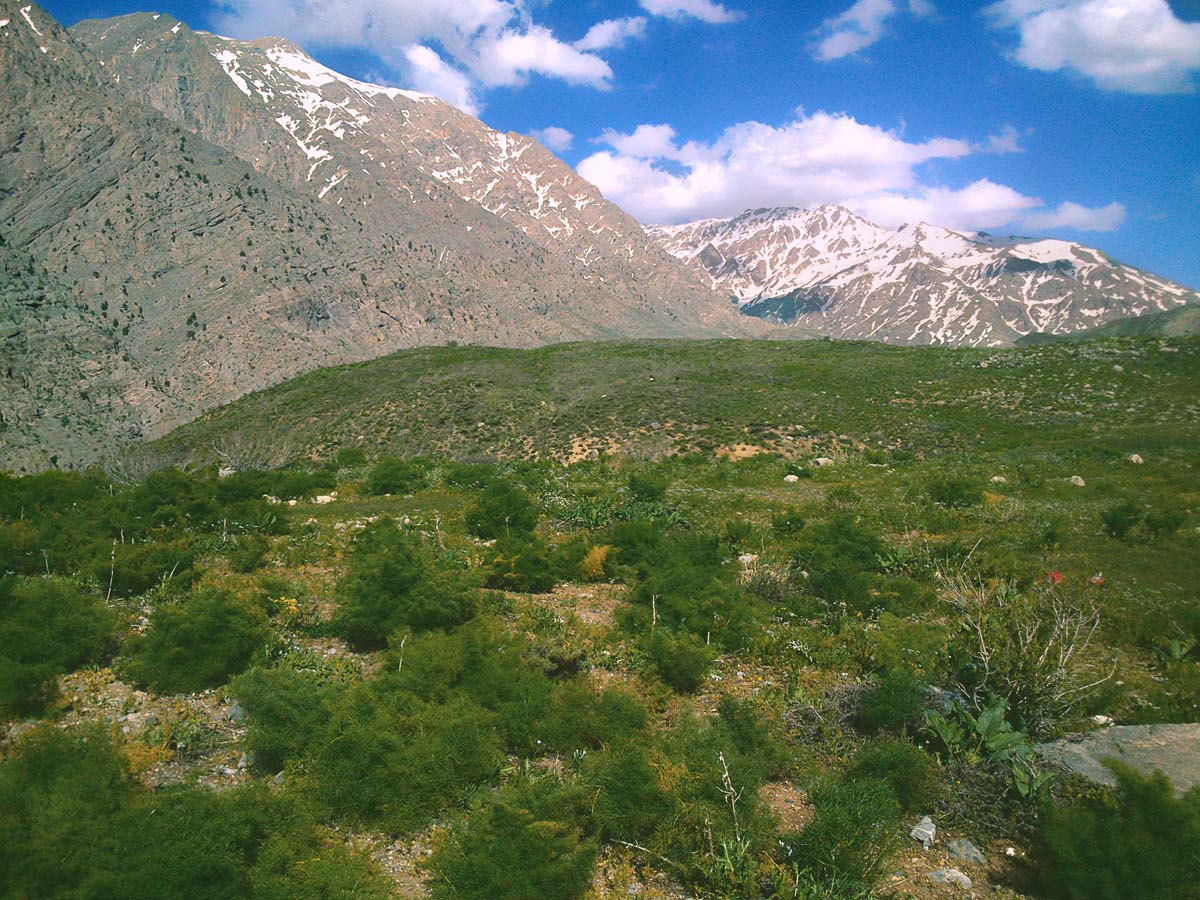
Dena: The Zagros Mountains' Longest Spine
Forty-nine peaks above 4,000 meters, and almost no one outside Iran has heard of any of them. The Dena range runs 80 kilometers through the central Zagros Mountains, the longest single range in the entire chain, and it holds one of the country's richest concentrations of wildlife in its gorges, oak forests, and alpine meadows. Camera traps capture Persian leopards prowling through Tang-e Shah Qasem. Springs bubble up from beneath snowfields and cascade down steep slopes to feed the Bashar and Khersan rivers. UNESCO recognized Dena as a biosphere reserve in 2010 -- Iran's tenth, and the first registered after the Islamic Revolution. The mountains don't care about politics. They just keep standing.
A Vertical World
The elevation difference between Dena's lowest and highest points spans nearly three thousand meters, and that vertical range creates three distinct worlds stacked on top of each other. At the base, dry and semi-dry forests of Persian oak cling to the lower slopes. Higher up, the landscape shifts to cold semi-steppe -- exposed rock, tough grasses, and wildflowers that bloom in brief, brilliant bursts during the short growing season. Above that, the peaks themselves rise into snow and sky. Botanists have cataloged roughly 1,250 plant species within the protected area, representing 15.6 percent of all plant species found in Iran. For a single mountain range, that density is remarkable. The gorges that cut through the rock -- Tang-e Potak, Tang-e Qodvis, Tang-e Hara -- each create microclimates where particular species thrive.
Leopards in the Gorges
The wildlife habitats scattered across Dena read like a gazetteer of Persian geography: Shanbliyeh Dun, Kharedun, Tel Siah, Gardaneh Bijan, Gardaneh Morak. In these remote gorges and ridges, nature enthusiasts can observe Zagros wildlife without great difficulty -- with patience and binoculars, at least. Persian leopards are the star residents, their presence confirmed by trail cameras that have captured increasingly clear images in recent years. The oak forests along Dena's edges provide critical corridors connecting habitat patches. Environmental protection stations at Kharedun, Koreh, Ab Sepah, and Meymand serve as the thin infrastructure holding conservation together in a landscape that resists easy access.
Rivers Born from Snow
On the slopes of Dena, dozens of valleys hide springs large and small. Many of these emerge directly from beneath the snowpack, surfacing cold and clear before tumbling down steep gradients. They merge and merge again, growing from trickles into streams into the Bashar and Khersan rivers -- cold, sweet, and drinkable at their sources. The Khersan eventually joins the Karun watershed, one of Iran's most important water systems. In a country where water scarcity shapes politics and settlement patterns, the springs of Dena are quietly vital. The cities at the mountain's edge -- Sisakht, Pataveh, Meymand, and the villages of Koreh and Padena -- have depended on this water for centuries. The mountains collect winter snow, store it, and release it slowly through the dry months.
Guarding the Range
Iran declared Dena a protected area in 1991, covering 93,660 hectares. Two decades later, in 2012, the government upgraded 25,822 hectares at the core to national park status, the highest level of environmental protection in the Iranian system. UNESCO's biosphere designation arrived in 2010, and the organization renewed it in June 2023 for another ten-year period. But protection on paper and protection on the ground are different things. In 2024, a complicated administrative reshuffling transferred management of part of the protected area in Isfahan Province to a new entity called the Padena Protected Area, adding 30,132 hectares from a former hunting-prohibited zone. Officials stressed that the national park itself remained untouched by the reorganization, its management staying with Kohgiluyeh and Boyer-Ahmad Province. The bureaucratic complexity reflects the territory: Dena straddles provincial boundaries, and governing a mountain range that doesn't respect human borders requires constant negotiation.
Edge Communities
The cities and villages ringing Dena's perimeter live in the mountain's shadow and off its resources. Sisakht serves as the center of Dana County and the eastern gateway to the protected area. Pataveh guards another approach. The village complexes of Koreh and Padena have existed here long enough that the landscape and the communities have shaped each other. These are not tourist towns in any Western sense, though researchers, hikers, and Iranian nature enthusiasts do come. The infrastructure is modest -- environmental stations rather than visitor centers, dirt tracks rather than paved scenic roads. What the area offers instead is scale and solitude. Eighty kilometers of mountain spine, 49 peaks above 4,000 meters, leopards in the gorges, and springs that have been running since before anyone was counting.
From the Air
Located at 30.93°N, 51.42°E in southwestern Iran. The Dena range runs roughly northwest-southeast through the central Zagros Mountains, visible as a long ridge with snow-capped peaks. The nearest major city is Yasuj to the south. The nearest airport is Yasuj Airport (OISY), approximately 50 km south. Isfahan International Airport (OIFM) lies to the northeast. From cruising altitude, the 80 km ridge is distinctive among the parallel folds of the Zagros, with its higher peaks standing above the surrounding ranges. Oak forests appear as dark patches on the lower slopes; above the treeline, the terrain turns to exposed rock and seasonal snow.