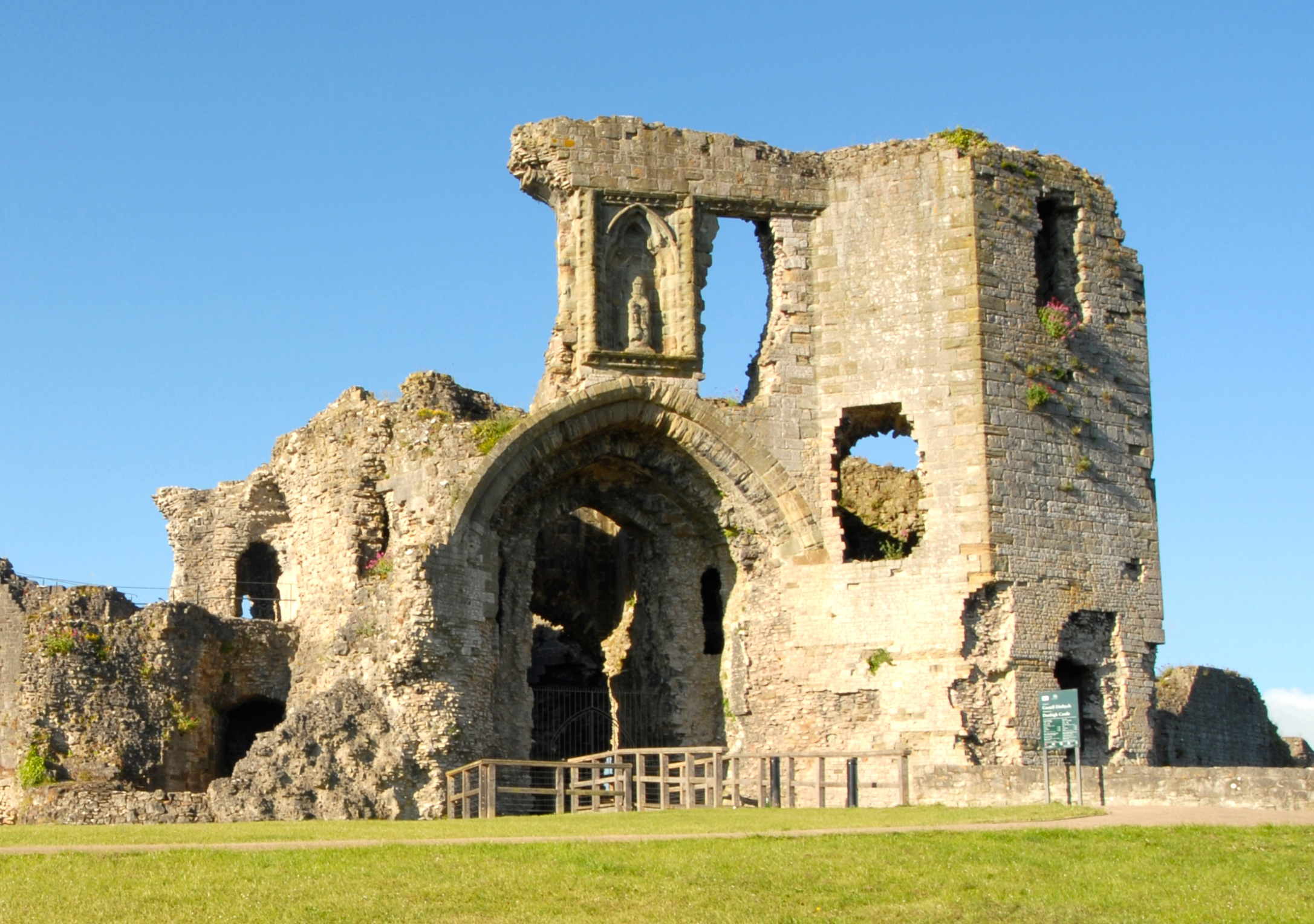
Denbigh Castle and Town Walls
By 1586, the antiquarian William Camden could observe that the old walled town of Denbigh was 'now deserted.' This was not the ruin of conquest or plague but something more prosaic: the town built inside the walls was simply an impractical place to live. Limited space, poor water supply, and the inconvenience of hauling goods up a steep hill drove the inhabitants outside within decades of the walls' completion. The castle that Henry de Lacy, Earl of Lincoln, raised above the Clwyd Valley after Edward I's conquest of Wales in 1282 was a fortress of extraordinary ambition. The town it was meant to protect became a ghost long before the castle fell to ruin.
A Gatehouse Like No Other
Denbigh's Great Gatehouse is formed by a triangle of three octagonal towers arranged around a central octagonal hall, a design that the historian John Goodall calls 'the most architecturally sophisticated gatehouse of the thirteenth century.' The Porter's Lodge and Prison towers face outward, while the Badnes Tower anchors the rear. The entire structure was built with decorative bands of masonry in contrasting colors, a deliberate display of Edward I's royal authority. A statue, probably of Edward II, once stood above the main entrance. Goodall notes that the architectural ideas pioneered at Denbigh were later 'reworked to brilliant effect' at Knaresborough. The gatehouse was not merely functional; it was a statement of power expressed in stone, intended to overawe anyone approaching the castle from the north.
The Town That Left Its Walls
Henry de Lacy populated his new walled town with English colonists, many drawn from his estates in northern England. He gave the settlement its first charter by 1285. But the settlement was doomed from the start by its own geography. Perched on a hillside with limited flat ground and poor water access, the town began spilling beyond its walls almost immediately. Within fifty years, the external settlement had grown to cover fifty-seven acres, far exceeding the cramped interior. The walled town's fate was sealed during the Wars of the Roses when Jasper Tudor, unable to capture the castle in 1468, burned the town's interior instead. By the end of the sixteenth century, the Burgess Gate had been converted into a jail, and the walled area had become little more than an extension of the castle's defenses.
Seven Centuries of Conflict
Denbigh's history reads as a catalogue of Welsh resistance and English determination. In 1294, barely a decade after construction began, Welsh forces under Madog ap Llywelyn seized the castle during a revolt. In 1400, the Glyndwr Rising saw the walled town raided, though the castle held firm. During the Civil War, a Royalist garrison of five hundred men defended Denbigh under Colonel William Salesbury until Charles I himself sent a personal message ordering surrender in October 1646. Even after that, a group of Royalist soldiers seized the castle again in 1659 during Sir George Booth's uprising. When the revolt failed, General George Monck ordered the castle slighted, its walls and towers systematically demolished to prevent further military use. The stone was carted away by townspeople to build houses, the castle's substance literally becoming the fabric of ordinary life.
Walls That Endure
Despite centuries of conflict and neglect, Denbigh's town walls remain remarkably intact, stretching for roughly 1,100 meters around the old settlement. The Burgess Gate, built from white limestone and yellow sandstone in a chequered pattern symbolizing civic pride, still stands, though its upper courses have been lost. The Goblin Tower perches on a rocky salient overlooking the cliff edge, and the Countess Tower anchors the eastern defenses. In the mid-nineteenth century, the town formed a Castle Committee to maintain the ruins, and by 1914 the Office of Works had assumed responsibility. Today, Cadw maintains the site, having invested six hundred thousand pounds in a new visitors' centre during the mid-2010s. The castle received just over ten thousand visitors in 2015, a modest number for a place whose gatehouse alone represents one of the finest achievements of medieval military architecture in Europe.
From the Air
Located at 53.181N, 3.421W, perched on a rocky outcrop above the Clwyd Valley in Denbighshire, North Wales. The castle and intact town walls are clearly visible from medium altitude. The chequered stonework of the Burgess Gate and the triangular Great Gatehouse are distinctive features. Nearest airports include Hawarden (EGNR, 15nm east) and RAF Valley (EGOV, 40nm west). The town of Denbigh spreads below the castle on the valley floor.