Denver Museum of Nature and Science
In 2025, geologists drilling a test well beneath the museum's parking lot pulled up a core sample containing dinosaur bone from 763 feet underground. The institution's geology curator wanted to excavate. The parking department said no. It was exactly the kind of tension that has defined the Denver Museum of Nature and Science since 1868, when a self-taught naturalist named Edwin Carter moved into a tiny cabin in Breckenridge to single-handedly catalog every bird and mammal in the Rocky Mountains. Great discoveries often hide in unexpected places.
A Collection Born in a Cabin
Edwin Carter spent decades in his Breckenridge cabin, building one of the most complete collections of Colorado fauna in existence. Word spread. In 1892, a group of prominent Denver citizens offered to buy his entire collection for $10,000 and move it to the capital. They added a collection of butterflies and moths, plus specimens of crystallized gold. Together, these three collections formed the nucleus of what became the Colorado Museum of Natural History, officially incorporated on December 6, 1900. The museum opened to the public on July 1, 1908. John F. Campion, the first board president, declared at the dedication: "A museum of natural history is never finished." The crystallized gold remains the museum's oldest exhibit, donated the same year the institution was founded.
Rewriting Human History
In 1927, a team from the Colorado Museum made a discovery that changed what scientists knew about human presence in the Americas. Near Folsom, New Mexico, they found two stone projectile points embedded in the bones of an extinct bison species. These Folsom points proved that humans had lived in North America more than 10,000 years ago, hundreds of years earlier than any previous evidence suggested. The discovery rewrote textbooks and established the museum as a serious research institution. The city of Denver increased its funding, leading to a name change to Denver Museum of Natural History in 1948. Another rename in 2000 brought the current title, reflecting the institution's broader focus on science education.
A Million Objects in the Basement
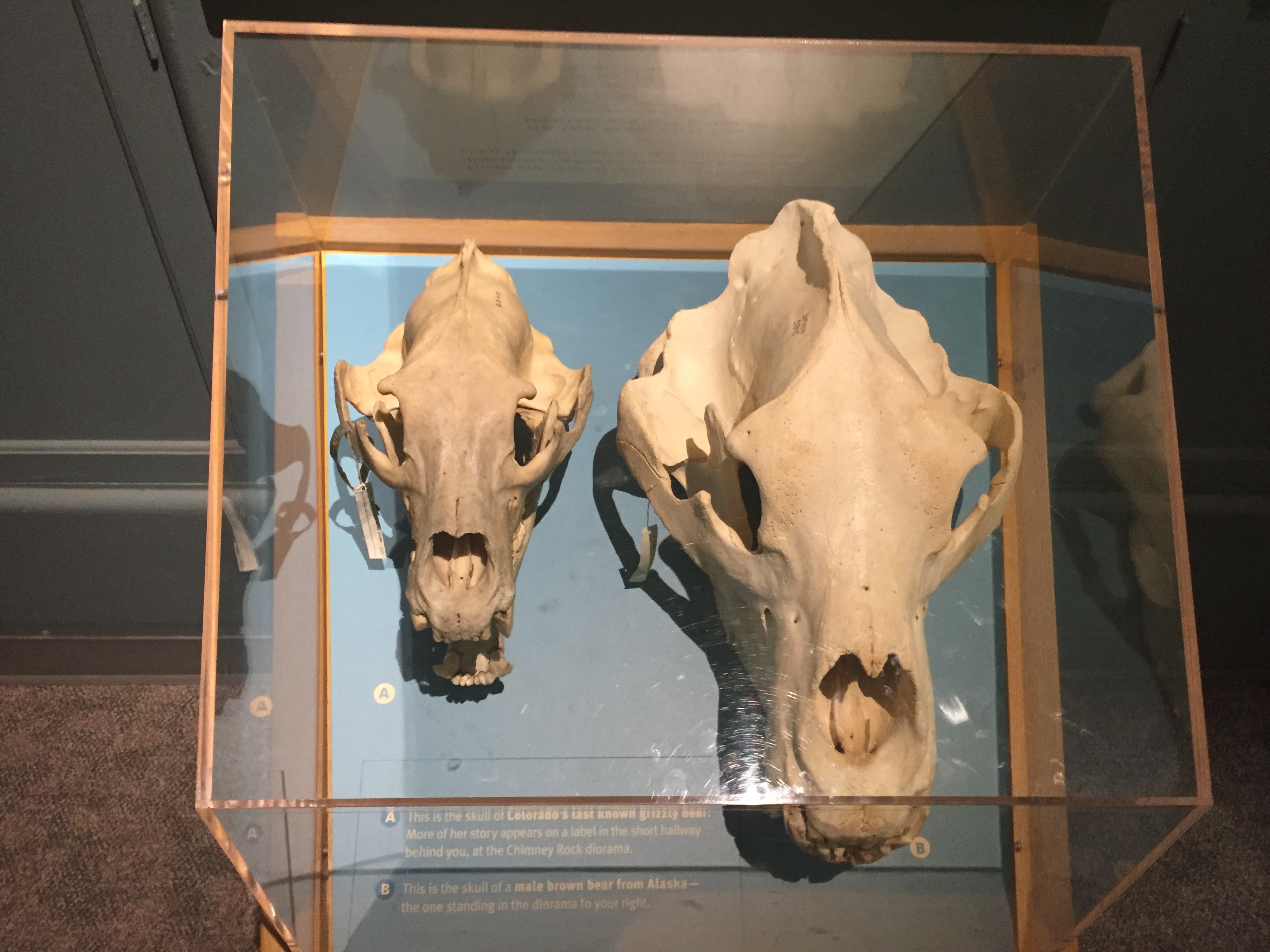
The Avenir Collections Center, part of a $70 million expansion completed in 2014, holds nearly 1.5 million artifacts and specimens across two underground levels. The zoology collection alone houses over 900,000 specimens, including 780,000 insects, 52,000 birds with their eggs and nests, and 14,000 mammals. Among them: bison from the 1870s, passenger pigeons from the century before they went extinct, and the last grizzly bear killed in Colorado in 1979. The public brings in roadkill, and the museum catalogs it. The anthropology collection contains over 50,000 objects, fully compliant with the Native American Graves Protection and Repatriation Act. The Bailey Library holds 53,000 publications and 2,500 rare books.
Dioramas and Deep Time
The Wildlife Halls contain one of North America's largest collections of animal dioramas. Scenes from Botswana, the Bering Strait, and the Australian outback share space with Colorado's own ecosystems. One 1942 polar bear diorama has become iconic. A Western Brazil scene was quietly removed for scientific inaccuracy, depicting animals that would never interact in the wild. The Prehistoric Journey exhibit, opened in 1995, traces evolution through mounted skeletons of Dimetrodon, Stegosaurus, Diplodocus, and Tyrannosaurus rex, whose bones greet visitors in the rotunda. Egyptian mummies, one called the "Poor Woman's Mummy" from the Ptolemaic period, underwent CT scans at a local children's hospital in 1991 and again in 2016. The Alma King, the world's largest rhodochrosite crystal, was found at the Sweet Home mine on August 21, 1992.
Hidden Secrets and Open Spaces
Diorama painter Kent Pendleton hid eight elves throughout his work in the museum. Visitors can download scavenger hunts to find them. The Gates Planetarium features a 125-seat theater with a perforated metal dome tilted 25 degrees. The Infinity Theater, formerly the Phipps IMAX, seats 440 and reopened in 2023 after renovations. From above, the museum sits at the edge of Denver's City Park, its 2014 Morgridge Family Exploration Center visible as a modern addition to the original 1908 structure. More than 300,000 students visit annually. And somewhere 763 feet below the parking lot, a dinosaur vertebra that the museum cannot excavate waits in the dark, proof that Colorado's natural history runs deeper than anyone planned for.
From the Air
Located at 39.748N, -104.943W on the eastern edge of Denver's City Park. The museum complex is visible from altitude, with the modern Morgridge Family Exploration Center addition distinguishable from the original neoclassical structure. Denver International Airport (KDEN) is 21 miles northeast. Centennial Airport (KAPA) is 17 miles south. Rocky Mountain Metropolitan Airport (KBJC) is 20 miles northwest. Best viewed at 3,000-5,000 feet AGL.