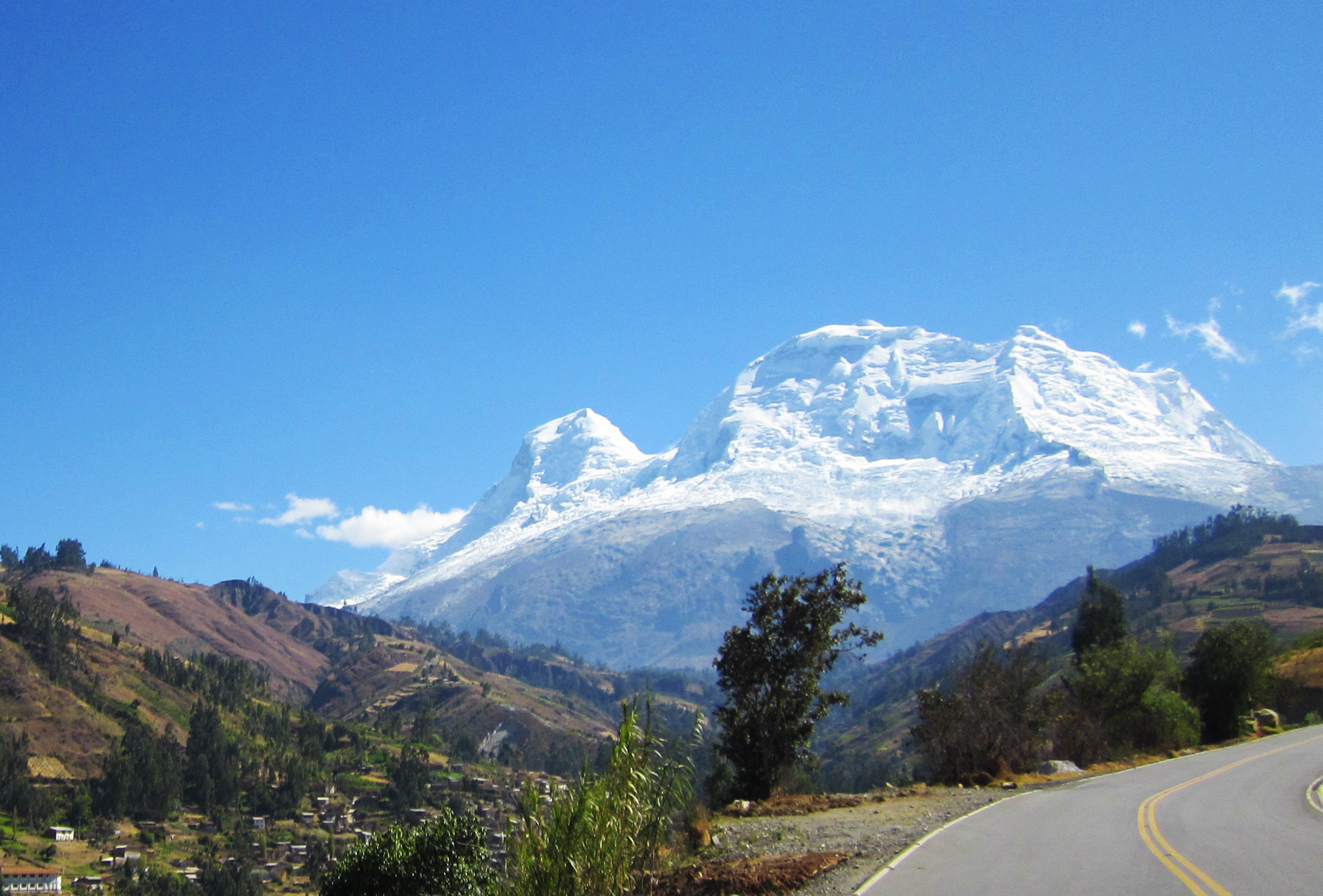
Department of Ancash
Two mountain ranges run parallel here, and the Spanish named them honestly. The Cordillera Blanca wears permanent snow. The Cordillera Negra does not. Between them, squeezed into a valley called the Callejón de Huaylas, flows the Santa River - the only river on this stretch of Peruvian coast that carries water year-round. On one side of the valley rises Huascarán at 6,768 meters, the highest peak in Peru and the highest in the tropics. On the other side, the Pacific drops into the Chimbote trough, 6,263 meters deep. Sea and summit, almost symmetrically opposed, compress the entire department into a space of dramatic extremes.
Mother of Civilizations
Between 400 and 600 BC, something happened in these valleys that would shape every Andean culture to follow. The people who built Chavín de Huántar carved stone heads that grimaced with fangs and feline eyes, raised temples with labyrinthine underground passages, and developed religious ideas that spread across the central Andes. Archaeologist Julio C. Tello, who spent decades studying the site, made his famous declaration: Chavín was the mother of all the cultures that later bloomed in the old Peru. Tello believed these people had come from the Amazon, scaled the eastern Andes, and brought jungle cosmology with them to the high country. The jaguar imagery, the serpent forms, the plant hallucinogens carved into stone - all hint at origins in rainforest beyond the peaks. Whatever the truth, Chavín sat here, at the center, for nearly a thousand years.
When the Mountain Fell
On May 31, 1970, a magnitude 7.9 earthquake struck offshore. The shaking dislodged a massive section of Huascarán's north peak - rock, ice, and debris that traveled down the mountain at speeds exceeding 200 miles per hour. The town of Yungay, population roughly 20,000, sat directly in the path. The entire settlement vanished beneath millions of tons of material, leaving only the tops of four palm trees in the old plaza and the statue of Christ at the cemetery on a small hill. Across the department, more than 50,000 people died and 186,000 houses were damaged. It remains one of the deadliest natural disasters in Peruvian history. The cemetery at Yungay Viejo is now a national memorial; visitors walk past the palm crowns that still mark where the plaza used to be.
The Anchovy Kingdom
On the coast, Chimbote tells a different story. The Humboldt Current drags cold water up from Antarctica, creating one of the richest fisheries on Earth. During the 1950s, the bay of Chimbote was the top fishing port in the world, its harbors thick with anchoveta boats feeding a global fish meal industry. But the fortune depends on cold water staying cold. When El Niño arrives - warm water pushing down from the equator - the anchoveta vanish, the boats sit empty, and the same sea that feeds the country turns against it. Catastrophic rains flood the usually-dry coastal deserts. Rivers that run only during highland storms become destructive torrents. The cycle is unpredictable, which is part of what it means to live here.
The Alley and the Duck
The Callejón de Huaylas - the Alley of Huaylas - is where most of Ancash's people still live, strung along the Santa River between those two mountain ranges. The valley is green and fertile; the ranges above hold Peru's most important glaciers. At its northern end, the Santa narrows and cuts through the Cordillera Negra at the Cañón del Pato, the Duck Canyon, a slot gorge so tight that road and rail once squeezed through dozens of tunnels blasted into solid rock. Lake Parón glows turquoise below the ice of Alpamayo, often called the most beautiful mountain in the world for its near-perfect pyramidal shape. From Huaraz, the departmental capital, you can see the white wall of the Cordillera Blanca rising like weather from the east.
Silver, Copper, Protest
The first Spaniards came for silver. Jerónimo de Alvarado founded Huaraz as a colonial outpost, and Simón Bolívar later used the same city as his headquarters during the Peruvian independence campaign. The department itself was carved out in 1839, named after Yungay where Peruvian and Chilean forces defeated the Peru-Bolivia Confederation. Modern Ancash still runs on minerals - gold, copper, zinc mining make it Peru's third-largest economy - but since 2011, the department has been the site of sustained protests against mining operations. The concerns center on water: whether private companies should control the rivers that feed farms and towns, and whether runoff is contaminating drinking supplies. Protesters, mining security, and federal police have clashed repeatedly. The mountains that built this place are also the ones people are fighting over.
From the Air
Located at 9.53°S, 77.53°W in western Peru. Recommended viewing altitude 20,000 feet (6,100 m) to clear the Cordillera Blanca - Huascarán tops out at 22,205 feet (6,768 m). Nearest airports are Anta Airport (SPHZ) serving Huaraz and Capitán FAP Carlos Martínez de Pinillos (SPRU) in Trujillo to the north. Look for the parallel mountain ranges running north-south with the Santa River valley between them.