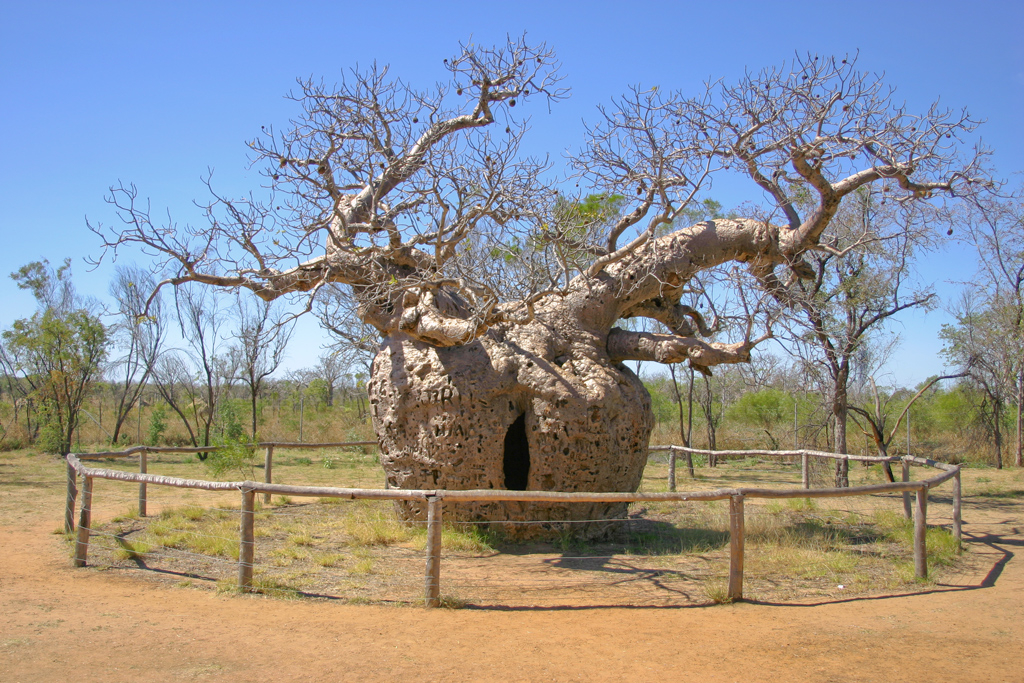
Derby, Western Australia
The tree at the entrance to Derby is 1,500 years old, hollow, and has a girth of 14.7 metres. Pearl luggers, cattle drovers, and stockmen all passed it on their way in and out of one of Australia's most remote towns. Despite persistent legend, it was never used as a jail — that was a different boab near Wyndham — but the Aboriginal people who preceded every European in this country used it as an ossuary, a place of bones. That distinction matters. The tree is older than European contact with this continent by a thousand years, and it stands at the entrance to Derby like something that has been waiting.
The Town at the Edge of Everything
Derby sits on King Sound, a tidal inlet of the Indian Ocean in the Kimberley Region of northwestern Australia. The 2016 census counted 3,325 people, roughly half of them Aboriginal. The nearest city of any size is Broome, 220 kilometres to the west, and Perth is a minimum 2,270 kilometres south by the fastest route. Darwin is 1,650 kilometres east. These distances are not merely large — they define how Derby functions. Supply chains are long, services are limited, and the land and sea around the town operate on terms of their own.
The tidal range here reaches up to 11.8 metres, among the largest in the world. Great expanses of mud flat emerge and disappear twice a day with startling speed. The jetty was first built in 1885 and connected to town by a horse-drawn tram; the current horseshoe structure dates from the 1960s. Early European settlers found the coast treacherous, with no safe harbours and enormous tidal swings that made navigation genuinely dangerous.
The Boab and What It Knows
Adansonia gregorii, the Australian boab, is related to the African and Madagascan baobabs — a botanical reminder that these continents were once joined. The species is found only in the Kimberley and a small part of the Northern Territory. The Derby Prison Boab, as it is sometimes called, is exceptional even among old specimens. Its hollow interior is large enough to stand in. The tree used it as an ossuary speaks to the Nyikina and other Aboriginal peoples' relationship with this country — a relationship measured not in years but in geological spans.
The real Derby jail sits 500 metres southeast of the tree. It handled the region's colonial order, including the incarceration of Aboriginal men during the pearling and cattle station era, when forced labour was common and legal protections were absent. Both sites — tree and jail — sit within a short walk of each other on the edge of town.
Mud, Tides, and Town Life
Derby's seafront is not a beach town by any definition. The big tides churn the sediment continuously, leaving the water the colour and texture of cold cocoa. Swimming is unappealing, snorkelling pointless. What the tidal flats do produce, in abundance, is mud crabs — large, aggressive, and commercially important. The Mary Island Fishing Club holds mud crab races two or three times a year: crabs are gathered, names painted on their shells, and they are tipped into a rope ring. The first to scramble out wins. All of them get eaten regardless.
One Mile Dinner Camp at the south end of the golf course has a more practical origin. Cattle drovers bringing herds overland would stop here before the final push to the jetty, where the animals would be loaded for shipment. By tradition, one cow was slaughtered and eaten at the camp, its meat traded for supplies from town. It is still a popular sunset picnic spot. The speedway runs May through October, the birdwatching is best along the tidal creeks, and the town's Memorial Swimming Pool — an open-air 25-metre pool — offers a reliable alternative to the turbid sea.
Gateway to the Kimberley
For travellers heading east or coming from Darwin, Derby marks a transition. East of town, the Great Northern Highway stretches toward Fitzroy Crossing, Halls Creek, and eventually Kununurra — a long, mostly featureless drive through spinifex and red-earth country. The alternative is Gibb River Road, an unsealed track through the heart of the Kimberley accessible by high-clearance 4WD in the dry season. It crosses river fords, passes gorges, and threads through pastoral stations before reaching Wyndham on the coast.
The town itself is functional rather than picturesque, but it is not without texture. Wharfinger's House Museum on Loch Street occupies one of Derby's few historic buildings. The Visitor Centre is by the bus stop where Greyhound services arrive from Darwin and Broome. The town's communications are patchy — as of 2024, 4G coverage from Optus and Telstra is inconsistent, and the approach highways have almost none. This is a place that requires self-sufficiency, and the people who live here have learned to provide it.
From the Air
Derby is at 17.38°S, 123.68°E on the southern shore of King Sound. The aerodrome (YDBY) is 2 km south of the town centre. Approach from the west over King Sound offers views of the extensive tidal mud flats and the horseshoe jetty. The boab tree is visible near the town entrance. Flying at 1,500–3,000 feet provides good perspective on the tidal flats and the low, flat coastal terrain. In the wet season (December–March), extensive flooding can transform the landscape; the dry season offers clear visibility and calm conditions.